Tallaght RSA Driving Test Routes
Book Test-
Free
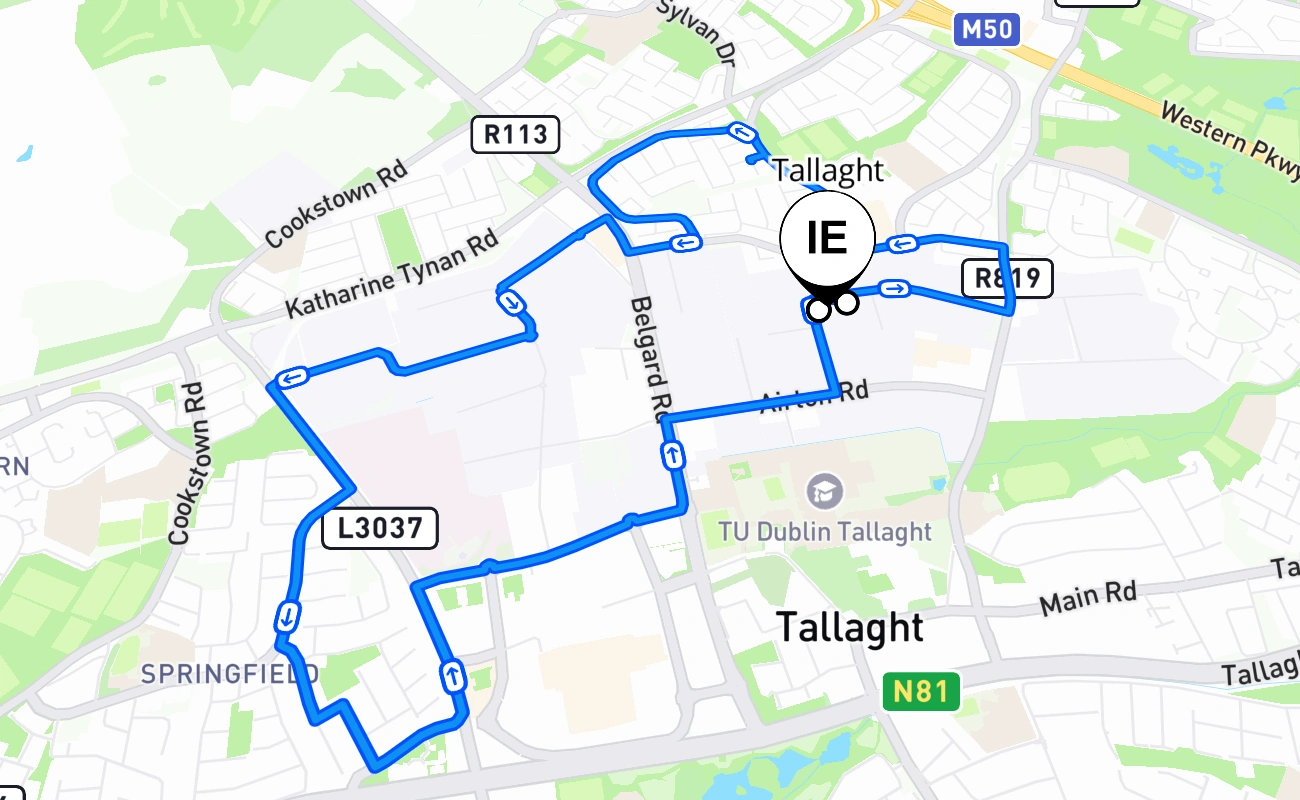
Tallaght (Leinster) #2800
 AUDrive 09 Sep 20260
-
Free
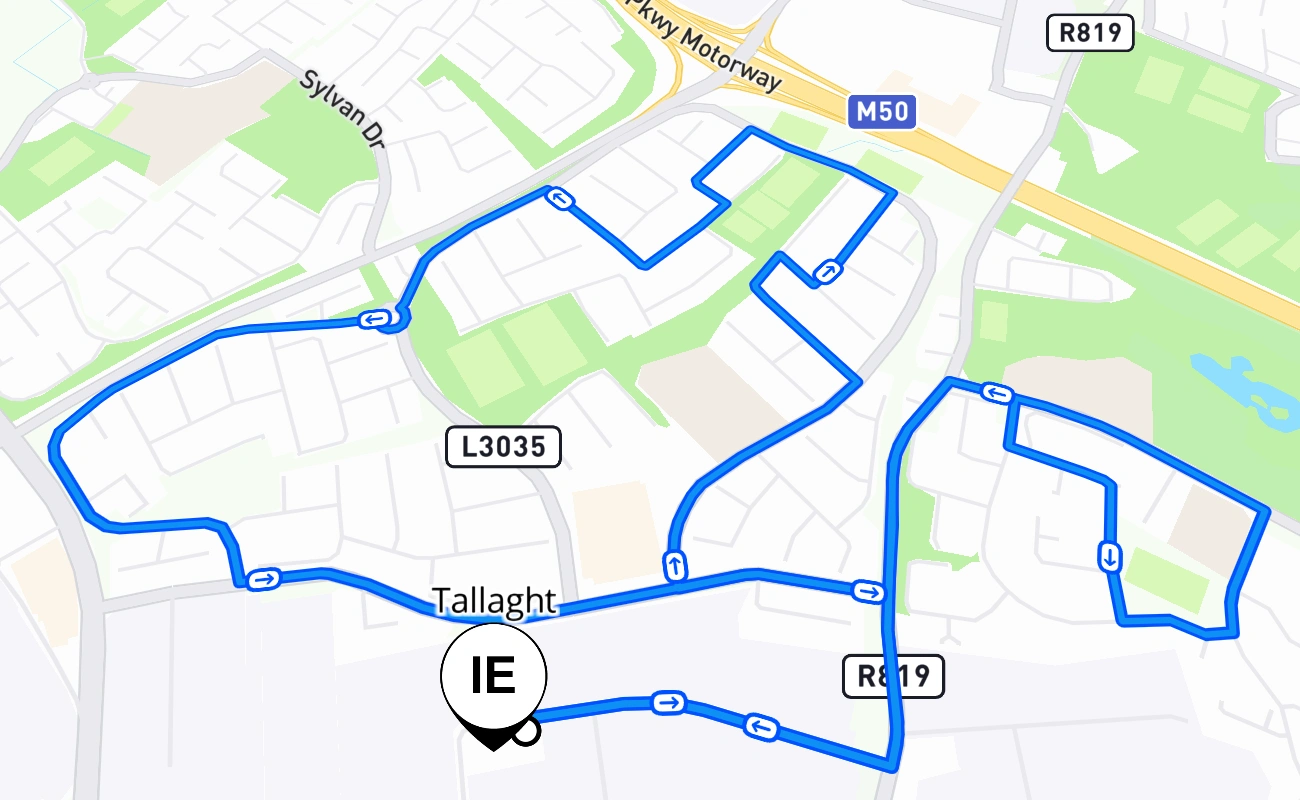
Tallaght (Leinster) #2804
AUDrive 12 Jun 20241 -
Pro
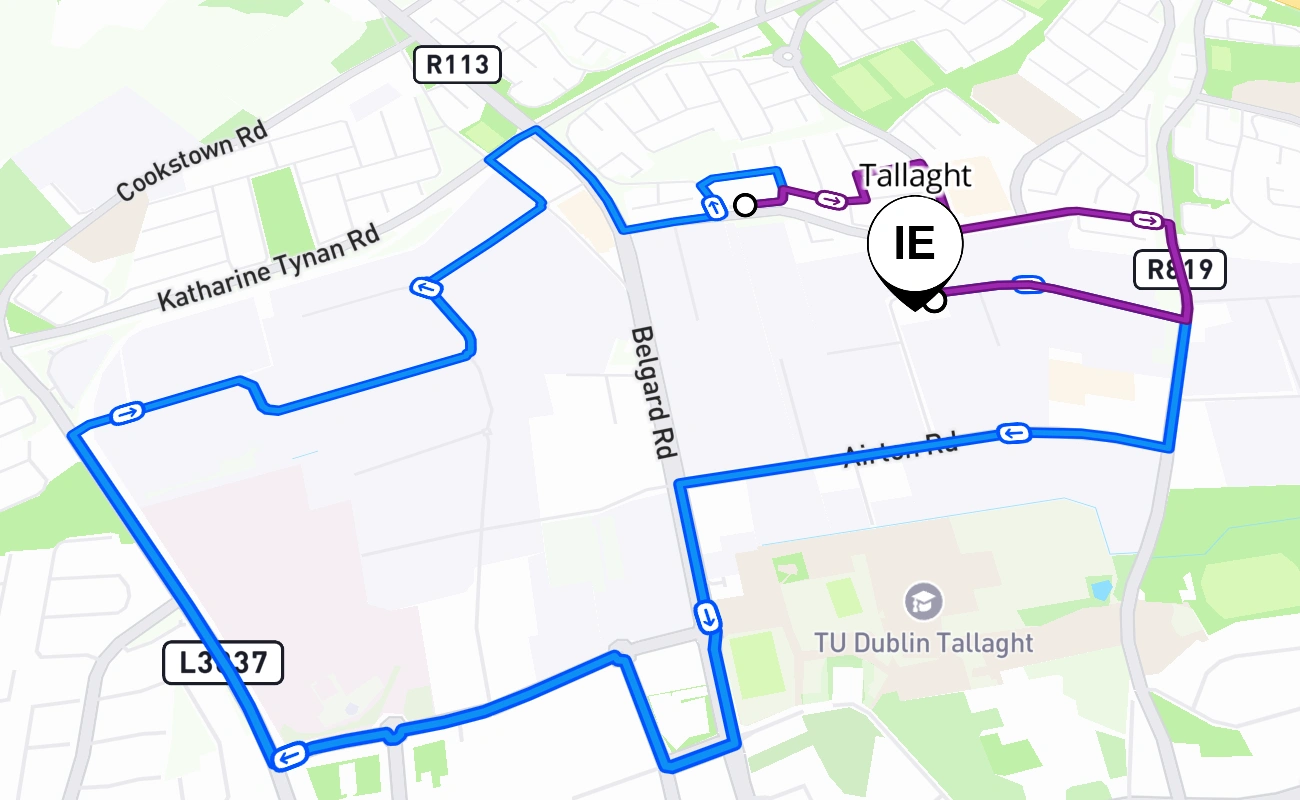
Tallaght (Leinster) #2803
AUDrive 12 Jun 20240 -
Pro
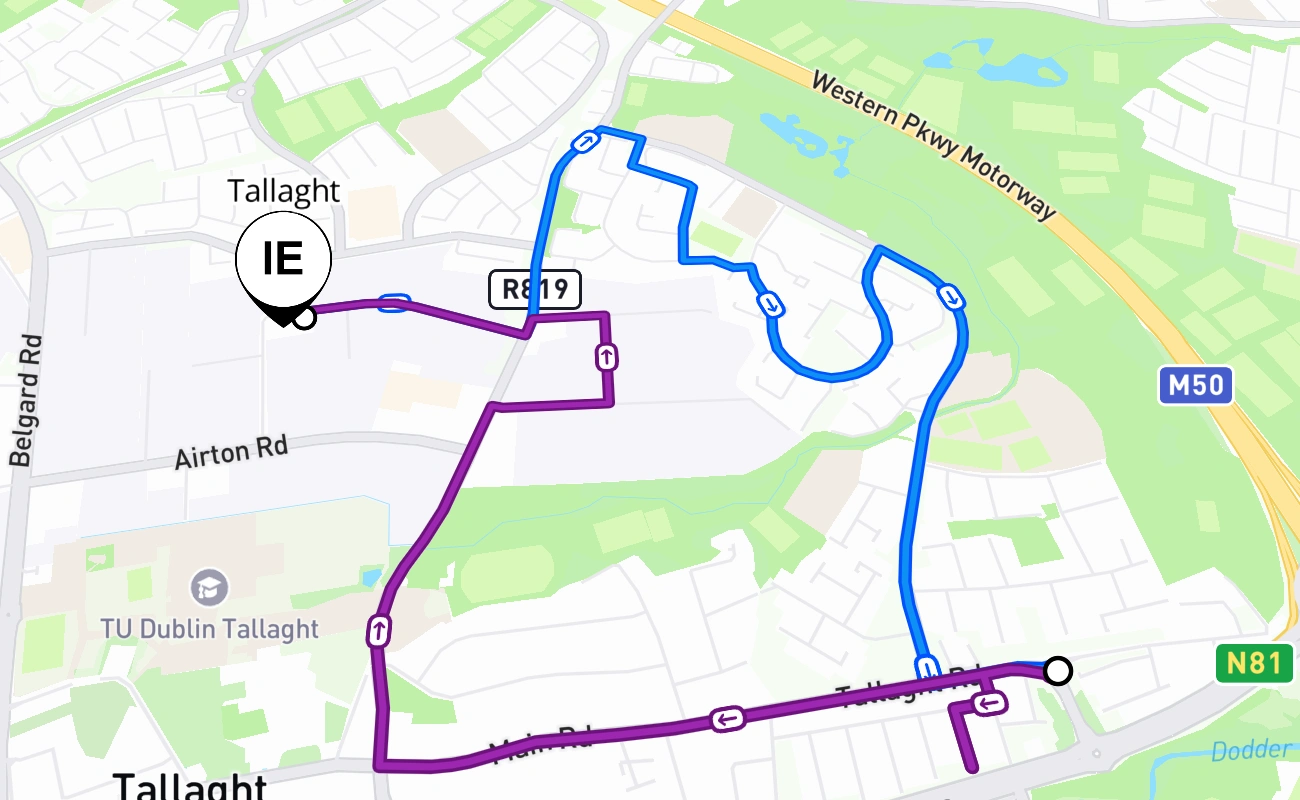
Tallaght (Leinster) #2802
AUDrive 12 Jun 20241 -
Pro
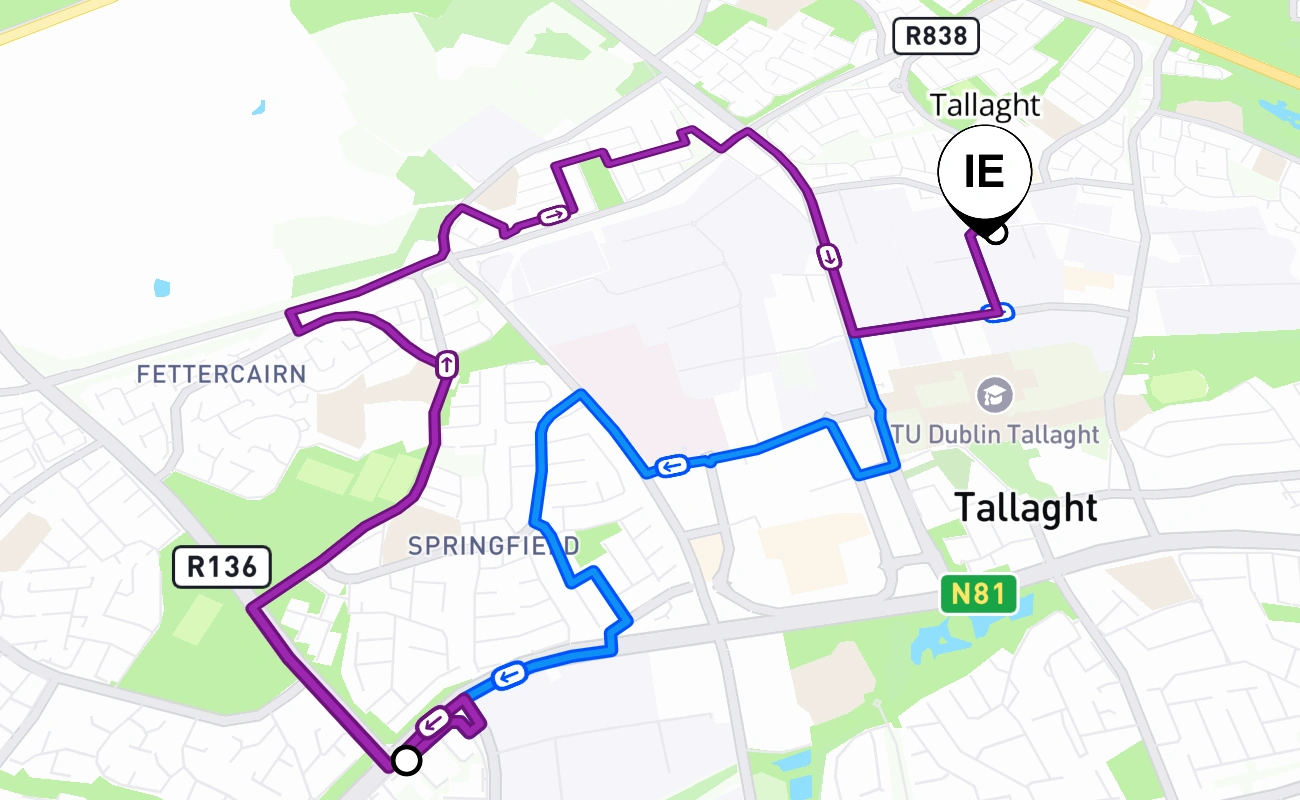
Tallaght (Leinster) #2801
AUDrive 12 Jun 20240 -
Earn Pro rewards
Passed your test?
Contribute your test route, earn a Pro reward.
Contribute a Route
General Tips
Car tests, October 2025 to September 2026, combined by AUDrive. Source: RSA statistics on CSO PxStat table ROA30, © RSA. ROA30, CC BY 4.0. Centre details: RSA.
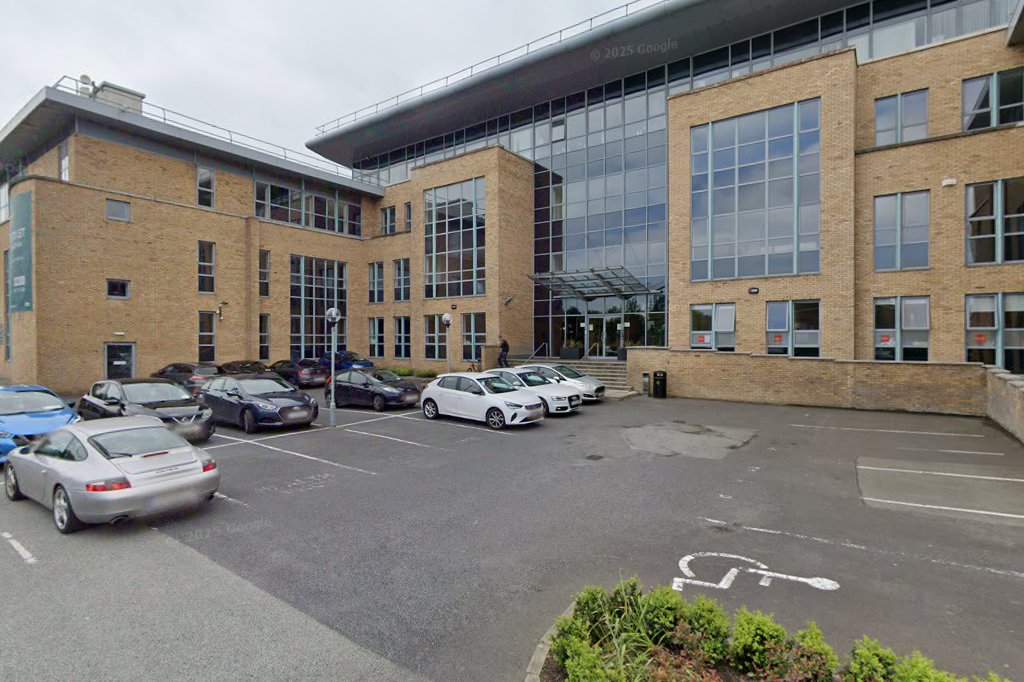
Official centre list: RSA, Where to take the test
The RSA does not publish a phone number for each centre. The number shown is the national RSA customer service line (096 25000, Monday to Friday 8.30am to 5pm). Tests are booked and changed online on MyRoadSafety, not by phone.
Frequently Asked Questions
What is the pass rate at Tallaght driving test centre?
Tallaght has a Category B car pass rate of 49.5% (CSO table ROA30, RSA data, October 2025 to September 2026), a little below the national figure of about 52%. It also ran more car tests than any other Irish centre in that period, 26,392 in total. Nearby, killester sits at a similar 49.4%, while naas is higher at 53.7%. The routes mix busy distributor roads such as Greenhills Road and Belgard Road with hilly housing estates.
How long is the waiting time for a test in Tallaght?
Tallaght had the longest wait of any centre at the end of September 2026: 22 weeks to a driving test invite, against 11.9 weeks for all centres (CSO table ROA36, RSA data). It was 13 weeks at the end of June 2026, so the wait has grown, and the RSA target is 10 weeks. The Irish Times reported in July 2026 that no site had yet been found for a new south Dublin centre after the Sandyford plan fell through. Check MyRoadSafety for cancellation slots.
Why have tests at Tallaght been cancelled or run late?
Traffic is the main reason. The Irish Times reported in June 2026 that 160 tests at Tallaght had been cancelled that year because they could not be completed before close of business. Testers asked for the set test time to rise from 50 to 55 minutes, and the RSA cut the slots on the busiest day from eight to seven. The RSA said it was exploring an overflow facility for Tallaght. Arrive early and allow extra travel time.
Which roads are used on Tallaght driving test routes?
Routes start on Broomhill Road and usually head out via Greenhills Road or Airton Road. Published practice routes from Pinnacle Driving School and a local route guide use Castletymon Road, Tallaght Main Road, Belgard Road, Cookstown Way, Belgard Square, Tallaght Village and the estates at Tymon North, St Aongus, Bancroft, Redwood, Treepark, Parkhill and Killinarden. Examiners can vary the route, so practise the whole area.
What should I watch for when leaving the Tallaght test centre?
Treat the exit from the business park as the first marked junction of your test. A driving school advises that you stop or slow to a crawl at the hedge and look both ways before turning left, because the hedge blocks your view. A boards.ie poster described the left turn out of the industrial estate onto Greenhills Road as dangerous, with no stop sign but a real need to stop. Weak observation and hesitation here are common early faults.
Where are the manoeuvres done on Tallaght test routes?
Manoeuvres are done in the residential estates. Pinnacle Driving School's routes place the reverse around a corner on Bancroft, St Aongus Park, Glenview Park and in Redwood, hill starts on St Aongus Road, Tymonville Park, Redwood Rise and Treepark Road, and turnabouts on St Aongus Crescent, Tymon North Park and Redwood Park. A local route guide lists Glenview Park as a very common turnabout spot and notes that steep gradients in Parkhill, Killinarden and Redwood cause rollback and clutch problems.
Which junctions and roundabouts catch learners out in Tallaght?
The Belgard Road roundabouts, including the one near the hospital, and the traffic lights on Greenhills Road are the main trouble spots. A local route guide lists drifting between lanes, late indicators, cutting exits and freezing at entry on Belgard Road, plus late lane choice and hesitation that blocks traffic on Greenhills Road. Pinnacle Driving School stresses lane discipline in Tallaght Village and around Belgard. Pick your roundabout lane early and hold it.
What faults are common in the Tallaght housing estates?
Estate exits are where many faults build up. A local route guide notes rushed exits and incomplete observation in Tymon and Bancroft, and timid or unsafe pulls from estate exits onto Castletymon Road. Pinnacle Driving School warns of speed bumps and school zones on the routes. Make a clear head check at every estate exit, take ramps slowly and watch speed limit changes between 50 and 60 km/h on the distributor roads.
What are the steps to get a full Irish driving licence?
For a car, the steps are: (1) pass the driver theory test; (2) apply to the NDLS for your first learner permit (EUR 45); (3) complete 12 one-hour Essential Driver Training (EDT) sessions with an RSA Approved Driving Instructor (ADI) and hold your first learner permit for at least 6 months; (4) pass the RSA driving test (EUR 85 for a car); (5) apply to the NDLS for your full licence within 2 years of passing, as the Certificate of Competency is valid for 2 years. You then display N-plates for 2 years.
How long is the driving test and what does it involve?
Citizens Information says the car test lasts about 50 to 100 minutes depending on traffic, and the practical drive itself takes approximately 40 minutes. It starts in the test centre with questions on the Rules of the Road, then the technical checks at your car, then the drive. You will be assessed moving off, driving in traffic, stopping, reversing around a corner, performing a turnabout and a hill start, and will usually meet left and right turns, a roundabout and traffic lights. At some point the tester will ask you to demonstrate hand signals.
What are the technical checks on the car test?
For a car (category B) test, after the Rules of the Road questions the tester takes you out to your vehicle and asks how you would carry out a technical check on three of the following: steering, horn, brakes, tyres, lights, reflectors, indicators, engine oil, coolant and windscreen washer fluid. To reach some of these you will have to show how to open the bonnet and close it securely, so practise this in your test car beforehand.
Do I need to know hand signals for the Irish driving test?
Yes. Both the RSA and Citizens Information list demonstrating hand signals as part of the car test; the tester will ask you to show them at some point during the test. Study the hand signal section of the RSA Rules of the Road booklet, which is also the basis for the Rules of the Road questions at the start of the test.
How are faults graded and what causes a fail?
RSA testers record faults in three grades: Grade 1 is a minor fault, Grade 2 is a serious fault, and Grade 3 is a dangerous or potentially dangerous fault, or a total disregard of traffic controls. Under the RSA marking guidelines you fail if you get any one of: 1 or more Grade 3 faults; 4 of the same Grade 2 fault for a single aspect; 6 or more Grade 2 faults under the same heading; or 9 or more Grade 2 faults overall. Grade 1 faults on their own do not cause a fail.
What are the most common reasons people fail?
The RSA lists the most common reasons as inadequate observation (moving off, at junctions, at roundabouts and when changing lanes), failure to anticipate the actions of other road users, incorrect road position, and incorrect use of mirrors and signals. In driver forums such as boards.ie, candidates also often mention observation faults while reversing around a corner and at roundabouts, and testers marking down mirror checks done after, rather than before, moving off or turning.
What must I bring and what does my car need on test day?
Bring your valid learner permit for the category being tested (it must match your identity and be in date). From 9 March 2026 you must also show a valid certificate of motor insurance proving you are insured to drive the test vehicle; if your name is not on it, bring an email or letter from the insurer confirming cover. Original or copy and digital versions are accepted. The car must be roadworthy, display L-plates front and rear, and show a valid insurance disc, motor tax disc and NCT disc if applicable. Tyres must be above the legal minimum tread (1.6 mm), space-saver spare wheels are not accepted, and warning lights showing a malfunction can stop the test. You will sign a statement that the car is roadworthy and insured.
Who can accompany me when I drive on a learner permit?
On a car learner permit you must always be accompanied and supervised by a qualified driver, meaning someone who has held a full licence for the same category for a continuous 2 years. You must also display L-plates front and rear, carry your permit, stay off motorways, and keep to the reduced drink driving limit and penalty point threshold. If the Gardaí stop you driving unaccompanied, they can seize your car.
How long must I hold a learner permit before I can take the test?
You must have held your first learner permit for at least 6 months before sitting a car test. You can apply early, but you cannot book an appointment until the permit has been valid for 6 months and your ADI has uploaded all 12 EDT sessions to the MyEDT system. If you hold a foreign licence, you can apply to the RSA for an exemption: a licence held for at least 2 years before your Irish learner permit can qualify for reduced EDT, which includes the 6-month exemption, and a licence held for between 6 months and 2 years can qualify for the 6-month exemption on its own. The licence must not have expired more than 6 months before you apply.
What is EDT and do I need all 12 lessons?
Essential Driver Training (EDT) is a mandatory course of 12 one-hour sessions with an RSA Approved Driving Instructor for anyone whose first car learner permit was issued on or after 4 April 2011. Each session is stamped and signed in your EDT logbook and recorded on MyEDT, and you bring the completed logbook on test day. There is no set price; each instructor sets their own. Holders of a foreign licence can apply to the RSA for reduced EDT of 6 sessions. It is not automatic: the licence must have been held for at least 2 years before your Irish learner permit was issued and must not have expired more than 6 months before you apply.
How do I book the driving test and how long is the wait?
Apply and pay online through the RSA MyRoadSafety portal (or by post with the application form). You join a queue and receive an email invitation to book; you then have 10 days to choose an appointment, or you can rejoin the queue later if you are not ready. The RSA cannot book tests by phone or email and does not offer earlier or cancellation slots on request. The RSA target is a 10-week wait; as of 19 September 2026 the RSA said the national average waiting time was 11.9 weeks. Waits vary by centre, so check the RSA online waiting time estimator for your centre.
How much does the driving test cost?
The car driving test fee is EUR 85 (the same fee applies to motorcycle, car and trailer, works vehicle and tractor tests). You must give 10 days' notice to cancel and get a refund, and if you cancel more than 2 tests you lose the refund and must make a new application. Related costs: the first learner permit is EUR 45, exchanging a foreign licence is EUR 65, and EDT lesson prices are set by each instructor.
What happens if I fail the test?
You get a detailed report of your faults to work on. To retest you reapply on MyRoadSafety; candidates who fail and reapply are automatically invited to book again about 10 weeks after the failed test, which may be longer at busy centres. The RSA cannot give earlier appointments to any individual. If you believe the test was not conducted properly, you can appeal to your local District Court (fee EUR 25); if the appeal is upheld you get a free retest with a different tester, but no compensation.
What happens after I pass?
You are given a Certificate of Competency, which is valid for 2 years; apply to the NDLS for your full licence within that time or you must take the test again. The certificate is not a licence, so until your full licence arrives you still cannot drive on a motorway, remove your L-plates or drive unaccompanied.
What are the N-plate (novice driver) rules?
For 2 years from the date your first full licence is issued, you must display N-plates. The novice period applies only once. During those 2 years you are disqualified at 7 penalty points (instead of 12 in 3 years), and the lower drink driving limit for learners and novices applies: 20 mg per 100 ml of blood, 27 mg per 100 ml of urine or 9 mg per 100 ml of breath.
Can I exchange my overseas licence, or do I need to take the test?
You can exchange a full licence issued by an EU or EEA country, or by a recognised state: Australia, Canada (some provinces), Georgia, Gibraltar, Guernsey, Isle of Man, Japan, Jersey, Moldova, New Zealand, Northern Ireland, South Africa, South Korea, Switzerland, Taiwan and the UK. The exchange fee is EUR 65, applied for online or at an NDLS centre. If your licence is from any other country, including mainland China, you must go through the full process starting with the theory test. You can then apply to the RSA for reduced EDT (6 lessons instead of 12, and no 6-month wait) if you held the licence for at least 2 years before your Irish learner permit; if you held it for 6 months to 2 years, only the 6-month wait can be waived. Visitors with such a licence and an international driving permit can drive for up to 12 months.
What is the national pass rate for the car driving test?
Based on CSO table ROA30, Category B (car) tests delivered nationally from October 2025 to September 2026 had a pass rate of about 52%, weighted by the number of tests delivered each month (calculated by AUDrive; monthly rates ranged from 50.9% to 53.1% across roughly 266,000 tests). In other words, about half of candidates pass, so prepare thoroughly on observation, road position and mirrors.
How do I contact the RSA or NDLS?
Driving tests are managed online through MyRoadSafety; the RSA asks people not to call about test appointments, as agents cannot manage tests by phone or offer urgent appointments. For other RSA queries, the RSA customer care centre is on 096 25000 (Monday to Friday, 8.30am to 5pm). Learner permits and licences are handled by the NDLS: customer care 0818 700 800 (+353 21 462 4810 from abroad), lines open Monday to Friday, 9am to 5pm, excluding public holidays. The RSA does not list phone numbers for individual test centres.

Office discussion
No comments yet
Share how your practice went. It helps the next learner.