AA Balclutha AA Driving Test Routes
Book TestBe the first to contribute a route for AA Balclutha
No practice routes have been shared for this centre yet. Use the AUDrive app to record your driving practice with GPS, then share it to help other learners prepare for their test here.
Contribute a route, get rewarded
Be the first to contribute one here and earn 2 Pro vouchers worth $20 (transferable to friends).
Already a Pro subscriber? Contribute your real test route after passing and get your subscription refunded.
1. Record
Drive with GPS recording on in the AUDrive app.
2. Review
See your route on the map with speed and timing data.
3. Contribute & Earn
Contribute your route and earn Pro vouchers as a thank-you.
Frequently Asked Questions
How do I book a driving test in New Zealand?
You can book your restricted licence practical test online through the NZTA (Waka Kotahi) website. Enter your licence number, date of birth, and last name to book and pay. You can also reschedule or cancel online. Alternatively, visit an AA Centre or VTNZ location in person. Before booking, you must visit a driver licensing agent to complete your application form, eye test, and photo. Booking slots can fill up quickly — keep refreshing the website as spots are released regularly.
Is there a driving test centre in Balclutha?
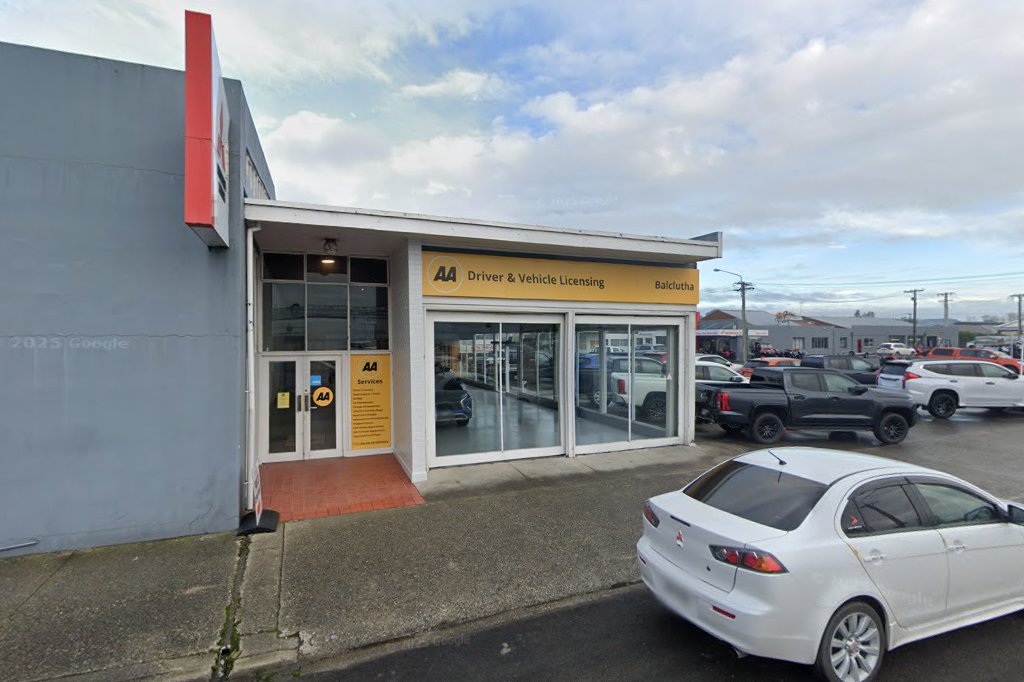
Yes. Balclutha has an AA agent office at 79 Clyde Street providing a full range of driver licensing services, including theory tests and practical tests for Class 1, Class 2-5 heavy vehicles, and Class 6 motorcycles. This is a community testing service run by AA, not a full VTNZ centre. Before this centre was established, South Otago residents had to travel approximately 80 km north to teviot street in Dunedin or south to invercargill for their driving test. The pass rate at Balclutha is approximately 51%. Note that the centre is closed on Fridays.
What is New Zealand's graduated driver licensing system?
New Zealand uses a three-stage Graduated Driver Licensing System. Stage 1: Learner licence (age 16+, pass theory test with 32/35 correct). Stage 2: Restricted licence (held learner 6+ months, pass practical driving test). Stage 3: Full licence (held restricted 18 months, or 12 months with approved defensive driving course, pass full licence test). Major reform: From January 25, 2027, the full licence practical test will be removed, and learner holding periods will change.
What are the requirements for the restricted licence driving test?
To sit the restricted licence test you must: be at least 16.5 years old, have held your learner licence for at least 6 months, and have completed your application at a driver licensing agent (including eye test and photo). You must bring a safe, registered vehicle with a current Warrant of Fitness (WoF). The test is in two stages: Stage 1 (about 10 minutes, up to 60 km/h) assessing basic skills, and Stage 2 (about 35 minutes, up to 100 km/h) assessing comprehensive driving ability across 6 core competencies.
What is the pass rate at AA Balclutha?
AA Balclutha has a pass rate of approximately 51%, which is below the national average of around 63% for restricted tests. This is comparable to other small-town AA centres across New Zealand. The nearby teviot street in Dunedin has a pass rate of around 50%, while invercargill sits at 57%. Despite the quiet rural setting and light traffic, candidates should not underestimate the test standards. Examiners apply the same criteria regardless of location, and complacency on quiet roads is a common reason for failure in small-town centres.
How much does the driving test cost in New Zealand?
The restricted licence application (including the practical test) costs $167.50 NZD and includes up to 2 test attempts. Additional re-sits cost $102.80 each. The learner licence application (including the theory test) costs approximately $96.20 and also includes 2 attempts. The full licence application costs $98.90. Total cost from learner to full licence is currently about $362.50. After the January 2027 reform, this drops to approximately $282.50.
What changes are coming to the NZ licensing system in January 2027?
From January 25, 2027: the full licence practical test will be removed for class 1 licences. Under-25 learner holding period doubles from 6 to 12 months (reducible with supervised hours or approved courses). Defensive driving courses will no longer shorten the restricted period. Zero-alcohol limit expands to all learner and restricted holders (currently only under-20). A hazard perception test moves from the full licence stage to the restricted stage. Demerit point violations extend the restricted period by 6 months.
What are the test routes like at AA Balclutha?
Test routes start from 79 Clyde Street and cover the compact Balclutha township. The town has a population of around 4,300 with very light traffic. Routes include quiet residential streets at 50 km/h, the main commercial area along Clyde Street, and potentially sections of State Highway 1 at higher speed limits of 80 to 100 km/h on the outskirts of town. The Clutha River bridge on Clyde Street may also feature on the route. Expect give-way intersections, stop signs, and speed limit transitions between the town centre and surrounding rural roads. AUDrive provides route maps for this centre.
What is the pass rate for the restricted licence test in New Zealand?
The national average restricted licence pass rate is approximately 55%, varying significantly by region. According to Waka Kotahi 2023 data: Auckland has the lowest at 49.2%, followed by Bay of Plenty (50.9%) and Wellington (51.9%). Provincial areas do much better: Gisborne (68.2%) and Taranaki (70.6%). Within Auckland, pass rates also vary by test centre: Highbrook (73%), Pukekohe (70%), Mt Wellington (69%), North Shore (68%), and Manukau (53%).
What are the restricted licence conditions in New Zealand?
Restricted licence holders cannot drive between 10pm and 5am unless accompanied by a supervisor (full licence holder of 2+ years). You also cannot carry passengers unless a supervisor is present. Exceptions apply for your spouse/partner, dependents, or if driving is required for work. During daytime hours (5am-10pm), you can drive alone but without passengers. Important: driving on a learner licence without a supervisor is illegal and carries fines of $400+.
What are the opening hours at AA Balclutha?
AA Balclutha operates Monday to Thursday 10:00 AM to 4:30 PM only. The centre is closed on Fridays, weekends, and public holidays. This is a notably restricted schedule compared to larger centres, and the late opening time of 10:00 AM means morning test slots are unavailable. Book well in advance through the NZTA website at online.nzta.govt.nz or by calling 0800 500 444. Test availability is limited due to the small number of operating days.
Can I convert my overseas licence to a New Zealand licence?
Yes. Drivers from 25 recognised countries (Australia, UK, USA, Canada, most EU countries, Japan, South Korea, Singapore, South Africa, etc.) can convert directly without tests. Drivers from non-recognised countries including China must pass the theory test (35 questions, 32 correct to pass) and the restricted licence practical driving test. You can drive on your overseas car licence for up to 18 months in NZ with an IDP or certified English translation.
How do I convert a Chinese licence to a New Zealand licence?
Chinese licence holders must: 1) Get a certified English translation (NAATI or NZ-approved translator, about $30-$50). 2) Visit a driver licensing agent with your Chinese licence, translation, passport, and proof of NZ address. 3) Pass the theory test (35 questions, 32 correct, available in Chinese). 4) Pass the restricted licence practical driving test ($167.50 application fee includes 2 attempts). You can drive on your Chinese licence + IDP/translation for up to 18 months after arriving.
What are common reasons for failing the driving test at Balclutha?
Common failure reasons at small-town centres like Balclutha include relaxed observation habits due to light traffic. Candidates may skip thorough checks at quiet intersections, neglect shoulder checks when no other cars are visible, or fail to signal properly. Speed management during the transition from 50 km/h town streets to 80 or 100 km/h rural roads is another common issue. Give-way rule errors at uncontrolled intersections are frequent, as are incomplete stops at stop signs. Agricultural vehicles on rural road sections may require sudden speed adjustments.
How is the restricted licence driving test structured?
The test takes approximately 45 minutes total in two stages. Stage 1 (about 10 minutes): driving in areas with speed limits up to 60 km/h, assessing basic vehicle control and driving skills. Stage 2 (about 35 minutes): driving on roads with speed limits up to 100 km/h, assessing comprehensive driving ability. You are assessed on 6 core competencies: speed management, following distance, observation and scanning, lane positioning, steering, and signalling. A pre-drive check covers demister, handbrake, and indicators.
What are the instant fail items in the NZ driving test?
Critical errors (instant fail) include: failing to give way at intersections or to pedestrians, running a red light or not stopping completely at a stop sign, exceeding the speed limit (including temporary speed zones like 30 km/h roadworks), unsafe lane changes without blind spot checks, following too closely, any dangerous driving action, causing a collision or near miss, and any situation requiring examiner intervention. A single critical error means immediate fail regardless of other performance.
What are the most common reasons for failing the NZ driving test?
The most common fail reasons are: poor observation (not checking mirrors frequently enough — you should check mirrors every 8-10 seconds even on straight roads, and always before braking), speed management errors (especially in temporary 30 km/h roadwork zones), not stopping completely at stop signs (rolling through = fail), incorrect signalling (indicators must be on for 3+ seconds; if the indicator auto-cancels during a turn, you must re-signal), and inadequate shoulder checks before lane changes.
What happens if I fail the restricted licence test?
If you fail, you receive feedback on areas to improve. Your $167.50 application fee includes up to 2 test attempts, so your first re-sit may be covered. Additional re-sits cost $102.80 each. There is no limit on attempts. Most candidates pass within 1-3 attempts. Tip: arrive 2 hours early to practise in the test area. One candidate spent $110/1.5 hours on lessons plus $70 for a test companion, but found that self-practice near the test centre was more effective.
How does Balclutha compare to Dunedin or Invercargill for the driving test?
Balclutha offers a much quieter testing environment than teviot street in Dunedin. Dunedin has hills, a one-way street system, busier intersections, and university traffic that add complexity. invercargill is also busier with a wider street grid, though still relatively calm. Balclutha's advantage is minimal traffic pressure in a compact township, which can help nervous candidates. However, the limited operating hours of Monday to Thursday and late 10:00 AM opening reduce flexibility. Pass rates are similar across all three centres, ranging from 50 to 57 percent.
Does New Zealand drive on the left or right side of the road?
New Zealand drives on the left side of the road, the same as Australia and the UK. If you are from a country that drives on the right (such as China, USA, or most of Europe), pay special attention at intersections and when turning. At uncontrolled intersections, give way to the right. At roundabouts, give way to traffic from your right already on the roundabout. One-lane bridges have priority signs — the larger arrow has right of way.
What is a defensive driving course and should I take one?
An approved defensive driving course teaches advanced safe driving skills and hazard awareness, costing approximately $150-$200 NZD from AA or other approved providers. Currently, completing one reduces your restricted holding period from 18 to 12 months. However, after the January 2027 reform, defensive driving courses will no longer shorten the restricted period. The course is still valuable for improving driving skills, but the time-saving benefit will be removed.
How should I prepare for the Balclutha driving test?
Practise driving in and around Balclutha township, focusing on Clyde Street, residential side streets, and the transition zones where speed limits change from 50 to 80 or 100 km/h. Build strong observation habits at every intersection even when no other vehicles are visible, as quiet conditions often lead to complacency. Practise give-way rules, complete stops at stop signs, and make shoulder checks clearly visible. If the route crosses the Clutha River bridge, practise maintaining lane position on narrower bridge sections. Ensure your vehicle WOF and registration are current. Bring valid ID and your current licence.
What is the NZ learner licence theory test like?
The learner licence theory test has 35 multiple-choice questions and you must get at least 32 correct to pass (91%). Questions cover road rules, traffic signs, safe driving practices, and hazard awareness. The test is available in multiple languages including Chinese. Study using the official Road Code on the NZTA website. The application fee of approximately $96.20 includes up to 2 test attempts. You can sit the test at an AA Centre or NZTA agent location.
What vehicle do I need for the NZ driving test?
You must bring a safe, registered vehicle with a current Warrant of Fitness (WoF) and valid registration (rego). Diesel or electric vehicles also need a current road user charges label. The vehicle must have working seatbelts, lights, indicators, brakes, mirrors, and a visible speedometer. No dashboard warning lights should be showing. If you test in an automatic, your licence will be restricted to automatic vehicles only.
Are there any tips for passing the NZ driving test?
Key tips from successful candidates: choose a test centre with higher pass rates (Highbrook 73% vs Manukau 53% in Auckland); arrive 2 hours early to practise nearby; make all shoulder checks exaggerated so the examiner sees you turn your head; check mirrors every 8-10 seconds even on straight roads and always before braking; at stop signs, come to a complete stop (wheels must stop moving); signal for at least 3 seconds before any manoeuvre; if your indicator auto-cancels, re-signal immediately; in 30 km/h roadwork zones, stay under the limit and accelerate gradually after.

Office discussion
No comments yet
Share how your practice went. It helps the next learner.