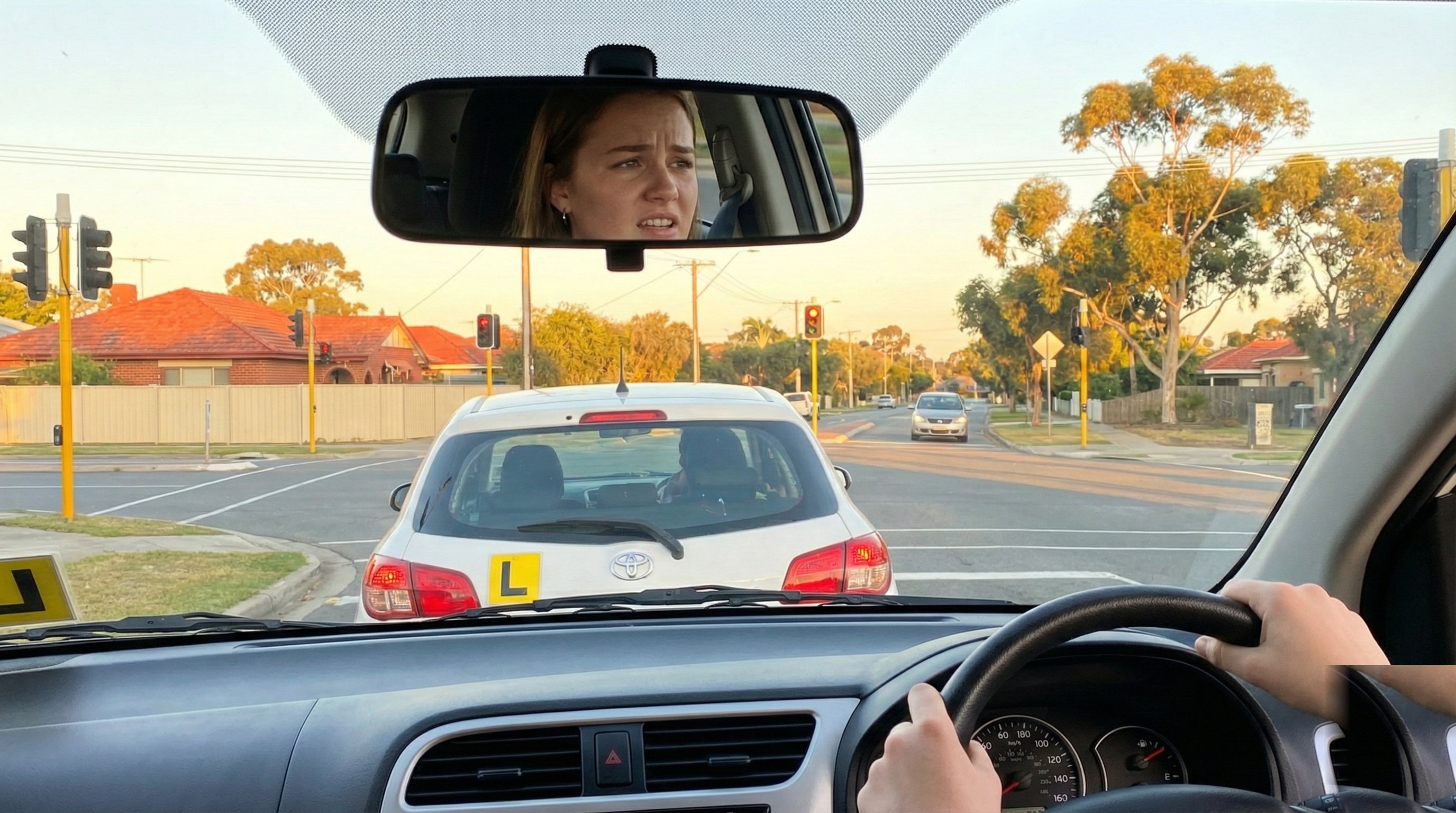
The Numbers Behind the Fails
About 36–40% of learners across Australia don't pass on their first attempt. In Western Australia, it's worse, only around 35% pass the PDA first time. Even in states with higher pass rates like Queensland (~61%) and NSW (~56%), thousands of candidates walk out disappointed every month.
But here's what most people miss: the reasons for failing are almost identical everywhere. The same handful of mistakes account for the vast majority of fails, no matter which state you're testing in.
Bottom line: Head checks, mirror use, and speed management are the top three fail reasons in virtually every state. Nail those three, and you've already dealt with most of what catches people out.
1. Missing Head Checks (Blind Spot Checks)
This is the number one fail reason across NSW, VIC, QLD, WA, and SA. It's not even close.
A head check means physically turning your head to look over your shoulder into your blind spot, the area your mirrors can't cover. Motorcyclists, cyclists, and even cars can sit in that zone completely invisible to your mirrors.
When you need one:
- Moving off from the kerb
- Changing lanes
- Merging
- Turning at intersections
- Pulling over or parking
The most common mistake isn't forgetting head checks entirely, it's doing them too subtly. A quick eye flick won't count. The examiner needs to see your head turn. If they can't tell you checked, it gets marked as "not performed."
Tip: Practise with your instructor sitting in the passenger seat. Ask them to tell you every time they can't clearly see your head turn. You might be surprised how often your checks aren't visible enough.
2. Poor Mirror Habits
Mirror use is a top failure category in NSW and shows up as a common error in every other state too.
Examiners expect a regular scanning pattern: check your interior mirror roughly every 8–10 seconds, and check the relevant exterior mirror before any change in speed or direction. That means before braking, before turning, before changing lanes, mirrors first.
Common mistakes:
- Staring at a mirror for too long (you should glance, not gaze)
- Only checking mirrors before manoeuvres instead of scanning throughout the drive
- Completely forgetting the interior mirror
- Not checking mirrors after passing through an intersection
The fix is building a habit, not memorising a checklist. On every practice drive, make mirror scanning automatic. Eventually it becomes second nature and you won't even think about it during the test.
3. Speed Management
Speed errors come in two forms, and both cost marks:
Going over the limit, even 3–5 km/h over can be marked, and anything significantly over is usually an immediate fail. In South Australia, missing school zone speed reductions (25 km/h) is one of the most frequently cited fail reasons. You have to actively watch for school zone signs, not just assume you'll notice them.
Going too slow, driving well below the speed limit when conditions are fine suggests you're not confident or not aware of your surroundings. In Victoria, examiners specifically watch whether you reach the posted speed within a reasonable distance after turning onto a new road. Crawling at 40 in a 60 zone with no reason will cost you marks.
Tip: When you enter a new street, actively look for speed signs. If you can't see one, check for repeater signs on the left side of the road. In residential areas without signs, the default is 50 km/h.
4. Rolling Stops
A stop sign means a complete stop. Your wheels must stop turning entirely, not slow to a crawl, not almost stop. A full, dead stop.
You need to stop behind the white stop line. If your view is blocked at that point, stop at the line first, then inch forward until you can see. Stopping beyond the line, or creeping through without ever fully stopping, is one of the most penalised errors on the test.
Tip: After you stop, count "one thousand" in your head. This does two things, it confirms you genuinely stopped (not just paused for a split second), and it gives you time to properly scan for traffic before moving off.
5. Roundabout Errors
Roundabouts trip people up in every state, but they're a particular problem in Victoria and Queensland.
The three most common roundabout mistakes:
- Not giving way to vehicles already in the roundabout. You must yield to any vehicle that's already circulating, even if they're still a few metres from your entry point.
- Wrong lane choice at multi-lane roundabouts. If you're turning right, you need the right lane. Going straight, you can typically use either lane. Turning left, use the left lane.
- Forgetting to signal left when exiting. This one catches a lot of people. You must indicate left as you pass the exit before yours.
In Melbourne, hook turns at certain intersections add another layer of confusion, but those are covered in the intersection rules rather than roundabout assessment.
6. Poor Observation at Intersections
Beyond mirrors and head checks, examiners assess your general awareness at intersections. Are you scanning left and right? Checking for pedestrians? Assessing gaps properly?
In Queensland, observation and scanning errors make up about 36.5% of all recorded errors, the single largest category. In South Australia, observation mistakes are consistently among the most cited failure reasons.
Common mistakes:
- Only looking in one direction at a T-intersection (you need to check both ways, even on a one-way street, pedestrians don't follow traffic flow)
- Not checking for pedestrians before turning left
- Failing to scan the intersection as you approach, not just when you arrive at it
- Not looking for vehicles running red lights before entering a green-lit intersection
7. Signalling Errors
Your indicators tell other road users what you're about to do. Errors include signalling too late (less than 5 seconds before turning), not signalling at all, leaving an indicator on after a turn, and signalling in the wrong direction.
Situations people commonly forget to signal:
- Exiting a roundabout (signal left)
- Pulling away from the kerb (signal right)
- Moving back to the left after overtaking a parked car
- Changing lanes in multi-lane roads
8. Poor Gap Selection
Gap selection, choosing when it's safe to pull into traffic, is a common fail area in Queensland and Western Australia.
Two types of errors:
- Too aggressive: pulling out when the gap is too small, forcing other vehicles to brake or swerve
- Too hesitant: letting safe gaps pass repeatedly, which holds up traffic and suggests lack of confidence
Tip: Once you commit to a gap, follow through. Stopping halfway into the road is more dangerous than completing the turn. The key is to make your decision before you start moving, look, decide, then go.
9. Steering and Lane Position
Examiners watch your lane position throughout the entire drive, not just during specific manoeuvres.
Common faults:
- Drifting towards the centre line on straight roads
- Cutting corners on left turns (your left rear wheel should clear the kerb)
- Swinging wide on right turns
- Overcorrecting on curves instead of smooth, gradual steering
This usually improves with practice. If you're consistently drifting, look further ahead, your car naturally follows where your eyes are pointed.
10. Instant Fail (Critical) Errors
Every state has a list of errors that end the test immediately, regardless of how well you've done otherwise. While the specific lists vary, these are common across most states:
- Exceeding the speed limit significantly (typically 10+ km/h over)
- Running a red light or failing to stop at a stop sign
- Mounting the kerb during any manoeuvre
- Causing or nearly causing an accident
- Examiner has to intervene: verbally or by grabbing the wheel/handbrake
- Driving on the wrong side of the road
- Failing to give way when required (causing danger)
In Victoria, their "Stage 1 + Stage 2" marking system allows up to 1 critical error in Stage 1 and a maximum of 2 critical errors total before you fail. In most other states, a single critical error ends the test.
Note: Even without a critical error, too many minor errors will add up to a fail. Each state sets a threshold, typically around 8–12 non-critical errors.
State-by-State Breakdown
| State | Pass Rate | Top Fail Reasons | Key Detail |
|---|---|---|---|
| NSW | ~56% | Mirror habits, head checks, speed | 120 hours logbook required before testing |
| VIC | ~75% | Head checks, roundabouts, speed | 1 critical error allowed in Stage 1, max 2 total |
| QLD | ~61% | Observation (36.5% of errors), gap selection, speed | Max 8 non-critical errors |
| WA | ~35% | Blind spot checks, observation, speed | PDA takes 45–50 minutes |
| SA | ~82% | Observation, school zone speed, gap selection | VORT format, school zone fails very common |
| TAS | ~60% | Head checks, signalling, intersection observation | Drive test ~30 minutes |
| ACT | ~28% | Observation, speed management, lane position | Lowest pass rate in Australia |
| NT | ~55% | Speed management, signalling, observation | Test is video recorded |
Watch: Common Fail Reasons Explained
This video from Driving School WA covers the 11 most common reasons people fail, with real examples of each mistake:
And this one from Driving Test Australia focuses on the single biggest mistake that catches learners, blind spot checks:
How to Avoid These Mistakes
-
Drive the test routes beforehand. Know the speed zones, the tricky intersections, and the roundabouts near your test centre. AUDrive has GPS practice routes for test centres across Australia, practise them until the roads feel familiar.
-
Build a scanning habit. Don't try to remember individual checks. Instead, develop a constant cycle: interior mirror → road ahead → exterior mirror → blind spot when needed. Do this on every single practice drive until it's automatic.
-
Get professional lessons near the end. Even two or three lessons with a qualified instructor close to your test date can make a big difference. They'll spot the habits you've developed that you don't even know about.
-
Practise under test conditions. Have your supervisor give you directions with minimal warning, stay quiet during the drive, and don't help you. The less coaching you get during practice, the more prepared you'll be when the examiner is in the passenger seat.
-
Learn your state's instant-fail list. There's no point perfecting your parallel park if you're going to roll through a stop sign and fail immediately. Know what ends the test instantly, and make sure those basics are rock solid.
Frequently Asked Questions
What is the most common reason for failing the driving test in Australia?
Missing head checks (blind spot checks) is the number one fail reason across NSW, VIC, QLD, WA, and SA. The examiner needs to see your head turn clearly.
What percentage of people fail their first driving test?
Between 35% and 65%, depending on the state. WA has the highest fail rate at about 65%, and the ACT is even higher at over 70%.
How many minor errors can I make and still pass?
This varies by state. Typically 8 to 12 non-critical errors are the threshold. In VIC, you can have up to 2 critical errors total before you fail. In most other states, a single critical error ends the test.
What fails you instantly on the driving test?
Exceeding the speed limit significantly, running a red light, failing to stop at a stop sign, mounting the kerb, causing or nearly causing an accident, and examiner intervention all result in an immediate fail in most states.
Does the state I test in matter?
Yes. Pass rates range from about 28% (ACT) to 82% (SA). But the same types of errors fail people everywhere: head checks, mirror use, and speed management are the top three across virtually every state.
Related Guides
- Head Check and Mirror Technique Guide: Deep dive into the number one fail reason and how to build the habit.
- Driving Test Checklist: What to Bring: Everything you need on test day.
- Best Time to Book Your Driving Test: When to book for the least traffic and best conditions.