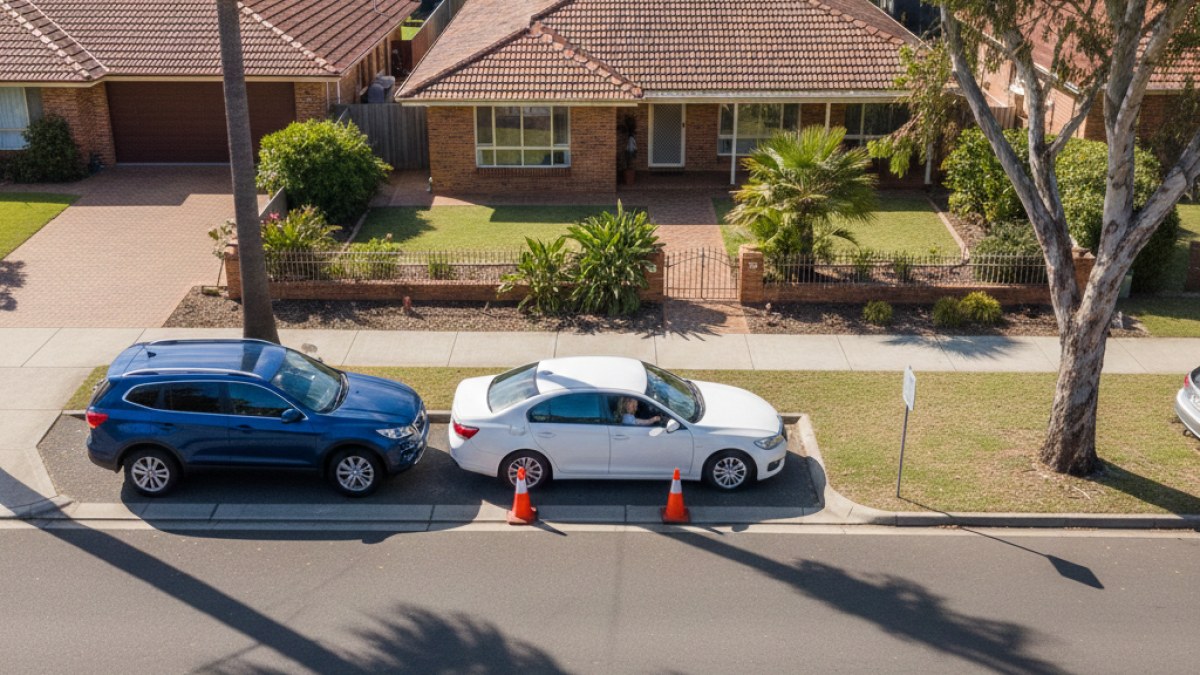
Parallel parking appears on practically every Australian driving test. The format varies by state, some test it every time, others pick it from a list of manoeuvres, but the core skill is the same: reverse your car into a space between two vehicles (or behind one), ending up reasonably close to and parallel with the kerb.
The actual procedure takes about 30 seconds. The mistakes that fail people take even less time, bumping the kerb, ending up too far out, or forgetting to check mirrors and blind spots during the manoeuvre.
The Basic Procedure
This video walks through the reverse parallel park step by step for the Australian driving test:
This is the standard method taught by most Australian driving instructors. It works for any standard sedan, hatch, or small SUV.
Setup
- Pull up alongside the vehicle you're parking behind (the "target car")
- Stop with your rear bumper roughly level with the target car's rear bumper
- Keep about 1 metre of space between your car and the target car
- Put the car in reverse
- Check all mirrors and do a head check in both directions before starting to move
Step 1: Turn In
- Look over your left shoulder through the rear window
- Begin reversing slowly
- When the rear of your car passes the rear corner of the target car, turn the steering wheel one full turn to the left (toward the kerb)
- Keep reversing slowly at this angle
Step 2: Straighten
- When your car is at roughly 45 degrees to the kerb (you'll see the right-side kerb line appear in your right mirror), straighten the wheel
- Continue reversing straight back
Step 3: Turn Out
- When your front bumper clears the rear of the target car, turn the steering wheel one full turn to the right (away from the kerb)
- This brings your car parallel to the kerb
- When you're parallel, straighten the wheel and stop
Final Check
- You should be within the required distance from the kerb (see state requirements below)
- Your car should be roughly parallel to the kerb
- You should be within the marked space (or a car-length behind the target vehicle)
The key to smooth parallel parking is speed control. Go as slowly as possible. The slower you go, the more time you have to adjust. If you're moving too fast, you'll overshoot your steering inputs and end up at the wrong angle.
Reference Points
Reference points are visual cues that tell you when to turn. They depend on your car, your seat position, and your height, so these are starting points that you'll need to fine-tune during practice.
When to Start Turning In
Reference point: When the rear corner of the target car aligns with the B-pillar of your car (the pillar between your front and rear doors), start turning the wheel to the left.
Some instructors teach a different reference: when you can see the whole rear of the target car in your left mirror. Both work, find whichever one gives you the right angle in your specific car.
When to Straighten
Reference point: Look in your right side mirror. When you can see the kerb line appearing at about a 45-degree angle, straighten the wheel. If the kerb is getting closer to your rear wheel in the mirror, you're at the right angle.
When to Turn Out
Reference point: When your front left corner is clear of the target car's rear bumper, turn right. Some instructors say: when you can see the target car's tail light at the bottom of your left front window.
This VIC driving school tutorial shows the technique with real driving and animated overhead views:
State-Specific Requirements
NSW
- Distance from kerb: Within 50 cm of the kerb
- Format: Reverse parallel park is tested on most assessments
- Key assessment points: Safety checks throughout (mirrors and blind spots), smooth execution, finishing within a car-length of the target vehicle
- What fails you: Hitting the kerb, finishing more than 50 cm away, not checking blind spots, taking more than 3 attempts
VIC
- Distance from kerb: Within 30-50 cm is expected
- Format: Part of Stage 1 (low-speed manoeuvres). Either parallel parking or a three-point turn, the examiner chooses
- Key assessment points: Observation before and during the manoeuvre, smooth steering, controlled speed, correct final position
- What fails you: Mounting the kerb (immediate fail), finishing too far out, poor observation
QLD
- Distance from kerb: Within 30 cm of the kerb
- Format: The examiner picks 3 out of 5 possible manoeuvres. Reverse parallel park is one of them, you may or may not get it
- Key assessment points: Checking all around before reversing, maintaining slow speed, smooth steering transitions
- What fails you: Hitting the kerb, being more than 30 cm from the kerb, excessive corrections (more than 3 adjustments)
WA
- Distance from kerb: Within 30 cm is the target
- Format: The PDA (Practical Driving Assessment) includes a reverse park. Takes about 45-50 minutes total
- Key assessment points: Checking mirrors and blind spots before and during, vehicle control, final position parallel and close to kerb
- What fails you: Contact with kerb, far from kerb, poor observation
SA
- Distance from kerb: Within 30 cm
- Format: The VORT (Vehicle On Road Test) includes reverse parallel parking as a standard manoeuvre
- Key assessment points: Systematic observation checks, controlled speed, correct distance from kerb
- What fails you: Touching the kerb, poor observation, not within the marked space
Common Mistakes
1. Hitting the Kerb
The number one fail. If your rear wheel mounts the kerb, it's typically an immediate fail in most states. If you feel you're getting too close, stop, pull forward slightly, and adjust your angle.
Prevention: Go slower. The slower you reverse, the earlier you'll notice you're heading toward the kerb, and the more time you'll have to correct.
2. Finishing Too Far from the Kerb
You complete the manoeuvre but end up 60+ cm from the kerb. This happens when you don't turn the wheel enough in Step 1, or when you straighten too early in Step 2.
Prevention: Make sure your initial left turn is a full turn (or close to it). If you're consistently too far out, increase the angle slightly.
3. Not Checking Mirrors and Blind Spots
Many learners focus entirely on the parking space and forget to check for traffic, pedestrians, and cyclists during the manoeuvre. Examiners mark observation separately from the physical parking, you can park perfectly but still lose marks for not checking.
What to check:
- Before starting: all mirrors + both blind spots
- While reversing: continuously scan mirrors, especially the side closest to traffic
- Before any forward adjustment: check ahead and mirrors
4. Going Too Fast
Speed is the amplifier of every other mistake. Too fast and you can't adjust the steering accurately. Too fast and you don't have time to check mirrors. Too fast and you overshoot.
Prevention: Use the lowest speed you can maintain without the car stalling (automatics: idle speed with foot hovering over brake). If you need to slow down, brake gently, don't ride the brake hard.
5. Too Many Corrections
Pulling forward and reversing repeatedly to fix your position. One or two adjustments are fine. Three or more starts to count against you, and in QLD, excessive corrections can fail the manoeuvre.
Prevention: Practice until you can complete the park in one clean movement with at most one adjustment.
6. Forgetting to Signal
In most states, you should signal left before pulling over to begin the parallel park (indicating to traffic behind you that you're about to park). Some examiners also expect a signal when pulling away from the kerb after completing the manoeuvre.
7. Starting Position Too Far or Too Close
If you stop too far from the target car (more than 1.5 metres), you won't have enough turning room. If you stop too close (less than 50 cm), you risk clipping it when you turn.
The sweet spot: About 1 metre between your car and the target car, with rear bumpers roughly aligned.
How to Practice
Start Without a Rear Car
When you're learning, park behind a single car with nothing behind you. This removes the stress of the rear boundary and lets you focus on the steering sequence.
Use Cones or Markers
If you have access to an empty car park, set up cones to represent the front and rear cars. This lets you practice the manoeuvre repeatedly without having to find a suitable street spot each time.
Practice in Different Cars
If you'll be using a specific car for the test, practice in that car. Reference points change between vehicles, what works in a Corolla won't work the same way in a RAV4.
Time Yourself
A good parallel park takes 20-40 seconds. If you're taking more than a minute, you're either going too slowly or making too many corrections. Find the balance between control and efficiency.
Practice on Your Test Routes
The streets around your test centre have specific parking scenarios, cars parked on particular streets, kerb heights that vary, slopes that affect your speed. Practise parking on these actual streets.
AUDrive maps driving test routes at centres across Australia. Use the routes to identify streets where parallel parking is commonly tested, then practise on those specific sections.
Automatic vs Manual
If you're driving an automatic (which most test cars are), parallel parking is simpler because you don't need to manage the clutch. Use creep speed (foot off brake, foot off accelerator) and tap the brake to control speed. On flat ground, the car's idle speed is usually slow enough.
If you're driving a manual, use the clutch to control speed. Half-clutch in reverse gives you fine control. On a slope, you may need to balance clutch and brake, practice this before test day.
Parking on a Hill
Some test routes include parallel parking on a slope. Two additional things to remember:
- Parking uphill: Turn your wheels away from the kerb (to the right) so the car would roll into the road and stop against the kerb if the handbrake failed
- Parking downhill: Turn your wheels toward the kerb (to the left) so the car would roll into the kerb if the handbrake failed
- Always engage the handbrake firmly when you've finished parking
Examiners may or may not ask about wheel direction on hills, but knowing it shows good driving sense.
Quick Reference Card
| Step | Action | Check |
|---|---|---|
| Setup | Pull up beside target car, 1m gap, bumpers aligned | Mirrors + both blind spots |
| Step 1 | Reverse, full turn left when rear clears target car | Left shoulder check |
| Step 2 | Straighten when at ~45° (kerb appears in right mirror) | Right mirror |
| Step 3 | Full turn right when front clears target car | Ahead + mirrors |
| Finish | Straighten, stop, car parallel and close to kerb | All mirrors |
| State | Max Distance from Kerb |
|---|---|
| NSW | 50 cm |
| VIC | 30-50 cm |
| QLD | 30 cm |
| WA | 30 cm |
| SA | 30 cm |
The manoeuvre itself is straightforward once you've practiced it 20-30 times. The differentiator on the driving test is observation, checking mirrors and blind spots throughout. A technically perfect park with no observation checks will still cost you marks.
Frequently Asked Questions
How close to the kerb do I need to finish?
SA, QLD, and WA require within 30 cm. VIC expects 30 to 50 cm. NSW allows up to 50 cm. Finishing more than 50 cm out is a fault in every state.
Is hitting the kerb an instant fail?
Mounting the kerb (rear wheel going over it) is typically an immediate fail in most states. Lightly touching the kerb is a minor fault. If you feel you are getting too close, stop and pull forward to adjust.
How many times can I adjust?
One correction (pulling forward and re-angling) is fine and will not fail you. In QLD, more than three adjustments can fail the manoeuvre. Aim to complete it in one clean movement.
What is the most important thing during parallel parking?
Observation. Checking mirrors and blind spots throughout the manoeuvre is scored more heavily than the final parking position. You can be slightly off the kerb and still pass. You cannot skip head checks and pass.
Should I practise in an automatic or manual?
Automatic is easier because you do not need to manage the clutch. Use creep speed and tap the brake to control speed. If testing in a manual, practise half-clutch in reverse until it feels natural.
Related Guides
- Driving Test Manoeuvres Guide: Step-by-step instructions for all five test manoeuvres including three-point turns and hill starts.
- Head Check and Mirror Technique Guide: Observation during manoeuvres is the top scoring area.