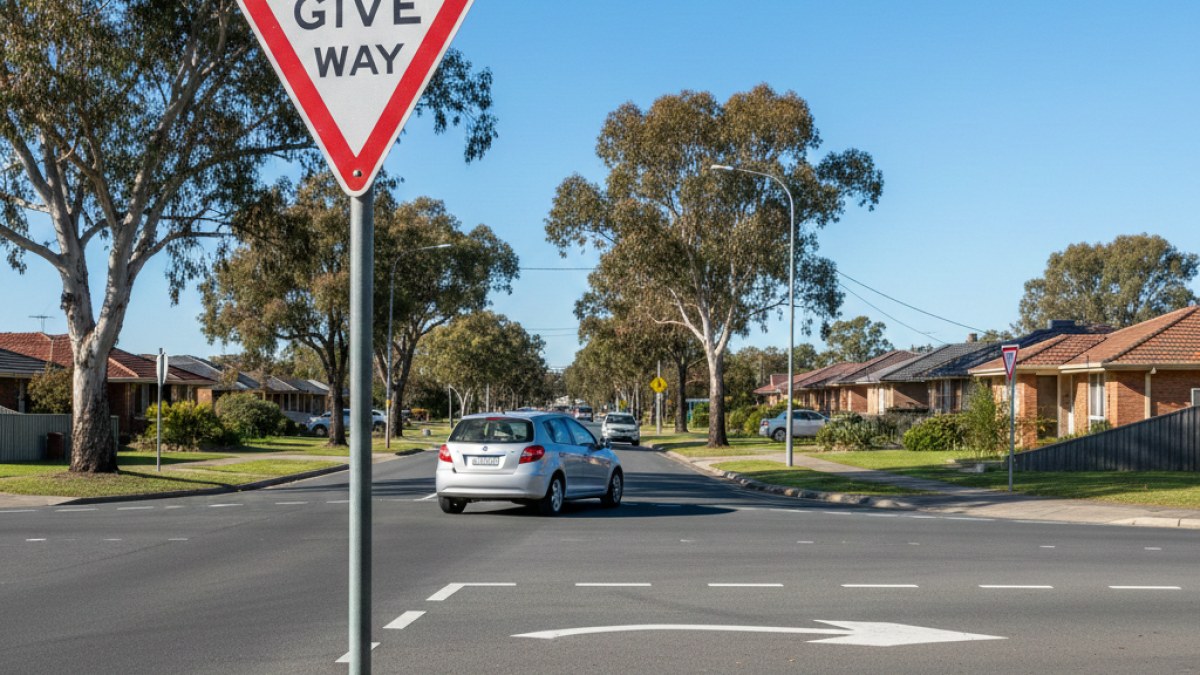
Give way errors are one of the top reasons people fail the Australian driving test, and one of the most common causes of crashes on Australian roads. The rules are consistent across all states, but they apply in more situations than most learners expect.
This guide covers every give way scenario you'll face during a driving test and in everyday driving, with the specific situations that catch people out.
The Core Give Way Rules
These are the building blocks. Every other give way situation is a variation of these five rules.
1. Give Way Signs
A red-and-white inverted triangle. You must slow down and be prepared to stop. Give way to all vehicles and pedestrians that have right of way. You don't have to stop if the way is clear, but you must be travelling slowly enough that you can stop if needed.
2. Stop Signs
An octagonal red sign. You must come to a complete stop, wheels not moving, behind the white stop line. If you can't see clearly from the stop line, stop there first, then creep forward until you can see. Proceed only when safe.
The difference between stop and give way: at a stop sign, you must stop even if nothing is coming. At a give way sign, you can proceed without stopping if the way is clear.
Driving test trap: A "rolling stop", slowing almost to a stop but not quite, is one of the most common test failures. If you're in doubt about whether you stopped, you didn't. Count "one thousand and one" after stopping.
3. Roundabouts
Give way to all vehicles already in the roundabout. In practice, most vehicles you need to yield to will approach from your right (since Australian roundabouts flow clockwise), but the rule is broader: give way to anyone already circulating, regardless of where they entered.
4. Turning Vehicles
When turning right, give way to oncoming vehicles going straight or turning left. This applies at intersections, driveways, and anywhere you're crossing the path of oncoming traffic.
When turning left or right into a road, give way to pedestrians crossing that road.
5. Uncontrolled Intersections
At an intersection with no signs, signals, or markings: give way to any vehicle approaching from your right. If two vehicles arrive at the same time from different directions, the one on the left gives way to the one on the right.
Intersection Scenarios
T-Intersection
The vehicle on the terminating road (the stem of the T) must give way to all traffic on the continuing road (the top of the T), whether turning left or right.
If both roads are equal (no clear continuing road), the standard rule applies: give way to the right.
Cross Intersection with No Signs
Give way to the right. If you arrive at the same time as a vehicle on your right, you wait. If you arrive at the same time as a vehicle on your left, you go first (they give way to you).
Cross Intersection with Opposing Traffic
If you're turning right and an oncoming vehicle is going straight or turning left, you wait. The oncoming vehicle has priority. This is one of the most tested scenarios on the driving test.
Slip Lanes (Left Turn Lanes)
Some intersections have a dedicated left-turn lane separated by a traffic island. When using a slip lane:
- Give way to pedestrians crossing the slip lane
- Give way to vehicles on the road you're joining
- Give way to vehicles approaching from the right on the roundabout (if the slip lane feeds into a roundabout)
Slip lanes often have their own give way sign. Don't assume you have a free run, check for pedestrians and traffic before merging.
Merging
Marked Lanes (Dotted Lines)
If your lane ends and you need to move into an adjacent lane: give way to vehicles already in that lane. Signal, check mirrors and blind spots, and merge when safe.
Unmarked Merging (Two Lanes Become One)
When two lanes merge into one and there are no lane markings: the vehicle that is ahead goes first. If you're side by side, the vehicle in the left lane has priority.
This is the "zipper merge" principle, in practice, vehicles alternate. But on the test, show that you're aware of who has priority and merge smoothly without forcing anyone to brake.
Entering a Freeway
Give way to all vehicles on the freeway. Use the acceleration lane to match the speed of traffic, check mirrors and blind spots, and merge when there's a safe gap. Don't stop on the acceleration lane unless traffic ahead has stopped.
Pedestrian Give Way Rules
Pedestrians have more right of way in Australia than many drivers expect.
At Marked Crossings
- Zebra crossings (no lights): You must give way to any pedestrian on or approaching the crossing
- Signalised crossings: Follow the lights, but even on green, check for pedestrians still clearing the crossing
- Children's crossings: When the flags are displayed, you must stop and remain stopped until all pedestrians have cleared the crossing and the flags are removed
When Turning
When turning left or right at any intersection, you must give way to pedestrians crossing the road you're turning into. This includes:
- Signalised intersections (even if you have a green light)
- Unsignalised intersections
- Driveways
This rule catches many drivers. You have a green light, you're turning left, and a pedestrian steps onto the road you're entering. You must stop and wait.
Shared Zones
Speed limit 10 km/h. Pedestrians have right of way everywhere in a shared zone. You must give way to all pedestrians at all times.
Trams (Melbourne)
Melbourne has specific give way rules for trams that don't exist anywhere else in Australia:
Tram Stops
When a tram stops and its doors open, you must stop behind the tram (or at the yellow line if marked) and wait until the doors close and pedestrians have cleared the road. You cannot pass a stopped tram with its doors open.
Hook Turns
At marked intersections in Melbourne CBD, you must turn right from the left lane. This is to keep the right lane clear for trams. When you see a "Right Turn from Left Lane Only" sign:
- Move into the far left lane
- Enter the intersection and stop just before the far side road (you'll be in the path of the left-turning traffic)
- Wait until the road you're turning into gets a green light
- Complete your right turn
Hook turns are unique to Melbourne at this scale. If you're testing in Melbourne, practice them specifically.
Emergency Vehicles
When you hear or see an emergency vehicle (sirens, flashing lights):
- Move to the left and stop if safe to do so
- If you can't move left safely, slow down and let them pass
- At intersections, do not enter until the emergency vehicle has passed
- Never follow within 200 metres of a fire truck responding to an alarm
On multi-lane roads, create a gap by moving left. On single-lane roads, pull over to the left and stop.
Give Way at Driveways
When crossing a footpath to enter or leave a driveway, give way to all pedestrians and cyclists on the footpath. This applies to residential driveways, shopping centre entrances, car park exits, everywhere.
Common Give Way Mistakes on the Driving Test
1. Rolling Through Stop Signs
The single most preventable error. Stop means stop. Wheels stationary. Wait, look, then go.
2. Not Giving Way When Turning Right
Turning right into oncoming traffic that has priority. Even if the gap looks big enough, if the oncoming vehicle has to slow down because of your turn, you've made an error.
3. Entering a Roundabout Too Early
Forcing a vehicle already in the roundabout to adjust their speed or position. If you have to rush, you're too late.
4. Forgetting Pedestrians When Turning
Green light, turning left, pedestrian on the road you're entering. Many candidates forget this give way obligation.
5. Merging Without Checking
Changing lanes or merging without checking mirrors and blind spots. Even if you give way correctly, not checking makes it unsafe.
6. Hesitating Too Long
The opposite mistake: being so cautious that you miss safe opportunities to proceed, holding up traffic behind you. Confidence matters, once you've determined it's safe, go decisively.
State-Specific Notes
Give way rules are consistent across Australia (they come from the Australian Road Rules, adopted by all states). The main differences are in enforcement and test emphasis:
- VIC: Give way at roundabouts is the #1 test failure in Victoria. Melbourne tram give way rules are unique.
- NSW: Merging and gap selection are heavily tested. 120 hours of logbook practice means examiners expect confident give way decisions.
- QLD: Observation errors (which includes checking before giving way) account for 36.5% of all recorded test errors.
- WA: The WA practical driving assessment (PDA) runs 45-50 minutes, longer than most states, giving examiners more time to test give way scenarios.
- SA: School zone give way rules include a 25 km/h limit (other states use 40 km/h), and violating school zone rules is a common fail.
- ACT: Canberra's roundabout-heavy design means you'll face many give way decisions in quick succession.
Practice Tips
-
Start with quiet intersections. Practice approaching give way signs, stop signs, and roundabouts with minimal traffic until the procedure is automatic.
-
Talk through your decisions. "Give way sign, slow down, checking right, checking left, clear, proceeding." This builds the habit of systematic checking.
-
Practice at busy times too. Give way decisions at a quiet Sunday morning intersection are very different from rush hour. You need experience with both.
-
Drive your test centre routes. The intersections near your test centre have specific give way scenarios that come up repeatedly. Learning them in advance takes the guesswork out of test day. AUDrive maps the actual routes used during driving tests, use them to practise the give way scenarios you'll face.
Quick Reference
| Situation | Who Gives Way |
|---|---|
| Stop sign | You stop, then give way to all traffic with priority |
| Give way sign | You give way (stop if needed) to all traffic with priority |
| Roundabout | Give way to vehicles already circulating |
| Turning right | Give way to oncoming traffic |
| T-junction (stem) | Give way to traffic on the continuing road |
| No signs, no markings | Give way to the right |
| Merging (your lane ends) | Give way to vehicles in the lane you're entering |
| Turning at any intersection | Give way to pedestrians crossing the road you're entering |
| Tram with doors open | Stop and wait (Melbourne) |
| Emergency vehicle | Move left, stop if safe |
Get these right, and you've eliminated one of the biggest sources of errors on the Australian driving test.
Frequently Asked Questions
What is the difference between a stop sign and a give way sign?
At a stop sign, you must come to a complete stop even if nothing is coming. At a give way sign, you can proceed without stopping if the way is clear, but you must be travelling slowly enough to stop if needed.
Who has right of way at a roundabout?
Give way to all vehicles already in the roundabout. In practice, most vehicles you need to yield to will approach from your right, since Australian roundabouts flow clockwise.
Do I have to give way to pedestrians when turning?
Yes. When turning left or right at any intersection, you must give way to pedestrians crossing the road you are turning into. This applies even when you have a green light.
What are the give way rules at a T-intersection?
The vehicle on the terminating road (the stem of the T) must give way to all traffic on the continuing road. If both roads are equal, the standard rule applies: give way to the right.
What is a hook turn?
A hook turn is a right turn made from the left lane. It is used at marked intersections in Melbourne CBD to keep the right lane clear for trams. You move to the far left lane, enter the intersection, wait for the cross road to get a green, then complete your right turn.
Related Guides
- Common Driving Test Fails in Australia: Give way errors are a top fail reason. See the full list of common mistakes.
- Head Check and Mirror Technique Guide: Observation and mirror habits are scored alongside give way decisions.