Glasgow (Shieldhall) DVSA Driving Test Routes
Book Test-
Free
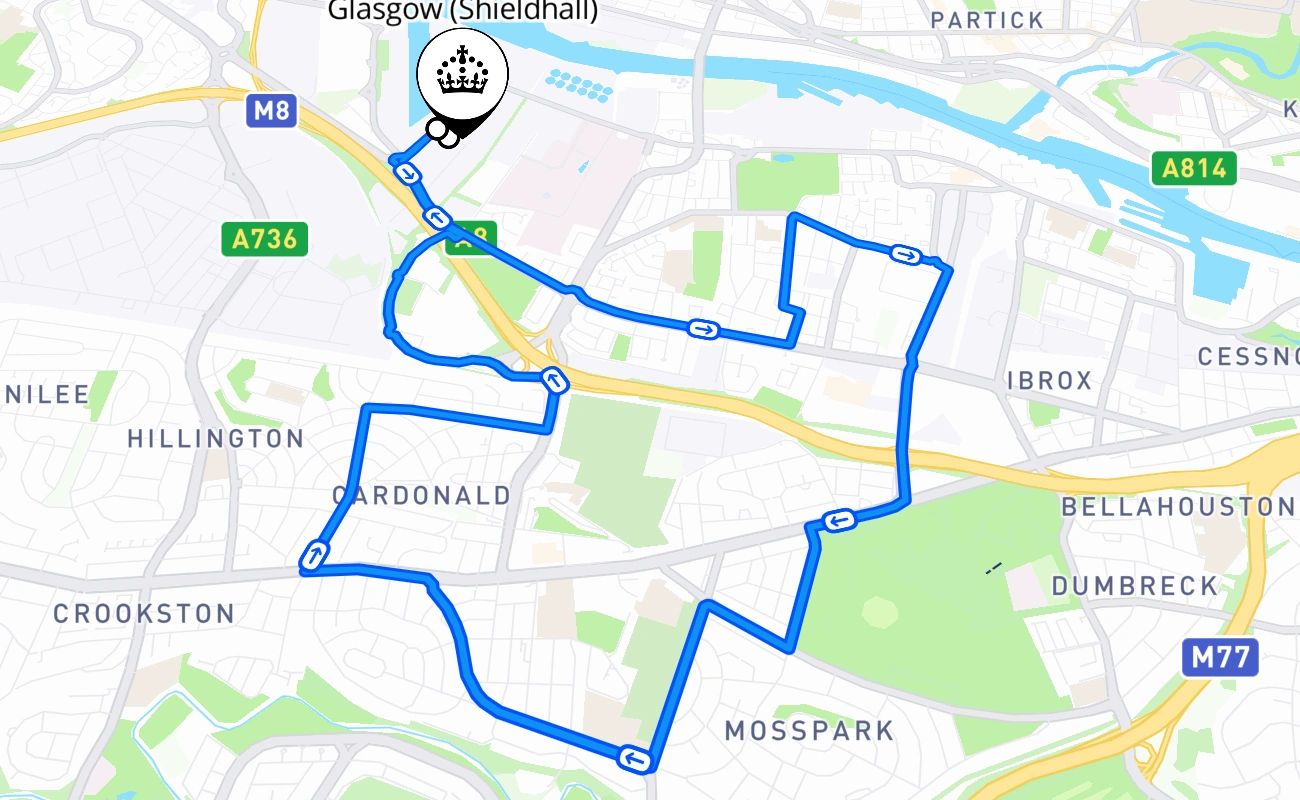
Glasgow (Shieldhall) (SCT) #605
 AUDrive 18 Jun 20241.3K
 -
Free
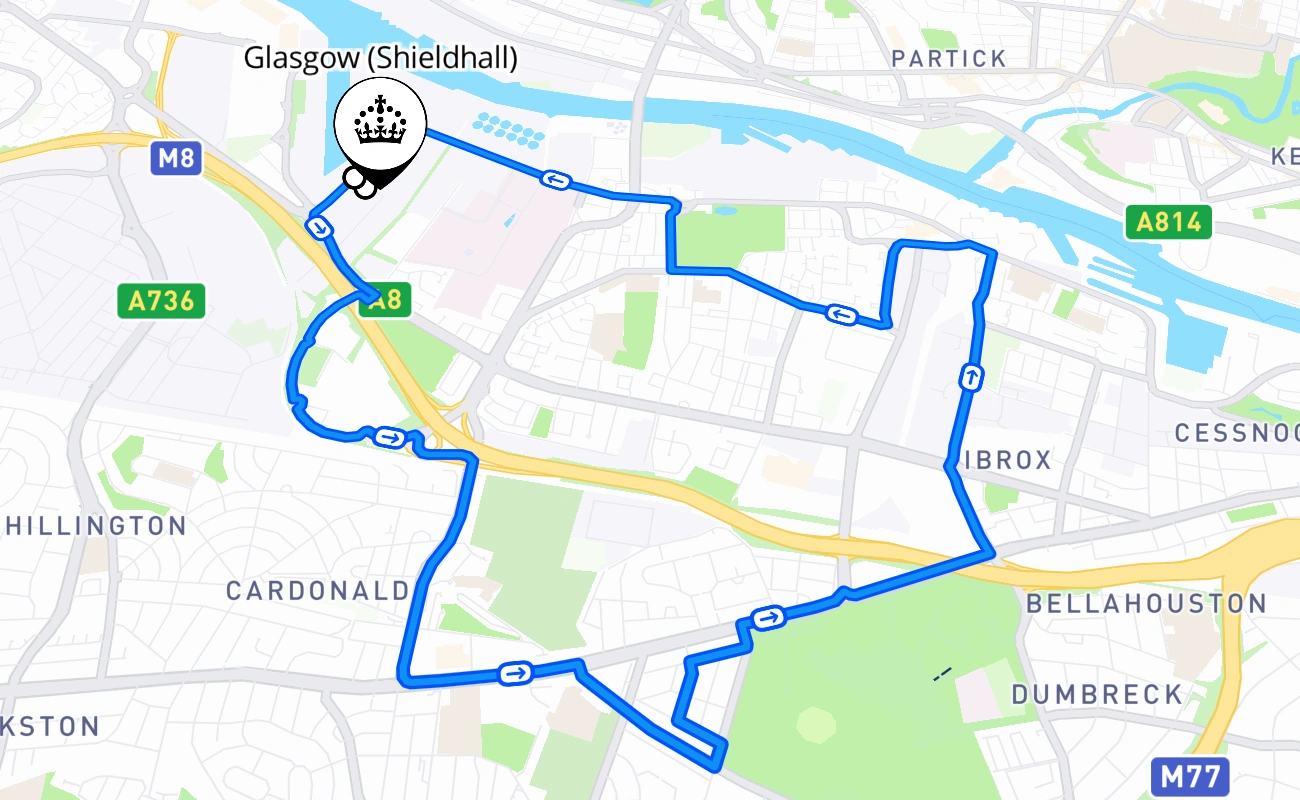
Glasgow (Shieldhall) (SCT) #606
AUDrive 18 Jun 20241K -
Pro
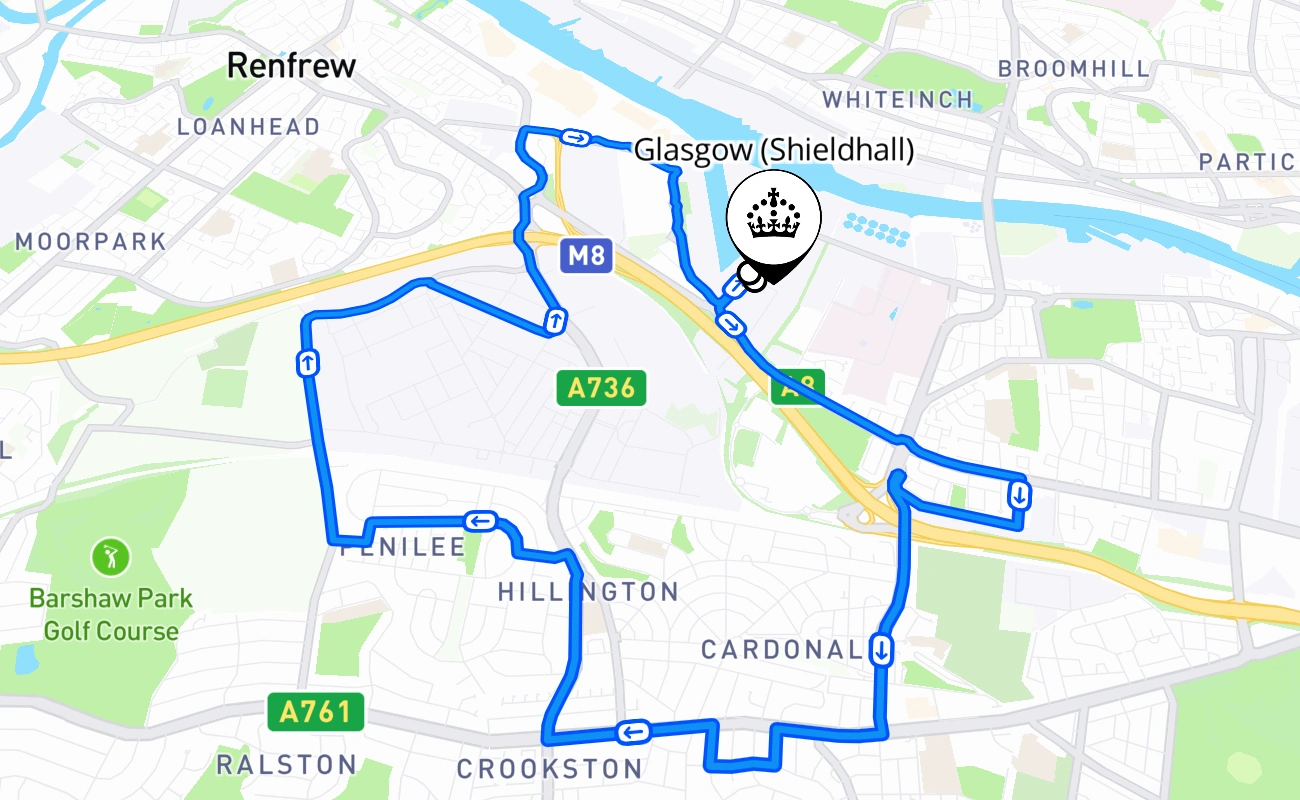
Glasgow (Shieldhall) (SCT) #603
AUDrive 18 Jun 2024940 -
Pro
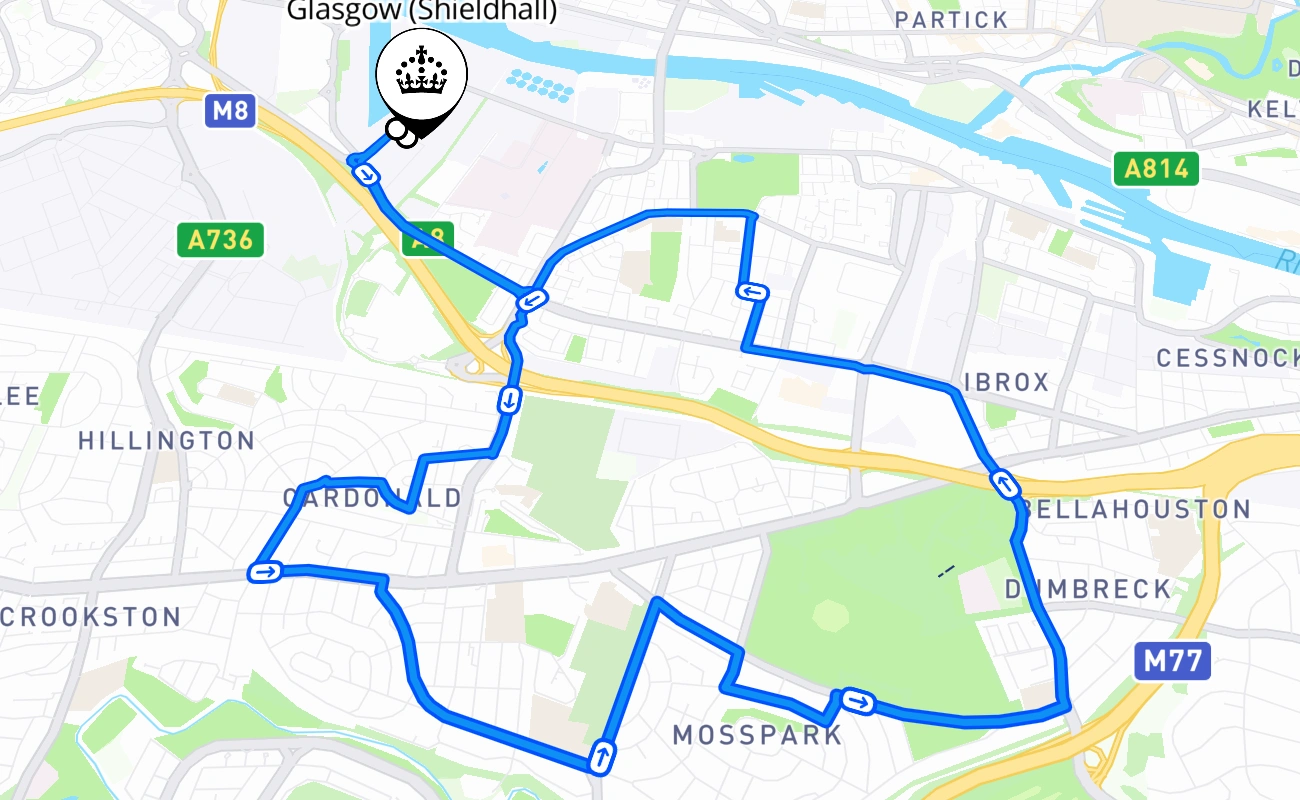
Glasgow (Shieldhall) (SCT) #601
AUDrive 18 Jun 2024943 -
Pro
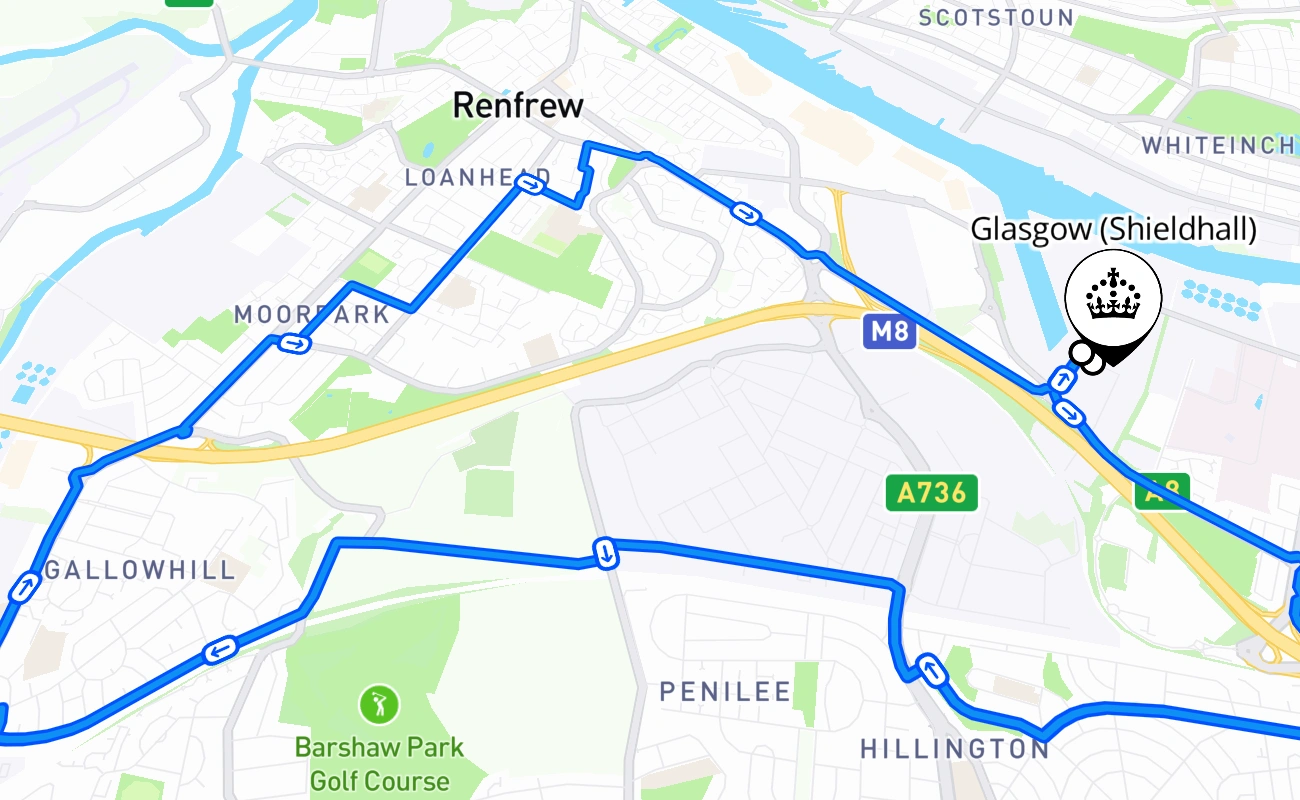
Glasgow (Shieldhall) (SCT) #600
AUDrive 18 Jun 2024977 -
Pro
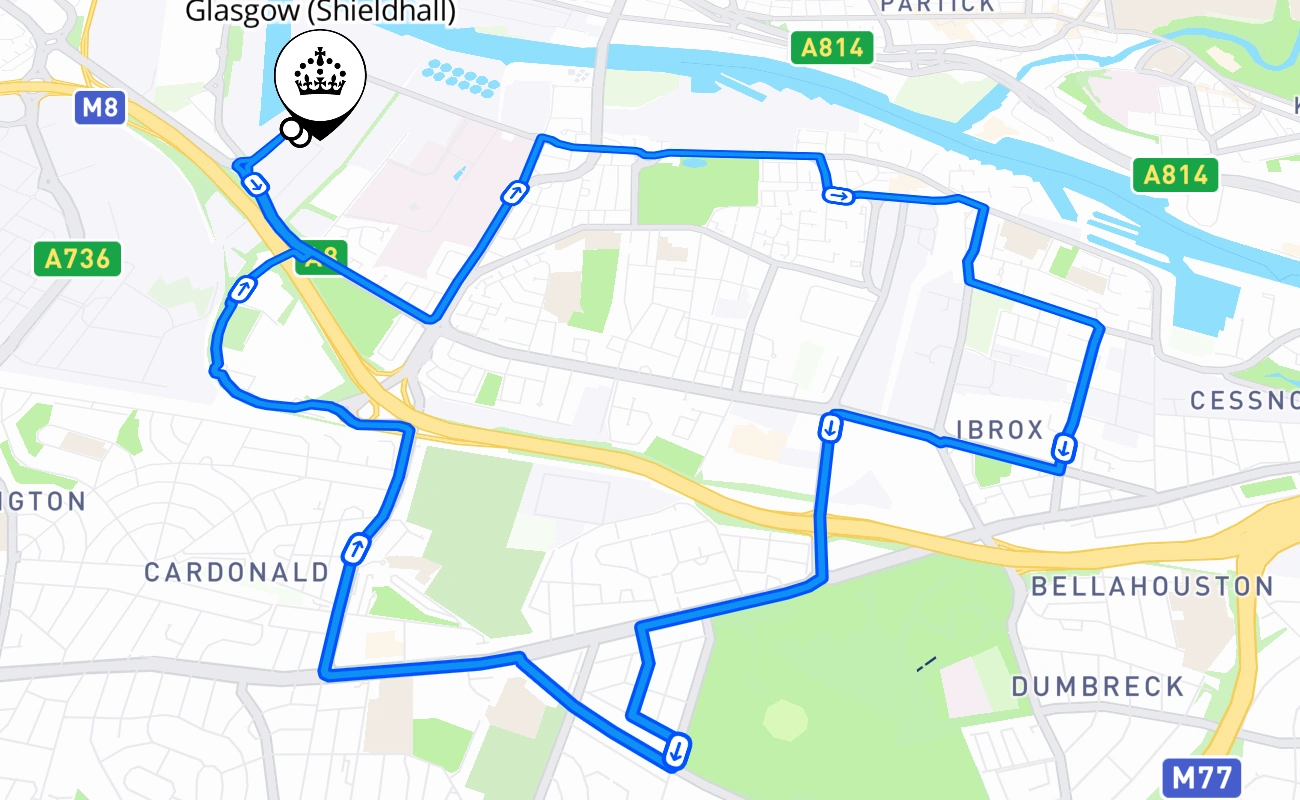
Glasgow (Shieldhall) (SCT) #598
AUDrive 18 Jun 2024915 -
Pro
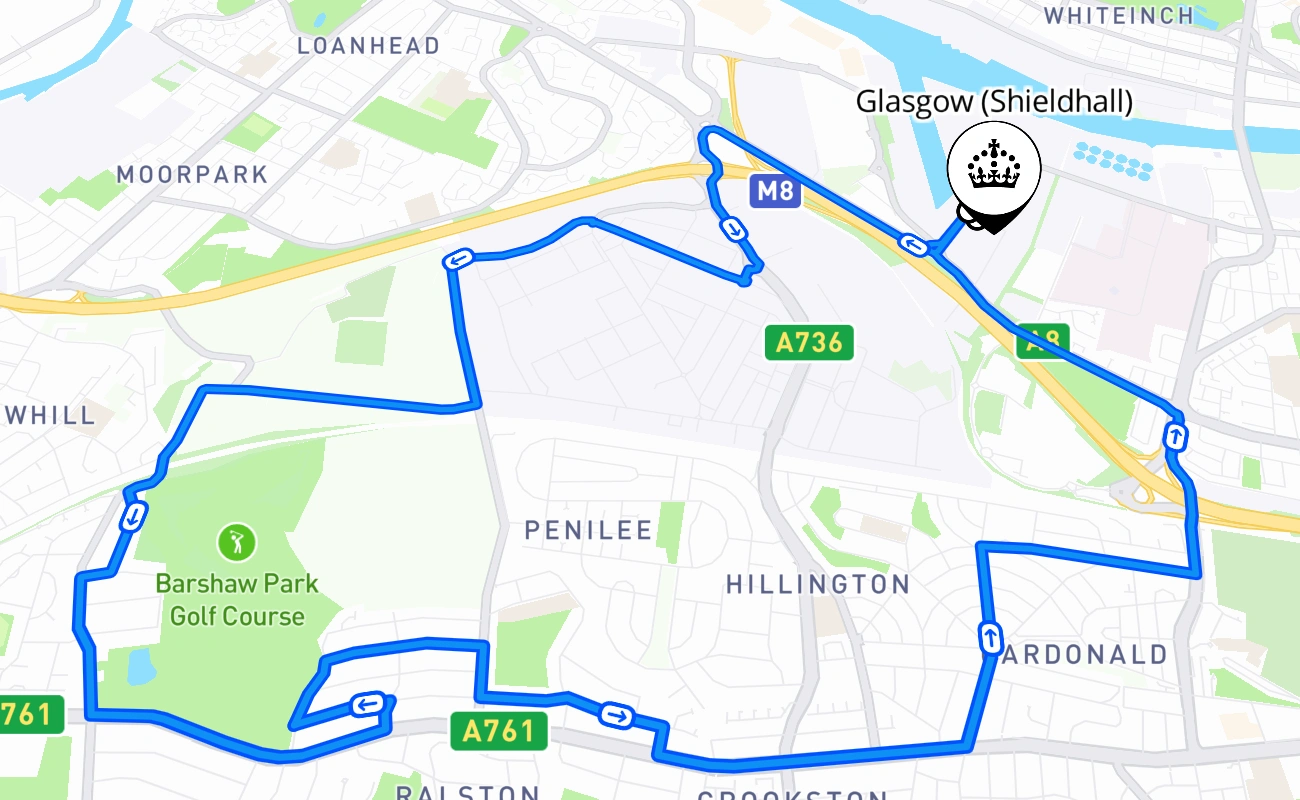
Glasgow (Shieldhall) (SCT) #597
AUDrive 18 Jun 2024772 -
Pro
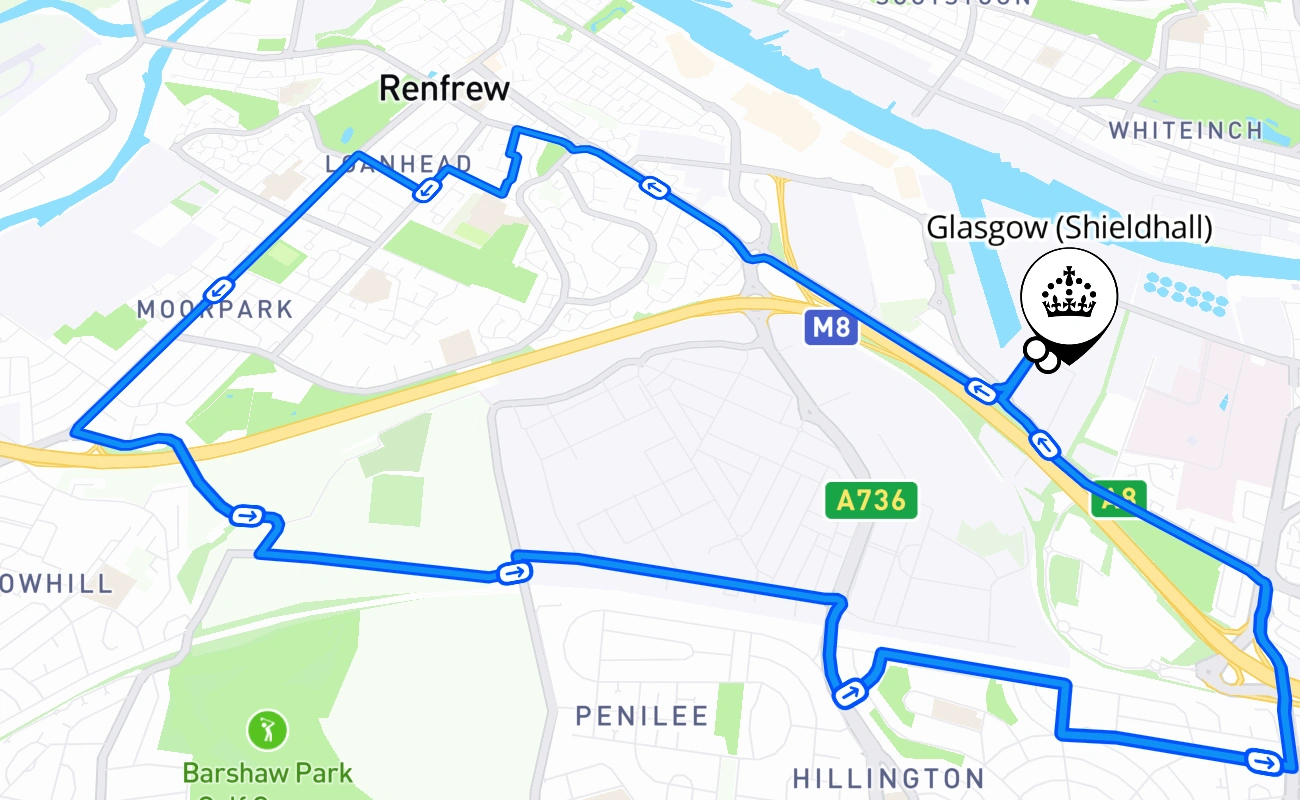
Glasgow (Shieldhall) (SCT) #596
AUDrive 18 Jun 2024869 -
Pro
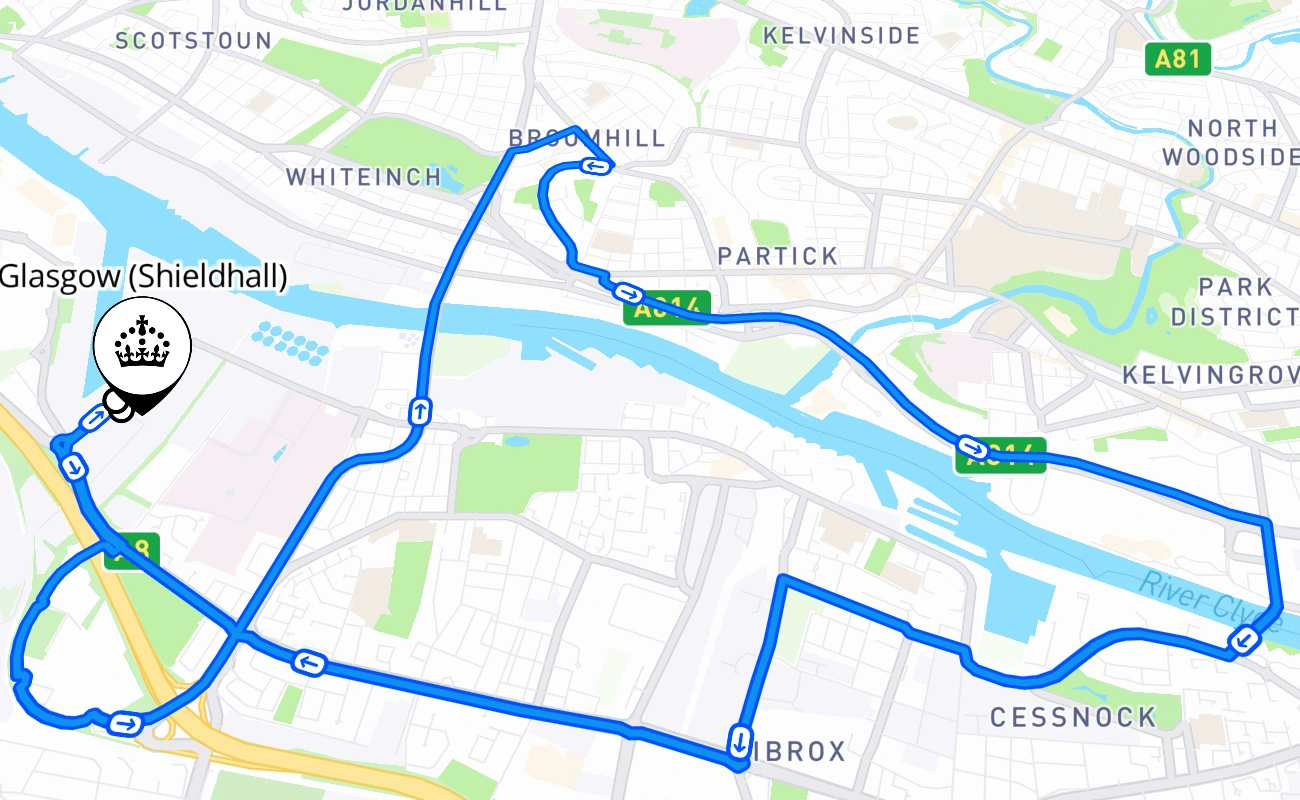
Glasgow (Shieldhall) (SCT) #595
AUDrive 18 Jun 2024934 -
Pro
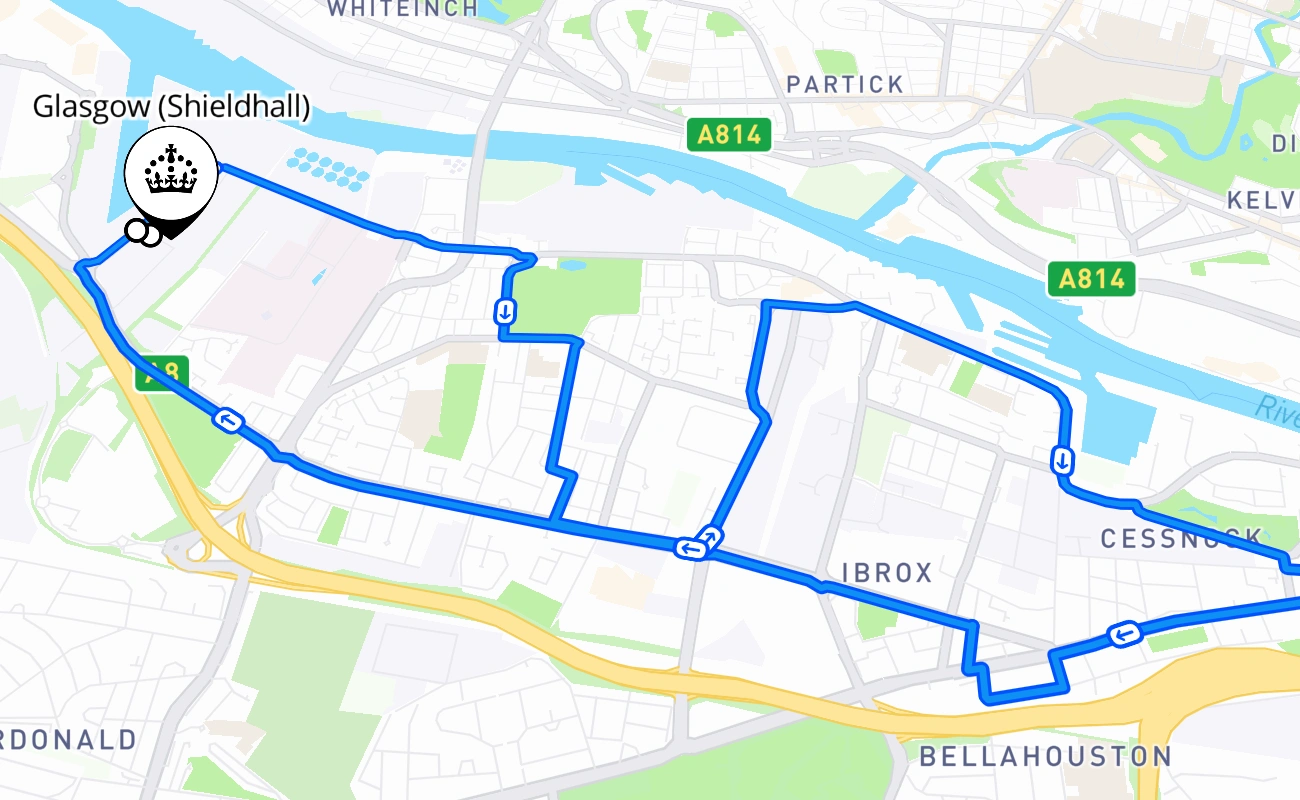
Glasgow (Shieldhall) (SCT) #609
AUDrive 17 Jun 2024763 -
Free
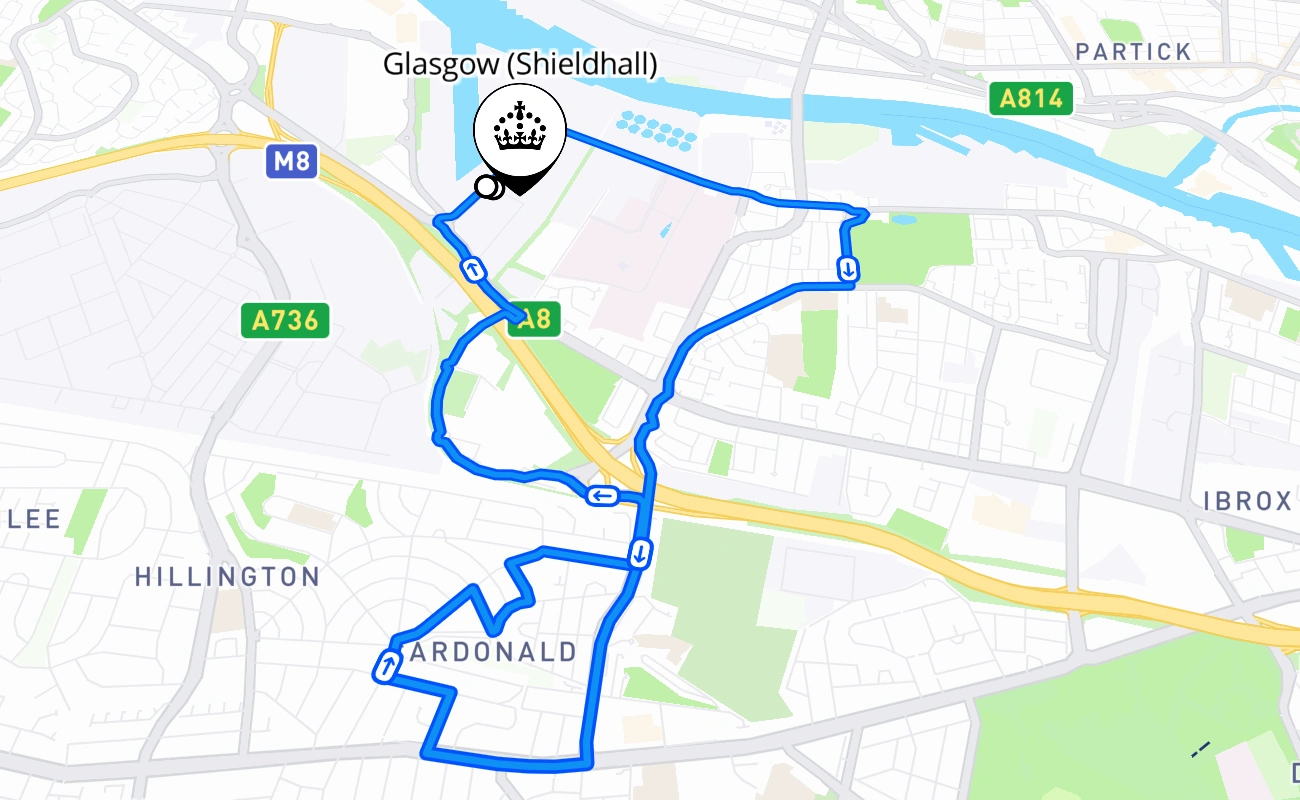
Glasgow (Shieldhall) (SCT) #608
AUDrive 17 Jun 2024796 -
Pro
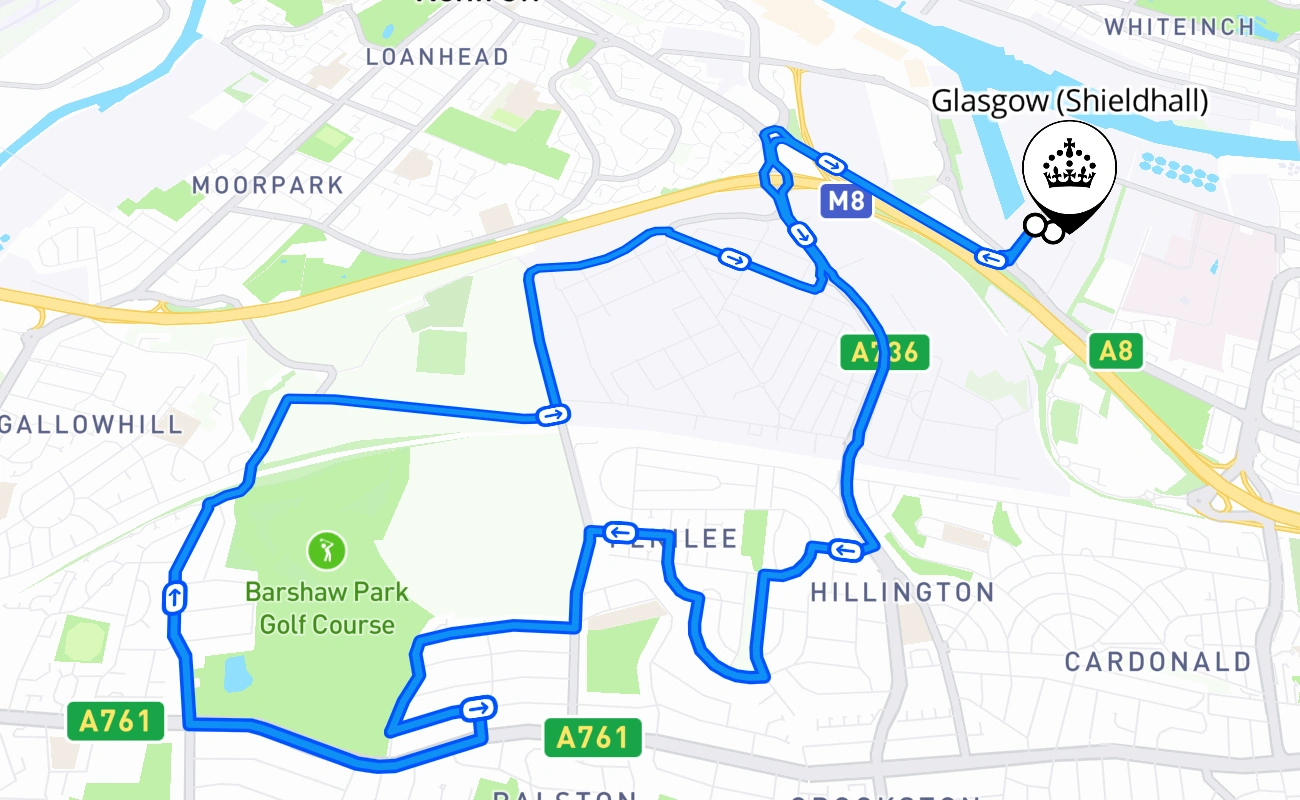
Glasgow (Shieldhall) (SCT) #607
AUDrive 17 Jun 2024841
General Tips
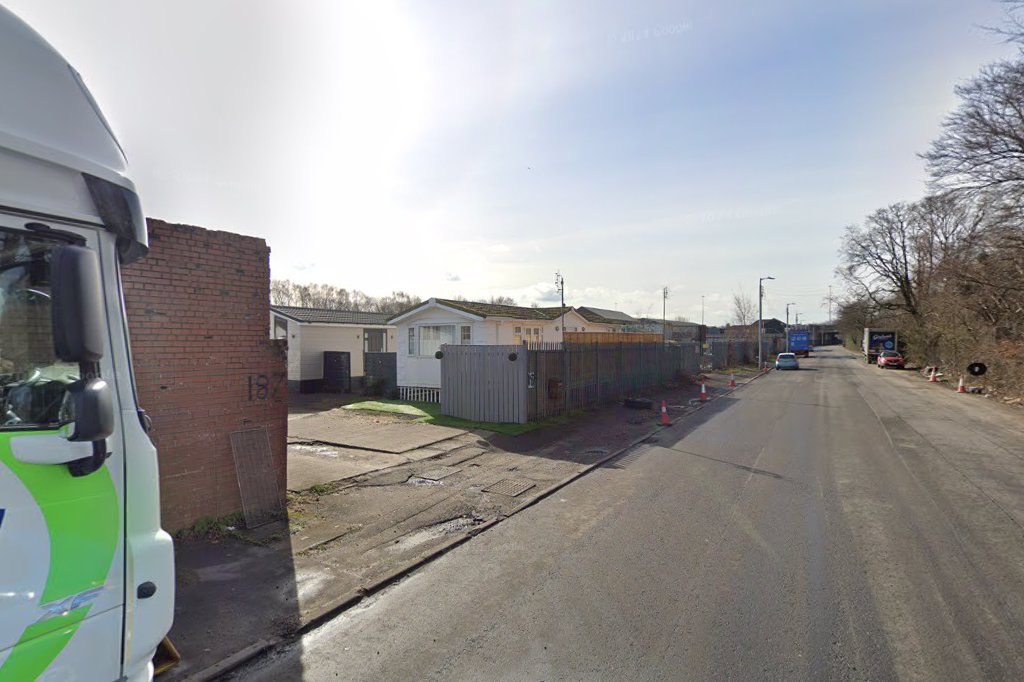
Typical Speed Limits Hillington Road and Paisley Road West carry 40 mph limits through industrial and commercial areas with speed cameras. Shieldhall Road and Renfrew Road are 30 mph. Clydeside Expressway sections reach 40 mph. Govan Road, Helen Street, and Broomloan Road near Ibrox Stadium are 30 mph. Residential estates in Penilee, Cardonald, Mosspark, and Craigton are 30 mph with 20 mph school zones near Mosspark, Govan Road, and Paisley Road West. Renfrew town centre drops to 20 mph.
Traffic Conditions Glasgow's south-side road network is busy with commuter and commercial traffic. Paisley Road West is a major arterial road with heavy bus traffic through Cardonald and Cessnock. The Clyde Tunnel approach carries fast-moving traffic. Hillington Road has speed camera zones and roundabouts. Renfrew town centre has narrow streets requiring careful navigation. Ibrox and Govan see increased traffic on match days at Ibrox Stadium. Penilee and Mosspark estates are quieter but have tight give-way junctions.
Key Features This centre covers a wide area from industrial Hillington to residential Mosspark and across to Govan and Ibrox. The Clyde Tunnel provides a unique tunnel-driving experience. Paisley Road West tests sustained driving on a busy arterial. Renfrew town centre navigation includes narrow streets and multiple give-way junctions. Fifty Pitches Road features roundabouts and give-way junctions in quick succession. Braehead shopping centre area tests navigation around King's Inch Drive. Multiple routes include U-turn manoeuvres.
Common Test Manoeuvres Pull up on the left is tested throughout the area, particularly on Bogmoor Road, Berryknowes Road, and Tweedsmuir Road. U-turns are conducted on Paisley Road West. Independent driving frequently routes through Hillington, Renfrew, or the Govan and Ibrox corridor. Bike lanes on Paisley Road West and near Kingsland Drive require cyclist awareness. Give-way junctions around Fifty Pitches Road and Corkerhill are key assessment areas.
Frequently Asked Questions
How difficult is the Glasgow (Shieldhall) driving test?
Glasgow (Shieldhall) is ranked as the hardest driving test centre in Scotland, with a pass rate of approximately 40.5% — well below the national average of 48%. The centre sits on Bogmoor Road in an industrial estate near the Clyde Tunnel and M8 Junction 25. Routes feature the Clyde Tunnel with its lighting changes and strict 30 mph limit, 50 mph flows on the A739, tight Govan dock-road gyratories, and busy multi-lane roundabouts. There are 30 route variations averaging 7.6 miles over 39 minutes, almost entirely urban driving.
What are the main test routes at Glasgow (Shieldhall) driving test centre?
All routes start from Bogmoor Road in the Shieldhall industrial estate. Key corridors include: Shieldhall Road with its roundabouts and hospital traffic from Queen Elizabeth University Hospital; the Clyde Tunnel (A739) requiring lane discipline through lighting changes; Renfrew Road for dual carriageway driving at 50 mph; Paisley Road West with shops, bus lanes, and signal-controlled junctions; Govan Road with mini-roundabouts and dock-road gyratories; Edmiston Drive near Ibrox Stadium; Hillington Road roundabouts; and residential areas through Penilee, Mosspark, and Cardonald with tight turns and parked cars.
What are the hardest parts of the Glasgow (Shieldhall) driving test?
The most challenging sections include: (1) Clyde Tunnel — candidates commonly drift to 40 mph due to the wide road and tunnel lighting; maintain 28 mph and watch lane arrows; (2) A739 Flyover — failing lane changes before weight restrictions; use mirror-signal-blend technique at 40 mph; (3) Govan Road consecutive mini-roundabouts — failing to give way the second time after clearing the first; pause and recheck right before each one; (4) Paisley Road West multi-hazard environment with bus lanes, parked cars, and pedestrians; and (5) Shieldhall Road roundabouts with heavy hospital and industrial traffic from QEUH.
What are common fail items at the Glasgow (Shieldhall) driving test?
Common reasons for failing at Shieldhall include: approaching roundabouts too quickly (especially Langlands Road and Meiklewood Road clusters), incorrect lane discipline in the Clyde Tunnel and on the A739, missed mirror checks during manoeuvres in Penilee and Mosspark residential areas, drifting above 30 mph in the tunnel, hesitation at Govan Road mini-roundabout sequences, poor awareness of cyclists on Govan Road and Shieldhall Road, wrong lane selection on the A814 Clydeside Expressway, and failing to adjust driving to tunnel lighting changes.
What is the best time to book the Glasgow (Shieldhall) driving test?
Book your Shieldhall test for mid-morning (10:00-11:30 AM), after the morning rush and before lunchtime. Avoid hospital shift-change times at Queen Elizabeth University Hospital which generates heavy traffic on Shieldhall Road. Check for Ibrox Stadium match days — Rangers home games cause severe congestion on Edmiston Drive and surrounding streets. The current average waiting time is approximately 23 weeks, one of the longest in Scotland, so consider cancellation services for earlier slots.
How do I handle the Clyde Tunnel during the Glasgow (Shieldhall) driving test?
The Clyde Tunnel is the signature challenge at Shieldhall. The speed limit is 30 mph, but the wide road and fluorescent lighting tempt candidates to drift to 40 mph — a serious fault. Engage cruise control or maintain 28 mph in 3rd gear as a buffer. Watch for lane arrows painted on the road surface. The lighting transition from daylight to tunnel and back can be disorienting — adjust your vision focus to the car ahead rather than the tunnel walls. Lane discipline is critical; examiners watch for drifting between lanes. Practice the tunnel approach from both directions at different times.
What speed zones should I watch for during the Glasgow (Shieldhall) driving test?
Shieldhall routes cover varied speeds in a compact urban area: 20 mph zones in residential Penilee and Mosspark, 30 mph on Govan Road, Shieldhall Road, and through the Clyde Tunnel, 40 mph on Helen Street and parts of Paisley Road West, and 50 mph on the A739 Renfrew Road dual carriageway. Speed changes happen rapidly — Edmiston Drive transitions between 30 and 40 mph depending on the section. On Eglinton Street and Cardonald Road, maintain strict 30 mph with pedestrian crossings throughout.
Where is the Glasgow (Shieldhall) driving test centre located?
Glasgow (Shieldhall) DVSA test centre is at Bogmoor Road, Shieldhall, Glasgow, G51 4TH, located inside an industrial estate near the Clyde Tunnel and M8 Junction 25. To reach it, exit M8 at J24 and take Paisley Road West then Bogmoor Road. Opening hours are Monday to Friday, 8:00 AM to 4:00 PM. There is no on-site parking, so arrive early to find street parking nearby. Male and female toilets are available; wheelchair access is by prior arrangement.
How does Glasgow (Shieldhall) compare to Edinburgh (Currie)?
Glasgow (Shieldhall) at 40.5% pass rate is significantly harder than edinburgh currie at 47.6%, and the wait is longer (23 weeks vs 19.9 weeks). Shieldhall is almost entirely urban with the unique Clyde Tunnel challenge, tight Govan gyratories, and heavy Glasgow traffic. Currie offers more variety with country roads and the A71 toward Balerno. Shieldhall is ranked the hardest centre in Scotland, while Currie sits close to the national average. If you can travel, Edinburgh may offer better odds of passing.
What manoeuvres are commonly tested at Glasgow (Shieldhall)?
At Shieldhall, parallel parking and bay parking are commonly tested in the quieter residential streets of Penilee, Mosspark, and Sandwood Road, where parked cars and tight turns are standard. Pull-up on the right may occur on wider residential streets off Hillington Road. The independent driving section typically follows a TomTom satnav through the Govan and Paisley Road West area or toward the Clyde Tunnel. Emergency stops may occur on Earl Haig Road or quieter sections of Cardonald.
Are there tips for the Govan Road mini-roundabouts at Glasgow (Shieldhall)?
The Govan Road mini-roundabout sequences are a common fail point. The key mistake is clearing the first roundabout and then driving straight through the second without re-checking for traffic from the right. Treat each mini-roundabout as a separate junction — pause, check right, then proceed. Keep your speed below 15 mph between consecutive roundabouts. Signal clearly even at mini-roundabouts, and be especially aware of cyclists who may not follow roundabout rules in the dock-road area.
What is the process to get a full UK driving licence?
The process has three main steps: (1) Apply for a provisional driving licence at age 17+ (costs GBP 34 online or GBP 43 by post). (2) Pass the theory test, which consists of 50 multiple-choice questions and 14 hazard perception video clips (costs GBP 23). (3) Pass the practical driving test, approximately 40 minutes of on-road assessment (costs GBP 62 weekday or GBP 75 evenings/weekends/bank holidays). Once you pass the practical test, your full licence is issued. There is no mandatory minimum hours of supervised driving, unlike Australia.
How do I book my practical driving test?
You can book your practical driving test online at gov.uk/book-driving-test or by phone on 0300 200 1122. You will need your provisional licence number, theory test pass certificate number, and your driving instructor's personal reference number (if applicable). You must have passed the theory test before you can book the practical test. Waiting times at popular test centres can be several months, so book as early as possible.
How long are the waiting times for a driving test?
Waiting times vary significantly by test centre and region. Popular urban centres (e.g., London, Birmingham, Manchester) can have waiting times of 3-6 months or more. Less popular or rural centres may have shorter waits of 4-8 weeks. Many learners regularly check for cancellation slots to get an earlier date. DVSA is introducing new booking rules from 31 March 2026 that may affect how cancellation slots are managed.
How can I find an earlier test date through cancellations?
You can check for cancellation slots by logging into your booking account on gov.uk and looking for earlier available dates. Many learners check frequently throughout the day as slots become available when others cancel. There are also third-party apps and services that monitor for cancellations and send alerts, though DVSA's new rules from March 2026 may restrict some of these services. Always use your own DVSA account details to book - never share them with third parties.
How much does it cost in total to get a UK driving licence?
The minimum official costs are: Provisional licence GBP 34 (online), Theory test GBP 23, Practical test GBP 62 (weekday) = Total GBP 119. However, most learners also pay for driving lessons with an ADI (Approved Driving Instructor) at approximately GBP 30-45 per hour. The average learner takes around 45 hours of professional instruction plus 22 hours of private practice before passing. Total cost including lessons typically ranges from GBP 1,500 to GBP 2,500.
What does the theory test involve?
The theory test has two parts taken in one sitting: (1) Multiple-choice: 50 questions with a 57-minute time limit. You need 43 out of 50 to pass. Topics include road safety, traffic signs, rules of the road, and vehicle handling. (2) Hazard perception: 14 video clips showing real driving scenarios. You must identify developing hazards by clicking at the right time. One clip has two hazards, the rest have one each. Pass mark is 44 out of 75. The theory test certificate is valid for 2 years - you must pass your practical test within this period.
What happens during the practical driving test?
The practical test lasts approximately 40 minutes and includes: (1) An eyesight check - read a number plate from 20 metres. (2) Two 'Show me, tell me' vehicle safety questions. (3) General driving for about 20 minutes following the examiner's directions. (4) Independent driving for about 20 minutes, usually following a satnav provided by the examiner. (5) One reversing manoeuvre (parallel park, bay parking, or pull up on the right). (6) Possibly an emergency stop (about 1 in 3 tests). You may accumulate up to 15 minor faults and still pass, but any serious or dangerous fault means an immediate fail.
What are 'Show me, tell me' questions?
These are vehicle safety questions asked during the practical test. A 'tell me' question is asked before you start driving - you answer verbally (e.g., 'Tell me how you would check the brakes are working'). A 'show me' question is asked while you are driving - you must demonstrate the action (e.g., 'Show me how you would wash and clean the rear windscreen'). There are 19 possible questions in total, published on gov.uk. Getting one or both wrong counts as one minor fault each. They will not cause you to fail on their own.
How does the independent driving section work?
Independent driving lasts about 20 minutes of your test. In most tests, you follow directions from a satnav (a TomTom unit provided by the examiner - not your own device). In some tests, you follow road signs instead. The key point is that you are NOT assessed on your navigation ability. If you take a wrong turn or miss a direction, the examiner will calmly redirect you, and you will not be marked down for the navigation error. You ARE assessed on your driving quality during this section - observations, signals, speed, and road positioning all count.
What is the pass rate for the UK driving test?
According to DVSA official statistics, the national average pass rate was 48.4% in 2023/24 (47.0% in Q4, 48.9% in Q1 2025). This is significantly lower than most Australian states (typically 65-80%). Males pass at 48.2% vs females at 45.6%. Pass rates vary dramatically by test centre, ranging from around 30% (inner London) to 65% (rural areas like Dorchester). Within London alone, Sidcup has 57.2% while Belvedere has only 34.9%. The low pass rate is attributed to the UK's complex road network, strict marking standards, and no mandatory minimum hours of practice.
What are the most common reasons for failing the practical test?
According to DVSA statistics, the #1 serious fault is Junctions—Observation (not looking properly before emerging). Other top faults: (2) Mirrors—not checking before changing direction or speed. (3) Steering control issues. (4) Road positioning, especially at roundabouts and dual carriageways. (5) Inappropriate speed for conditions. (6) Not responding to traffic signals or signs. (7) Reversing manoeuvre errors. The average pass candidate has 5.3 minor faults; the average fail has 9.7. Even a single serious or dangerous fault means immediate fail, regardless of how well you drove otherwise.
What happens if I fail the practical test?
If you fail, you will receive a test result form showing all faults marked during the test, categorised as minor, serious, or dangerous. You must wait at least 10 working days before taking the test again. There is no limit to the number of times you can retake the practical test, but you must pay the full fee each time (GBP 62 weekday / GBP 75 evenings/weekends). Your theory test must still be valid (within 2 years of passing). Use the fault feedback to focus your practice before rebooking.
Can I exchange my overseas driving licence for a UK licence?
It depends on which country issued your licence. Licences from 'designated countries' (most EU/EEA countries and select others like Australia, Canada, Japan, South Korea) can be exchanged directly for a UK licence for GBP 43 without taking any tests. For non-designated countries (including China), you must apply for a provisional licence, pass the theory test, and pass the practical test - the full process. You can drive on your overseas licence for up to 12 months after becoming a UK resident, but must obtain a UK licence within that period.
I have a Chinese driving licence - what do I need to do?
China is not on the UK's designated countries list, so you cannot directly exchange your Chinese licence. You must: (1) Apply for a UK provisional driving licence (GBP 34 online). (2) Pass the UK theory test (GBP 23). (3) Pass the UK practical driving test (GBP 62-75). You may drive on your Chinese licence for up to 12 months after becoming a UK resident. After 12 months, you must have a UK licence to drive legally. Many Chinese learners find the roundabouts, right-of-way rules, and mirror checking standards different from China.
Do I need a certain number of practice hours before taking the test?
No, the UK has no mandatory minimum hours of supervised driving practice, unlike Australia. However, DVSA recommends an average of 45 hours of professional instruction with an ADI (Approved Driving Instructor) combined with 22 hours of private practice before taking the test. Candidates who take lessons with an ADI-approved instructor generally have higher pass rates. You can also learn with a friend or family member who is over 21 and has held a full UK licence for at least 3 years.
What is an ADI and do I need one?
An ADI is an Approved Driving Instructor - someone who has passed DVSA's rigorous three-part qualification process and is registered to give paid driving lessons. Their car will display a green octagonal badge. While not legally required, taking lessons with an ADI is strongly recommended as they know the test standards, local test routes, and common fault areas. A PDI (Potential Driving Instructor) displaying a pink badge is a trainee instructor who has passed part of the qualification. Both can provide quality instruction.
What are the 2026 changes to driving test booking rules?
DVSA is implementing new booking rules effective 31 March 2026. These changes aim to address the chronic test availability problems, long waiting times, and the impact of automated booking bots and commercial resellers who bulk-buy and resell test slots. The new rules introduce restrictions on booking frequency and cancellation/rebooking patterns. Learners should check gov.uk/book-driving-test for the latest information. These changes may affect third-party cancellation-monitoring services that many learners rely on to find earlier test dates.
What should I do on the day of my practical test?
On test day: (1) Bring your provisional driving licence (photocard). (2) Arrive at the test centre at least 10 minutes early. (3) Your car must be roadworthy, properly insured for a driving test, and have L-plates (or D-plates in Wales) displayed front and rear. (4) The examiner will check your eyesight first - if you fail this, the test is terminated. (5) Stay calm during 'Show me, tell me' questions. (6) Drive normally as you have been taught. (7) Minor mistakes are expected - do not let one error affect your concentration for the rest of the test. (8) If you are unsure about a satnav direction, drive safely and the examiner will redirect you.
Is the UK practical test the same in England, Scotland, and Wales?
Yes, the practical driving test is standardised across England, Scotland, and Wales as all three are governed by DVSA. The same test format, marking criteria, and pass standards apply everywhere. The only notable difference is that in Wales, you may request to take the test in Welsh, and D-plates (Dysgwr, meaning learner) can be used instead of L-plates. Northern Ireland has its own DVA (Driver & Vehicle Agency) with a separate test system and is not covered by DVSA standards.
What tips do experienced learners recommend for passing first time?
Common advice from successful candidates: (1) Take enough lessons - do not rush to book the test to save money, as retakes cost more in the long run. (2) Practice in the area around your test centre to become familiar with the roads. (3) Master roundabouts thoroughly - they are a major source of faults. (4) Develop a consistent mirror-checking routine (interior mirror, door mirror, signal, manoeuvre). (5) Practice the independent driving section with a satnav. (6) Take at least one mock test with your instructor. (7) On the day, treat it as just another driving lesson. (8) If you make a mistake, move on mentally - one minor fault does not fail you.

Office discussion
No comments yet
Share how your practice went. It helps the next learner.