Auckland has the lowest restricted licence pass rates in New Zealand. The regional average sits around 49%, meaning more than half of candidates fail on their first attempt. But the gap between individual centres is huge. At Highbrook, 59% of candidates pass. At Saturn Place in Albany, only 40% do.
That 19-percentage-point gap means your choice of test centre matters. This guide breaks down the official data for all 13 Auckland centres so you can make an informed decision.
All Auckland Centres Ranked by Pass Rate
This data comes from NZTA via Official Information Act requests (2022). All Auckland centres are operated by VTNZ.
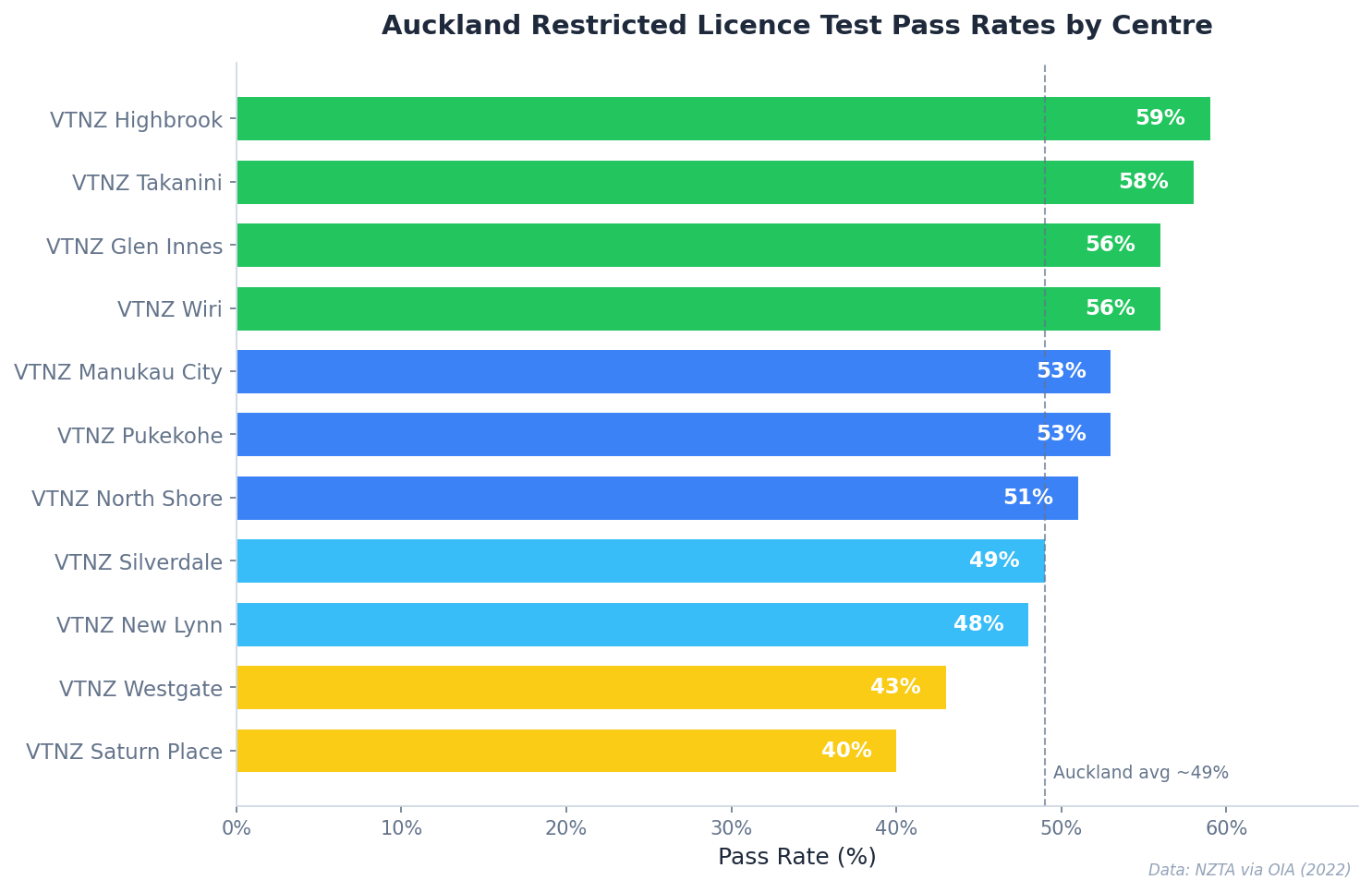
Auckland restricted licence pass rates by centre (2025 Waka Kotahi data, regional average)
| Rank | Centre | Pass Rate | Suburb | Area |
|---|---|---|---|---|
| 1 | VTNZ Highbrook | 59% | Highbrook | East Auckland |
| 2 | VTNZ Takanini | 58% | Takanini | South Auckland |
| 3 | VTNZ Glen Innes | 56% | Glen Innes | East Auckland |
| 3 | VTNZ Wiri | 56% | Wiri | South Auckland |
| 5 | VTNZ Manukau City | 53% | Manukau | South Auckland |
| 5 | VTNZ Pukekohe | 53% | Pukekohe | Far South |
| 7 | VTNZ North Shore | 51% | Glenfield | North Shore |
| 8 | VTNZ Silverdale | 49% | Silverdale | North Auckland |
| 9 | VTNZ New Lynn | 48% | New Lynn | West Auckland |
| 10 | VTNZ Westgate | 43% | Westgate | West Auckland |
| 11 | VTNZ Saturn Place | 40% | Rosedale (Albany) | North Shore |
| - | VTNZ Sylvia Park | No data | Mt Wellington | Central-East |
| - | VTNZ Warkworth | No data | Warkworth | Far North |
The pattern is clear: east Auckland centres outperform the rest, while west Auckland and one North Shore centre (Saturn Place) have the toughest numbers.
Top 3 Centres
VTNZ Highbrook (59%)
Highbrook sits in a business park area in east Auckland. The roads are wide, well-marked, and designed for commercial traffic, which means clear lane markings, good signage, and relatively predictable traffic flow. Stage 2 routes head into the surrounding East Tamaki residential area where traffic is lighter than most of Auckland.
The business park layout means fewer pedestrians and cyclists compared to centres near shopping areas. If you're looking for Auckland's best statistical odds, this is your centre.
Address: 33 Cryers Road, Highbrook
Best for: Candidates comfortable with wider commercial-area roads and lighter residential traffic.
Here's what a restricted licence test from Highbrook actually looks like:
VTNZ Takanini (58%)
Takanini is in south Auckland, tucked between residential suburbs and newer developments. The road network is a mix of quiet residential streets and main arterials. Traffic is moderate: busier than Highbrook but calmer than Manukau, which is just up the road.
Stage 2 routes may take you onto faster roads heading south toward Papakura, where the environment opens up and traffic thins out. The centre benefits from being slightly away from the heavy commercial zones that drag down other south Auckland centres.
Address: 2-14 Spartan Road, Takanini
Best for: South Auckland residents who want a less hectic alternative to Manukau City.
VTNZ Glen Innes (56%)
Glen Innes has long been considered one of Auckland's easier centres, and the data backs it up, though not by as much as some online forums claim. The test routes run through a mix of residential streets and moderate-traffic roads in the eastern suburbs.
The road layout is straightforward with clear signage and manageable intersections. Stage 2 routes tend to head toward quieter eastern areas rather than into central Auckland's congestion.
Address: Apirana Avenue, Glen Innes
Best for: East Auckland residents familiar with the area's residential street network.
Centres to Be Cautious About
VTNZ Saturn Place, Albany (40%)
Saturn Place records the lowest pass rate in Auckland by a significant margin. Located in Rosedale near the Albany commercial area, test routes encounter busy intersections around the Westfield Albany mall and the Northern Motorway interchange. The area mixes heavy commercial traffic with motorway on/off-ramps, a combination that catches many candidates off guard.
The roads around Rosedale and Albany are fast-moving and complex, with multi-lane roundabouts and frequent lane changes needed to follow the route correctly. If you don't know the area well, this centre is particularly unforgiving.
Address: 3/5 Saturn Place, Rosedale
Why it's hard: Motorway-adjacent traffic, complex intersections near Albany mall, fast-moving multi-lane roads.
VTNZ Westgate (43%)
Westgate sits in the middle of west Auckland's most rapidly developing area. The NorthWest Shopping Centre generates heavy traffic, and the surrounding roads are a mix of brand-new subdivisions and busy arterials. Test routes often include multi-lane roundabouts and intersections along the northwestern motorway corridor.
The road layout is still changing as development continues, which means some routes may feel unfamiliar even to locals.
Address: 6 Pinot Lane, Westgate
Why it's hard: Heavy shopping centre traffic, multi-lane roundabouts, rapidly evolving road network.
VTNZ New Lynn (48%)
New Lynn is a major transport hub in west Auckland. Great North Road carries heavy traffic through the town centre, and the area mixes older narrow residential streets with busy commercial zones. Pedestrian activity is high around the shops and train station.
The combination of congestion, varied speed zones, and unpredictable pedestrian movements makes this one of west Auckland's trickier centres.
Address: 46 Portage Road, New Lynn
Why it's hard: Congested town centre, narrow older streets, heavy pedestrian activity.
The Middle Pack
These centres sit close to Auckland's ~49% average:
VTNZ Manukau City (53%). Despite being in busy south Auckland, Manukau's pass rate is higher than you might expect. The centre at 132 Cavendish Drive serves one of Auckland's busiest commercial zones, but experienced local drivers who know the traffic patterns can do well here.
VTNZ Pukekohe (53%). Located in Auckland's far south, Pukekohe offers a semi-rural test environment. Roads are generally quieter than urban Auckland, but Stage 2 speeds reach 100 km/h on open roads, which some candidates find challenging.
VTNZ North Shore (51%). Based in Glenfield at 120 Sunnybrae Road, this centre covers the central North Shore area. Traffic is moderate: less intense than west Auckland but busier than east Auckland centres. The road layout is manageable for candidates familiar with the area.
VTNZ Silverdale (49%). Silverdale is in a newer development area north of Auckland. Roads are modern and well-maintained, but the Hibiscus Coast Highway and surrounding areas carry fast-moving traffic during Stage 2. At 49%, it's right on Auckland's average despite the newer road infrastructure.
VTNZ Wiri (56%). Wiri performs better than its south Auckland location might suggest. The centre at 103 Roscommon Road sits in a mixed residential-industrial area where traffic is steady but predictable. It's a solid choice for south Auckland candidates.
Why Auckland Pass Rates Are So Low
Auckland's ~49% regional average is the worst in New Zealand. Compare that to Taranaki (65%), Southland (65%), or Northland (61%). Several factors explain the gap:
- Traffic volume. Auckland has 1.7 million people. More cars, more unpredictable situations, more chances for errors.
- Speed and complexity. Multi-lane roads, motorway ramps, and busy roundabouts are part of many Auckland test routes. Smaller centres in other regions have simpler road layouts.
- Candidate mix. Auckland handles a huge share of overseas licence conversions. Drivers adjusting to left-hand traffic and unfamiliar road rules pull the average down.
- Age demographics. Nationally, candidates aged 16-24 pass at ~51%, while the 40+ group drops to ~37%. Auckland's diverse age mix affects overall numbers.
How to Choose Your Centre
Familiarity beats statistics
A candidate who has driven around Manukau every day for six months will probably do better there than at an unfamiliar Highbrook. Local knowledge (which intersections are tricky, where the speed limits change, how traffic flows at different times) is worth more than a few percentage points of pass rate difference.
Practice on the actual test routes
Whichever centre you pick, spend at least 5-10 hours driving the surrounding streets. Learn the speed limits. Find the awkward intersections. Get comfortable with the typical traffic at the time of day you plan to test.
This is exactly what AUDrive is built for. Our route maps show you the roads used in actual driving tests so you can practise them before test day.
Book at quieter times
Avoid testing during peak hours (7:30-9:00 AM, 3:00-5:30 PM). Mid-morning on a Tuesday or Wednesday typically offers the calmest traffic.
Don't travel too far
If you live in south Auckland, driving 40 minutes to Highbrook for a 3% better pass rate might not be worth it. You'll arrive less familiar with the roads and potentially more stressed from the commute.
What the Restricted Test Looks Like
The test takes about 45 minutes and has two stages:
Stage 1 (10 minutes): Low-speed driving in 50-60 km/h zones. Basic vehicle control, turns, intersections, and following the examiner's directions.
Stage 2 (35 minutes): Higher-speed driving up to 100 km/h. Lane changes, merging, roundabouts, speed management, and responding to hazards.
Watch the official Drive NZ guide to see exactly what's assessed:
Instant Fail Errors
Any of these ends your test immediately:
- Exceeding the speed limit (even by 1-2 km/h during the test)
- Running a red light or rolling through a stop sign
- Failing to give way when required
- Unsafe lane change without checking
- Examiner has to intervene for safety
Tip from NZ driving instructors: The two most common critical errors are driving too slow (hesitating at green lights, sitting 10+ km/h under the limit for extended periods) and failing to look (not checking mirrors and blind spots when pulling out or changing lanes). Many candidates focus on not speeding but forget that being overly cautious is also penalised.
Common Non-Critical Errors
These won't fail you individually, but accumulating too many will:
- Insufficient head checks when turning or changing lanes
- Drifting in lane or poor road positioning
- Not adjusting speed for conditions (rain, school zones)
- Forgetting to signal or signalling too late
- Hesitating at roundabouts when there's a clear gap
2027 Reform: What's Changing
Starting 25 January 2027, New Zealand's licensing system gets a major overhaul:
- The full licence practical test is being scrapped, so the restricted test becomes the only driving test you'll ever take
- A hazard perception component gets added to the restricted test
- Total licensing costs drop from $362.50 to $282.50
- Under-25s will hold their Learner licence for 12 months instead of 6
This makes the restricted test even more important. It's your one shot at proving you can drive safely.
Booking Your Test
Book through VTNZ:
- Online: vtnz.co.nz
- Phone: 0800 288 869
- In person: Any VTNZ centre
| Item | Cost |
|---|---|
| Restricted licence (includes up to 2 test attempts) | $167.50 |
| Theory test (for overseas licence conversion) | $46.40 |
Bring with you:
- Current learner licence (or overseas licence + translation for conversions)
- A registered, warranted vehicle in safe condition
- Payment for any fees
What We'd Do
Book Highbrook if you can get there. 59%, wide roads, predictable traffic. If you're in south Auckland, Takanini (58%) is just as good and closer.
Avoid Saturn Place unless you live in Albany and know those roads cold. 40% is not a fluke. The motorway interchange and mall traffic are genuinely harder.
And honestly, if you've been practising around your local centre for months, just test there. Knowing the roads is worth more than a few extra percentage points on a chart.
Related Guides
- NZ Driving Test Complete Guide: Everything you need to know about the NZ restricted licence test, from eligibility to what happens on the day.
- Head Check and Mirror Technique Guide: The mirror and head check routine that examiners actually want to see, broken down step by step.
- Driving Test Checklist: What to Bring: The full list of documents, vehicle requirements, and things to check before you leave the house on test day.
Frequently Asked Questions
What is the easiest driving test centre in Auckland?
Based on NZTA data from 2022, VTNZ Highbrook has the highest restricted licence pass rate in Auckland at 59%. VTNZ Takanini (58%) and VTNZ Glen Innes (56%) are close behind. All three are in the eastern and southern suburbs where roads tend to be wider and traffic lighter.
What is Auckland's average driving test pass rate?
Auckland's regional average for the restricted licence test sits around 49%, the lowest of any region in New Zealand. By comparison, Taranaki and Southland both average 65%.
Why is Saturn Place (Albany) so hard to pass at?
Saturn Place in Rosedale records just a 40% pass rate, the lowest in Auckland. Test routes run through busy intersections near Westfield Albany and the Northern Motorway interchange, with fast-moving multi-lane roads and frequent lane changes required. Candidates who don't know the area well find these conditions particularly unforgiving.
How long does the Auckland restricted licence test take?
The test takes about 45 minutes total. Stage 1 covers 10 minutes of low-speed driving in 50-60 km/h zones. Stage 2 takes about 35 minutes and includes higher-speed driving up to 100 km/h, lane changes, merging, and roundabouts.
What are the instant fail errors on the NZ restricted test?
Any of these ends the test immediately: exceeding the speed limit (even by 1-2 km/h), running a red light, rolling through a stop sign, failing to give way, making an unsafe lane change without checking, or requiring examiner intervention for safety.
How much does the restricted licence test cost in Auckland?
The restricted licence fee is $167.50, which includes up to 2 test attempts. Book through VTNZ online at vtnz.co.nz, by phone at 0800 288 869, or in person at any VTNZ centre.