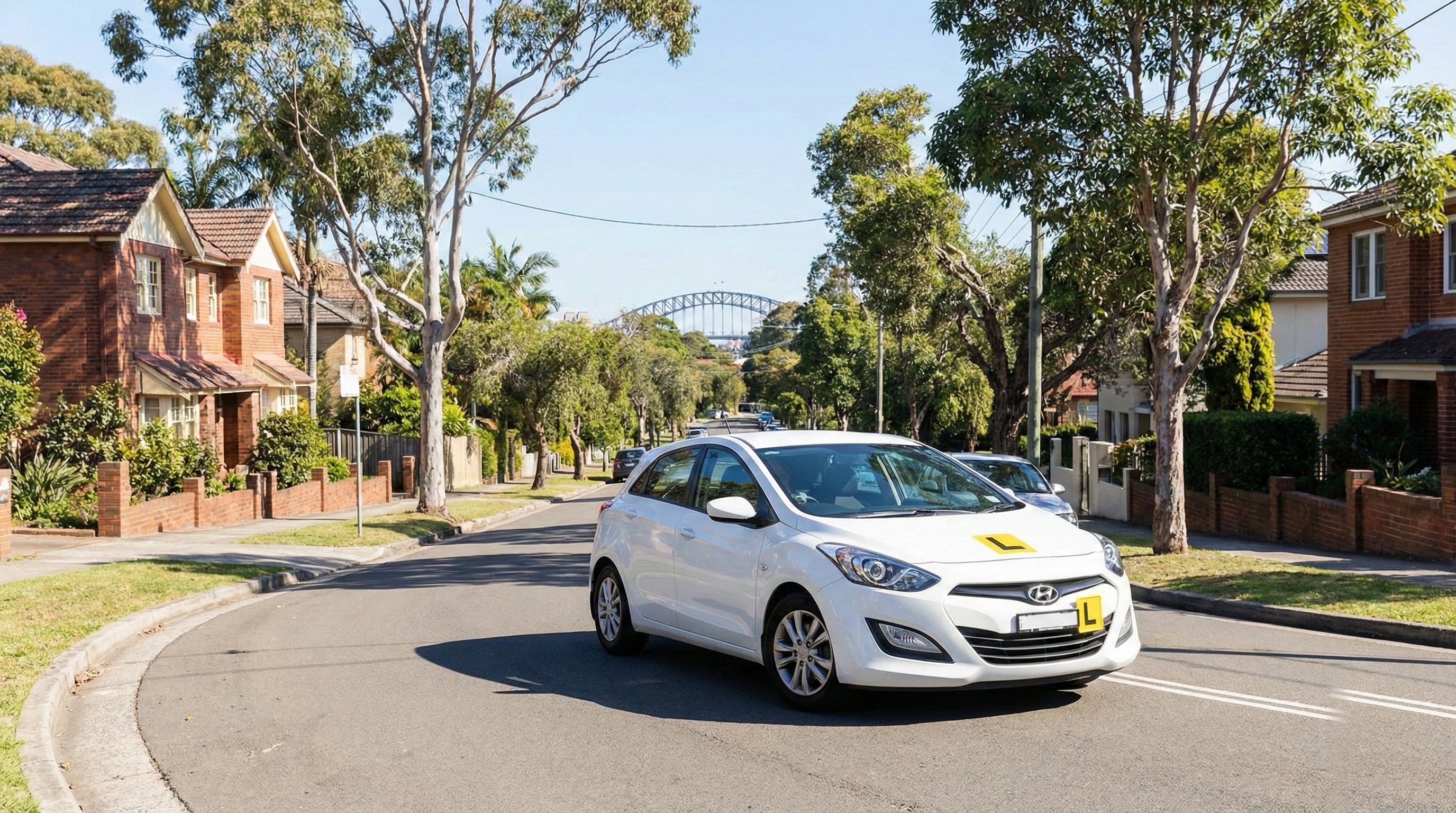
What You're Up Against
The NSW driving test lasts about 45 minutes. You need 90% to pass, and any single critical error is an automatic fail. Across the state, about 56.5% of candidates pass (TfNSW official data), and at some Sydney centres the rate drops to 47%.
Those numbers aren't meant to scare you. They're meant to make a point: preparation matters more than talent. Most people who fail make the same handful of mistakes, and every one of them is avoidable.
This guide covers the full process from learner to P1, with real pass rate data by test centre and the specific errors that trip up the most candidates.
The NSW Licence System
NSW uses a four-stage graduated system. Here's the quick version:
| Stage | Min Age | Speed Limit | Key Requirement |
|---|---|---|---|
| Learner (L) | 16 | 90 km/h | 120 hours supervised driving (under 25) |
| P1 (Red P's) | 17 | 90 km/h | Pass HPT + driving test |
| P2 (Green P's) | 18+ | 100 km/h | Hold P1 for 12 months |
| Full | 20+ | Posted limit | Hold P2 for 24 months, pass DQT |
Getting Your Learner Licence
Pass the Driver Knowledge Test (DKT). It's an online interactive test that costs $57 and gives you unlimited attempts. You can do it from home.
Building Your Hours
If you're under 25, you need 120 hours in your logbook, including 20 hours at night. That sounds like a lot, but there are shortcuts:
- 3-for-1 bonus: Each hour with a licensed instructor counts as 3 hours in your logbook (up to 10 instructor hours = 30 logbook hours)
- Safer Drivers Course: Completing this course can credit you with extra hours, potentially reducing your total from 120 to 80
Submit your logbook via the Service NSW app at least 48 hours before your test date.
If you're 25 or older, there's no logbook requirement and no minimum holding period for your learner licence. You just need to pass the Hazard Perception Test ($57) and book the driving test.
P1 Restrictions
Once you pass, you'll be on red P's for at least 12 months. The rules are strict:
- 90 km/h maximum, even on motorways
- Zero alcohol, not a drop
- No phone use at all, not even hands-free, Bluetooth, or mounted GPS. Don't touch it.
- One passenger under 21 between 11 pm and 5 am (if you're under 25)
What the Test Actually Looks Like
The test is about 45 minutes and has three parts.
Part 1: Pre-Drive Checks (5 minutes)
Before you start driving, the examiner checks that you know your car. They'll ask you to demonstrate:
- Headlights, high beams, indicators, and hazard lights
- Brake lights (they'll check from behind)
- Horn, windscreen wipers, demisters
- Handbrake and seatbelt
This part is easy if you've practised it once. Don't lose marks here.
Part 2: Low-Speed Driving (10 minutes)
Basic skills in quiet streets: moving off smoothly, steering control, reversing in a straight line, and a kerb-side stop or three-point turn.
Part 3: Traffic Driving (25-30 minutes)
This is where most people pass or fail. You'll drive through a mix of:
- Intersections: traffic lights, stop signs, give way signs
- Roundabouts: correct lane, giving way to the right, signalling out
- Lane changes: mirror, signal, head check, move
- Speed zones: 40, 50, 60, 70, 80 km/h transitions
- Gap selection: merging and turning into traffic
The examiner uses a tablet to mark errors in real time. You can have a few minor errors, but three or more of the same type will fail you, and any critical error is an instant fail.
The Instant Fail List
One critical error = automatic failure. It doesn't matter how well you drove for the other 40 minutes.
These will end your test on the spot:
- Running a red light, including going through on amber when you could have safely stopped
- Speeding, even 1 km/h over the posted limit
- Stop sign violation: not stopping completely, or stopping past the white line
- Failing to give way at intersections, to pedestrians, or to emergency vehicles
- School zone speeding: not slowing to 40 km/h during active times
- Causing danger: forcing another driver to brake or swerve
- Hitting anything: kerbs, parked cars, bollards
- Examiner intervention: if they have to speak up, grab the wheel, or use the brake
- Crossing a solid line unsafely
- Missing a head check when changing lanes or merging
Why People Actually Fail
The top reasons aren't complicated. They're just easy to forget under pressure.
1. Head checks. You need to physically turn your head to check your blind spot before every lane change, merge, and pull-out. A quick eye glance isn't enough. The examiner needs to see your head move. This is the number one fail reason for overseas drivers.
2. Mirror habits. Check your mirrors every 5-8 seconds. Make it obvious with a small head movement so the examiner can tell you're looking.
3. Stop signs. Come to a complete stop. Count "one-one-thousand" before moving. Rolling through a stop sign, even slowly, is an instant fail.
4. Speed management. Too fast is an instant fail. But too slow (holding up traffic) also costs marks. Know the speed limit for every zone you'll drive through.
5. Indicator timing. Signal at least 5 seconds before turning or changing lanes. Many people signal too late or forget to cancel.
6. Roundabouts. Wrong lane, forgetting to give way, or not signalling when exiting. Practice these until they're automatic.
If You're Converting an Overseas Licence
Drivers from China and other non-recognised countries often fail on things that aren't emphasised in their home countries:
- Head checks: mandatory in Australia, rarely practised elsewhere
- Stopping at amber lights: in NSW, you must stop on amber if it's safe to do so
- Pedestrian right of way: always give way to pedestrians at marked crossings, even if they haven't started crossing yet
- Overconfidence: years of driving experience can actually work against you if your habits conflict with Australian rules
Pass Rates by Test Centre
The following data is from TfNSW Open Data, covering 1.6 million+ driving tests (July 2022 to February 2026). Pass rates are at the LGA level. NSW state average: 56.5%.
Best Centres in Sydney
| Test Centre | Pass Rate | Notes |
|---|---|---|
| Macarthur | 59.7% | Campbelltown area, wide suburban roads |
| Miranda | 59.6% | Sutherland Shire, well-spaced intersections |
| Richmond | 58.3% | Semi-rural, lower traffic |
| Marrickville | 57.4% | Inner west, manageable routes |
| Castle Hill | 57.1% | Hills District, predictable traffic flow |
Toughest Centres in Sydney
| Test Centre | Pass Rate | Notes |
|---|---|---|
| Auburn | 47.0% | Cumberland LGA, heavy congestion |
| Merrylands | 47.0% | Cumberland LGA, varied speed zones |
| Chatswood | 50.4% | North shore, complex intersections, dense pedestrians |
| Parramatta | 50.1% | Congested commercial area |
What the Data Tells You
- South and southwest Sydney (Macarthur, Miranda) have the highest pass rates
- Western Sydney (Auburn, Merrylands) has the lowest, but the gap is about 13 points, not the 27 points some older guides claim
- The examiner criteria are standardised statewide. The difference is road complexity and traffic, not examiner strictness
Tip: Choose a centre where you've actually practised. Travelling to a "high pass rate" centre in an unfamiliar area can do more harm than good. For detailed centre analysis with route maps, see our Sydney Test Centre Comparison.
NSW Rules That Catch People Out
U-Turns at Traffic Lights
In NSW, U-turns are banned at traffic lights unless a sign specifically allows them. This is the opposite of Victoria, where U-turns are allowed unless signed otherwise. If you've been practising in both states, be careful.
School Zones
| Time | Speed Limit | When |
|---|---|---|
| 8:00 - 9:30 AM | 40 km/h | School days only |
| 2:30 - 4:00 PM | 40 km/h | School days only |
Watch for the flashing lights. Exceeding the school zone limit is an instant fail.
Booking tip: Schedule your test between 10 AM and 2 PM on a weekday. You'll avoid both school zone windows and peak traffic.
Mobile Phone Rules
L-plate and P1 drivers cannot touch a phone while driving. Not on speaker, not on Bluetooth, not as a mounted GPS. If the examiner sees you look at your phone, the test is over.
Costs (Current as of July 2025)
| Item | Cost |
|---|---|
| Driver Knowledge Test (DKT) | $57 (unlimited online attempts) |
| Hazard Perception Test (HPT) | $57 per attempt |
| Driving test | $70 per attempt (inc. GST) |
| 1-year licence | $72 |
| 3-year licence | $168 |
| 5-year licence | $228 |
Total minimum cost from learner to P1: $184 (DKT + HPT + driving test) Total with a 5-year licence: $412
How to Book
- Online: service.nsw.gov.au (fastest method, choose your centre and time)
- Phone: 13 22 13
- In person: Any Service NSW centre
If You Fail
Wait at least 7 days before rebooking. You pay the full $70 again each time. There's no limit on attempts.
Keep the feedback sheet from your examiner. It tells you exactly which categories you lost marks in. Focus your practice on those specific areas.
Converting an Overseas Licence
For a complete comparison of overseas licence conversion across all 8 Australian states (including costs, pass rates, deadlines, and the 2026 EDR changes), see our full overseas licence conversion guide.
Recognised Countries (No Test Required)
Drivers from 28 countries can swap directly: Austria, Belgium, Canada, Croatia, Denmark, Finland, France, Germany, Ireland, Italy, Japan, Netherlands, New Zealand, Norway, Portugal, Singapore, Spain, Sweden, Switzerland, United Kingdom, United States, and others.
Non-Recognised Countries (Including China)
You must pass:
- The Driver Knowledge Test (DKT), $57
- The Practical Driving Test, $70
2026 EDR Reform: Important Change
From 1 February 2026, the Experienced Driver Recognition (EDR) pathway has been removed. Drivers aged 25+ from "List B" countries (including Taiwan, Hong Kong (SAR), and South Africa) now must pass both the DKT and practical driving test. Previously, they could convert directly.
Service NSW has added "Super Saturdays" with 320 extra weekend testing slots to manage the surge in demand.
What Licence You Get
| Your Overseas Experience | NSW Licence |
|---|---|
| Less than 1 year | P1 (Red P's) |
| 1 to 3 years | P2 (Green P's) |
| 3+ years | Full licence |
Deadlines
- Permanent residents: Convert within 3 months
- Temporary visa holders: Convert within 6 months
Documents You'll Need
- Original overseas licence (not a copy)
- NAATI-certified English translation
- Passport and visa
- Proof of NSW address (utility bill, lease, bank statement)
Practical Tips
Before the Test
- Take at least 5 professional lessons with an instructor who knows your test centre routes. Even experienced drivers benefit from learning what examiners specifically look for.
- Drive the area around your test centre until you know every roundabout, speed zone change, and tricky intersection. Practise with GPS-guided routes on AUDrive: Castle Hill, Rockdale, St Marys, and more NSW centres.
- Book mid-week, 10 AM - 2 PM. Less traffic, no active school zones, cheaper parking near the centre.
On the Day
- Arrive 15 minutes early with your learner licence, HPT pass, and a fully licensed driver (they can take the car home if you pass)
- Check your car: lights, indicators, tyres, clean windscreen, L plates on
- Put your phone away, not on silent, away
During the Test
- Mirrors: Check every 5-8 seconds. Move your head slightly so the examiner sees it.
- Head checks: Turn your head past your shoulder. Be obvious about it.
- Stop signs: Full stop. Count to three. Then look and go.
- Speed: Stay at or just under the limit. Don't creep up and don't dawdle.
- Roundabouts: Signal left when exiting. Always.
- If you make a mistake: Keep driving. Most people who pass make 3-5 minor errors. One slip doesn't end your test.
- If you don't understand: Ask the examiner to repeat the instruction. They won't mark you down for asking.
Recommended Resources
- The Driving Test Guy NSW: Jimbo has been teaching in Sydney since 1997 and covers mock test routes for Liverpool, Bankstown, Castle Hill, and more
- NSW Guide to the Driving Test (PDF): the official Service NSW document covering exactly what's assessed
- AUDrive: practice GPS-guided driving test routes from actual Service NSW centres
What We'd Do
Book Macarthur, Miranda, or Castle Hill if you're in Sydney. All around 57-60%, suburban roads, manageable traffic. Auburn and Merrylands (47%) are the toughest. Chatswood (50.4%) is below average but not as bad as older guides claim.
Take 5 professional lessons minimum, even if you've already got your 120 hours. An instructor who knows your test centre is worth more than another 20 hours with your parents.
And the one thing most people get wrong: they practise driving but don't practise the test. The pre-drive checks, the mirror routine, the head check habit. These are skills you rehearse, not things you figure out on the day.
Frequently Asked Questions
How long is the NSW driving test?
About 45 minutes total: 5 minutes of pre-drive checks, 10 minutes of low-speed driving, and 25-30 minutes in traffic.
What score do I need to pass?
90% with zero critical errors. Most people who pass make 3-5 minor errors.
Can I use an automatic car?
Yes. About 86% of candidates do. In NSW, passing in an automatic does not restrict your licence.
How much does the NSW driving test cost?
The driving test is $70. A 5-year licence is $228. You'll spend $184 minimum on tests alone (DKT + HPT + driving test).
What happens if I fail?
Wait 7 days, then rebook. Full fee each time. No limit on attempts.