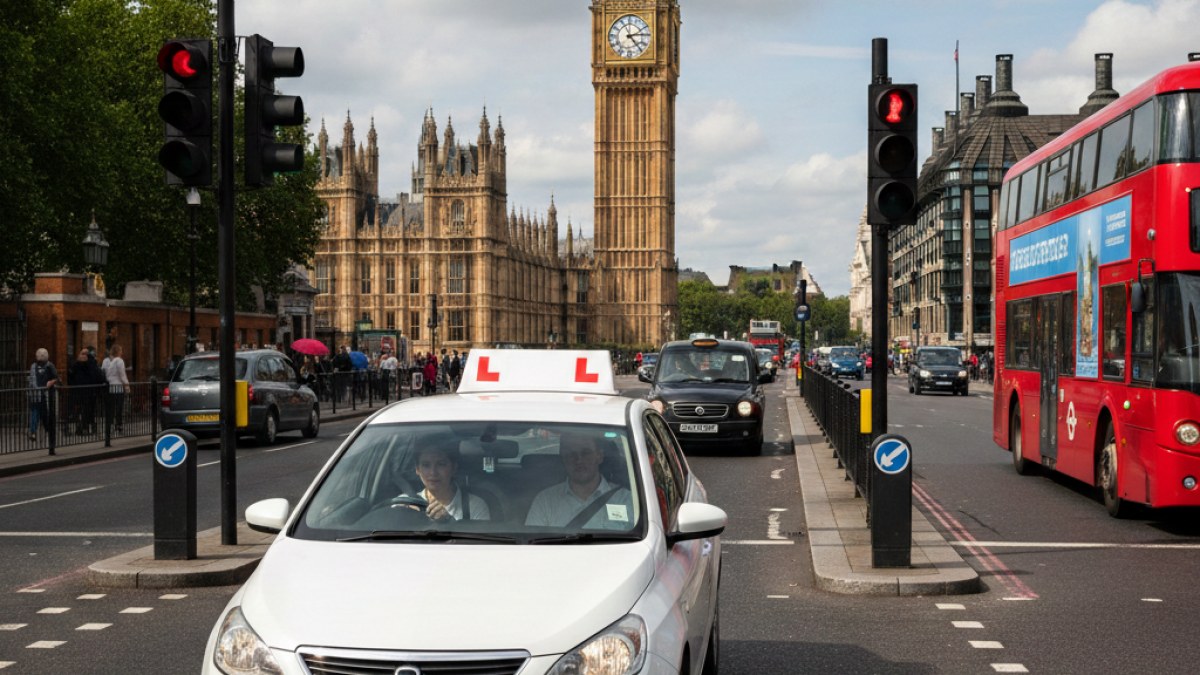
London is one of the hardest places in the UK to pass a driving test. The capital's average pass rate is about 48%, compared to the national average of 51%. Heavy traffic, bus lanes, cyclists, complex junctions, and some of the busiest roads in Europe all work against you.
But not all London centres are equal. Sidcup passes 59% of candidates. Chingford, in northeast London, passes only 36.5%. That gap can make a real difference.
London Pass Rates at a Glance
The following data is from DVSA official statistics for the 2024/25 financial year (April 2024 to March 2025).
Above 50%: Your Best Options
| Centre | Pass Rate | Area |
|---|---|---|
| Sidcup | 59.0% | Southeast (Bexley) |
| Enfield (Innova) | 54.1% | North (Enfield) |
| Tolworth | 53.3% | Southwest (Kingston) |
| Hither Green | 53.1% | Southeast (Lewisham) |
| Isleworth | 51.8% | West (Hounslow) |
| Bromley | 51.7% | Southeast (Bromley) |
| Mill Hill | 51.1% | North (Barnet) |
| West Wickham | 50.9% | Southeast (Bromley) |
| Pinner | 50.3% | Northwest (Harrow) |
| Chertsey | 50.3% | Southwest (Surrey border) |
45-50%: Decent Options
| Centre | Pass Rate | Area |
|---|---|---|
| Barnet | 49.9% | North (Barnet) |
| Uxbridge | 49.6% | West (Hillingdon) |
| Hendon | 49.5% | North (Barnet) |
| Erith | 49.3% | Southeast (Bexley) |
| Mitcham | 48.9% | South (Merton) |
| Morden | 48.8% | South (Merton) |
| Brentwood | 48.5% | Northeast (Essex border) |
| Hornchurch | 48.3% | East (Havering) |
| Loughton | 48.0% | Northeast (Essex border) |
| Tottenham | 47.9% | North (Haringey) |
| Yeading | 46.9% | West (Hillingdon) |
| Wood Green | 46.8% | North (Haringey) |
| Borehamwood | 46.8% | North (Hertfordshire border) |
| Southall | 46.2% | West (Ealing) |
| Slough | 45.6% | West (Berkshire border) |
Below 45%: Tougher Centres
| Centre | Pass Rate | Area |
|---|---|---|
| Goodmayes | 43.7% | East (Redbridge) |
| Greenford | 40.5% | West (Ealing) |
| Wanstead | 40.4% | East (Redbridge) |
| Belvedere | 38.3% | Southeast (Bexley) |
| Barking | 37.9% | East (Barking & Dagenham) |
| Chingford | 36.5% | Northeast (Waltham Forest) |
Chingford, Barking, and Belvedere rank among the hardest test centres in all of Great Britain: not just London.
Top Centre Analysis
Sidcup (59.0%): London's Best
If you can only read one section, read this one. Sidcup passes 59% of candidates, up from 58% last year. That's over 20 points higher than Chingford. The difference is the routes: Sidcup's tests stay on quiet suburban roads around the A222, with logical junctions and decent visibility. No bus lanes. Minimal cyclist traffic. Roundabouts that actually make sense.
35 minutes from central London on the Southeastern line (London Bridge or Charing Cross to Sidcup station). Worth the trip.
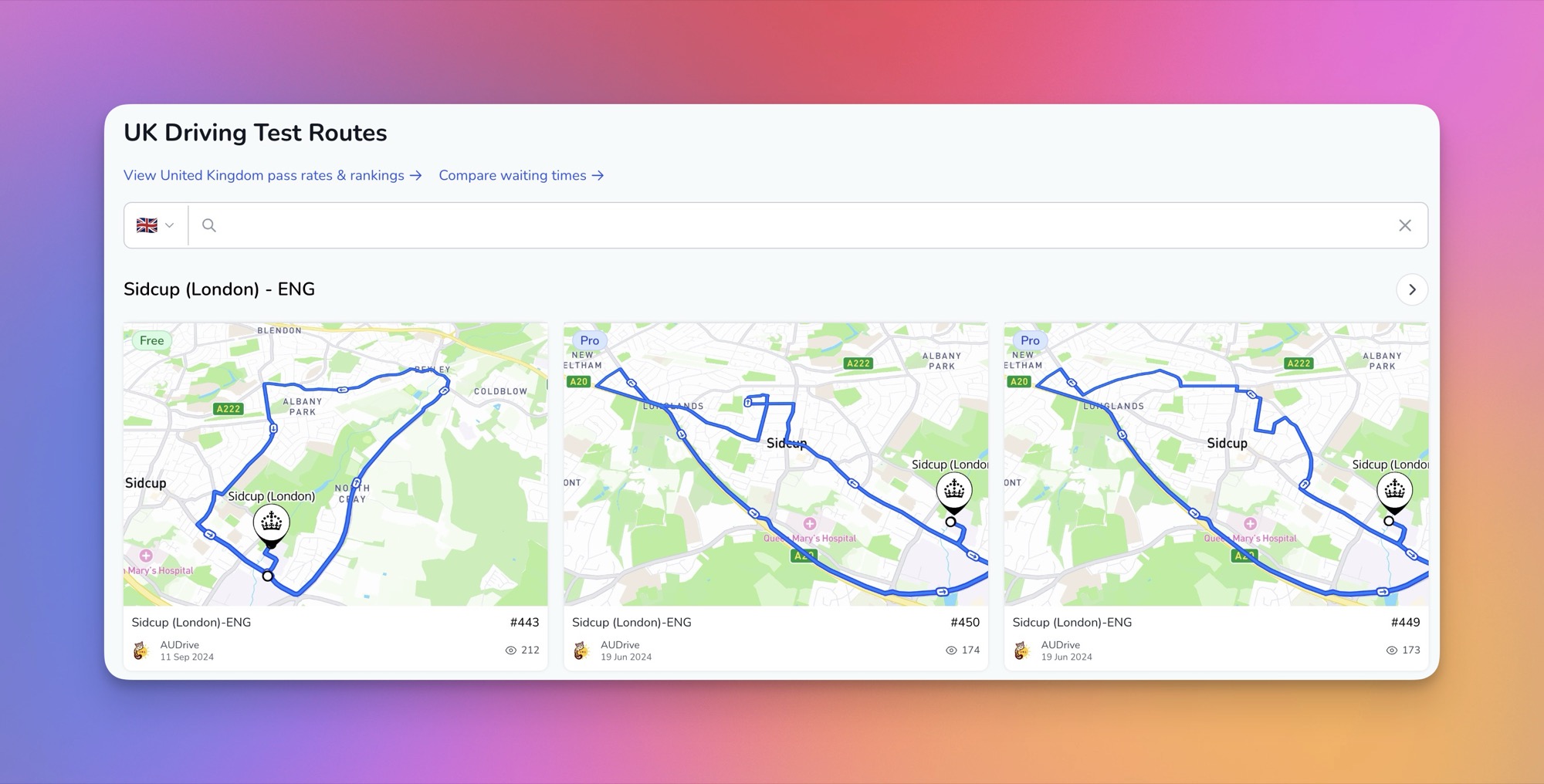 Real Sidcup test routes on AUDrive. Browse all Sidcup routes, practise on the actual roads, and record your own GPS practice sessions.
Enfield Innova (54.1%)
A relatively new centre in north London. 54% pass rate puts it second best in London. The area around Innova Business Park is less congested than central London, with more predictable road layouts. Accessible via Enfield Town station.
Tolworth (53.3%)
Southwest London, near Kingston. Test routes include some dual carriageway on the A3 corridor, so you need to be comfortable merging at speed. Otherwise, a manageable environment with moderate traffic. 30 minutes from Waterloo. Tolworth climbed from 51.7% to 53.3% this year.
Hither Green (53.1%)
Closer to central London than Sidcup, only 20 minutes from London Bridge. The trade-off: busier roads, including stretches of the South Circular (A205) where you need solid lane discipline. But 53% is still well above the London average.
Good pick if southeast London is convenient and Sidcup feels too far.
Centres to Avoid
Chingford (36.5%): London's Hardest
Nearly two out of three candidates fail here. Northeast London, Waltham Forest. The problem: narrow residential streets that suddenly open onto busy high streets, plus some routes heading towards Epping Forest where the speed jumps to 50-60 mph. Managing that transition catches people off guard.
Belvedere (38.3%)
Still one of the toughest in London, though it improved from 35% to 38% this year. The routes run through industrial roads near the Thames, complex junctions near the A2016, and stretches where heavy commercial vehicles dominate. Same borough as Sidcup, completely different experience.
Barking (37.9%) and Greenford (40.5%)
Both under 41%. Barking throws you onto the A13 with heavy traffic and awkward junctions near the town centre. Greenford mixes busy arterial roads with tight residential streets. Neither gives you much room for error.
What Makes London Hard (and How to Handle It)
London tests are harder for specific, predictable reasons. Each one has a counter-move.
Bus lanes
Bus lanes are everywhere in London, and the rules vary. Some operate 24 hours, others only during peak times, and some allow motorcycles but not cars. Entering a bus lane when it's active is a serious fault.
Cyclists on left turns
London has a large cycling population. Candidates need to give cyclists at least 1.5 metres when passing and check for cyclists when turning left, particularly at junctions with cycle lanes.
Box junctions
London's road network includes multi-lane roundabouts, box junctions with yellow grids (you must not enter unless your exit is clear), and asymmetric intersections that don't follow standard patterns. Getting box junctions wrong is one of the most common London fails.
20 mph zones
London has extensive 20 mph zones, particularly near schools and in residential areas. Islington, Hackney, and Camden are largely 20 mph throughout. Missing a 20 mph sign and driving at 30 mph is a serious fault.
Parking pressure
Test routes in inner London often pass through areas with heavy parking on both sides, narrowing the road. Navigating between parked cars while managing oncoming traffic takes practice. This catches people who only practise on wide suburban roads.
Pedestrian crossings
London has more pedestrian crossings per mile than anywhere else in the UK. Pelican, puffin, toucan, and zebra crossings all have slightly different rules. The key principle: give way to any pedestrian already on the crossing. Don't wave them across (the examiner marks that as a fault too).
Nearby Alternatives Outside London
If you're willing to travel, several centres just outside London have significantly better pass rates:
| Centre | Pass Rate | Wait | Distance |
|---|---|---|---|
| Chichester | 64.2% | 11wk | ~65 mi southwest |
| Tunbridge Wells | 58.9% | 13wk | ~35 mi southeast |
| Farnborough | 58.3% | 1wk | ~35 mi southwest |
| Maidstone | 58.0% | 23wk | ~40 mi southeast |
| Gillingham | 57.2% | 23wk | ~35 mi southeast |
| Sevenoaks | 53.6% | 21wk | ~25 mi south |
These centres offer better rates, but the new DVSA booking rules (from 9 June 2026) will limit centre changes to the 3 nearest centres, reducing "test centre tourism." If you do switch, make sure you practise extensively on the new centre's routes first.
One caveat: pass rates don't tell the whole story. A centre with a low rate might just have more first-time candidates, while a high-rate centre might attract test-ready repeaters. We don't have data on attempt number breakdowns, so treat these as useful signals, not guarantees.
Booking Your Test
Book at gov.uk/book-driving-test.
| Item | Cost |
|---|---|
| Weekday test | £62 |
| Evening/weekend/bank holiday | £75 |
London wait times vary widely. As of early 2026, London centre waits range from 1 week (Wanstead, Farnborough) to 23 weeks (Borehamwood, Erith, Sale), with a London average around 15 weeks. A National Audit Office investigation in December 2025 found a backlog of approximately 1.1 million tests accumulated during COVID-19. DVSA doesn't expect to reach its 7-week target until late 2027. Check current waiting times for any London centre.
Book as early as possible, and regularly check for cancellation slots: apps like Testi and Driving Test Cancellations Now can help you find earlier dates.
2026 booking changes: From 12 May 2026, only learners can book their own test on GOV.UK (instructors can no longer book on behalf). Test moves limited to twice (since 31 March 2026). From 9 June 2026, centre changes restricted to the 3 nearest centres. These changes target bot resellers who charge up to £500 for a £62 slot.
You'll need:
- A valid theory test pass certificate (within 2 years of passing)
- UK provisional driving licence number
What the Test Covers
The practical test lasts 38-40 minutes: eyesight check, two safety questions, general driving, independent driving (can now run the full test duration, following a satnav), one reversing manoeuvre, and a possible emergency stop (1 in 7 tests). Up to 15 minor faults allowed. Any serious or dangerous fault is an instant fail. For full details, see the UK Driving Test Complete Guide.
What We'd Actually Do
Book Sidcup. 59% pass rate, quiet routes, 35 minutes from central London. If Sidcup is fully booked for months, try Enfield Innova (54%, north London) or Hither Green (53%, 20 minutes from London Bridge).
Avoid Chingford, Barking, and Belvedere unless you have no choice. The routes are genuinely harder, and the numbers prove it.
One more thing: pick a centre you can reach by public transport. If you fail, you can't drive home.
Related Guides
- UK Driving Test Complete Guide. Format, scoring, and what to expect on test day.
- UK Test Centre Comparison. Pass rates for all UK centres, not just London.
- Head Checks and Mirrors: #1 Reason for Test Failure. The technique that fails more candidates than anything else.
FAQ
Which London test centre has the highest pass rate?
Sidcup, at 59.0%. Southeast London, Borough of Bexley. The routes stick to quiet suburban roads with few bus lanes and minimal cyclist traffic. 35 minutes from London Bridge by train.
Which London test centre has the lowest pass rate?
Chingford, at 36.5%. Nearly two out of three candidates fail here. Narrow residential streets that suddenly open onto busy high streets, plus routes heading towards Epping Forest at higher speeds. Belvedere (38.3%) is also among the hardest.
How long is the wait to book a driving test in London?
London centre waits currently range from 1 to 23 weeks, with an average around 15 weeks. Some centres (Wanstead, Farnborough) have short waits, while others (Borehamwood, Erith) are 23+ weeks out. DVSA doesn't expect to hit its 7-week target until late 2027. Book early, and check current waiting times to compare centres.
Can I book my test at a centre outside my area?
Yes, but new DVSA rules limit test moves to twice (since March 2026). From 9 June 2026, centre changes are restricted to the 3 nearest centres to your current booking. If you switch, practise on the new routes first.
How much does the driving test cost in London?
£62 on weekdays, £75 for evenings, weekends, and bank holidays. Same price regardless of centre.
Is it worth travelling to a centre with a higher pass rate?
If the gap is big enough, yes. Sidcup (59%) vs Chingford (36.5%) is a 22-point difference. That's not just statistics. The routes are genuinely easier. But show up having practised those specific roads, not cold.
Data: DVSA official statistics, 2024/25 financial year (April 2024 to March 2025). Pass rates are for car practical tests and may change over time.
Explore driving test routes near any London test centre with AUDrive. Practise on the actual roads used during your test.
This article is for informational purposes only. Refer to gov.uk for the latest test requirements and booking information.