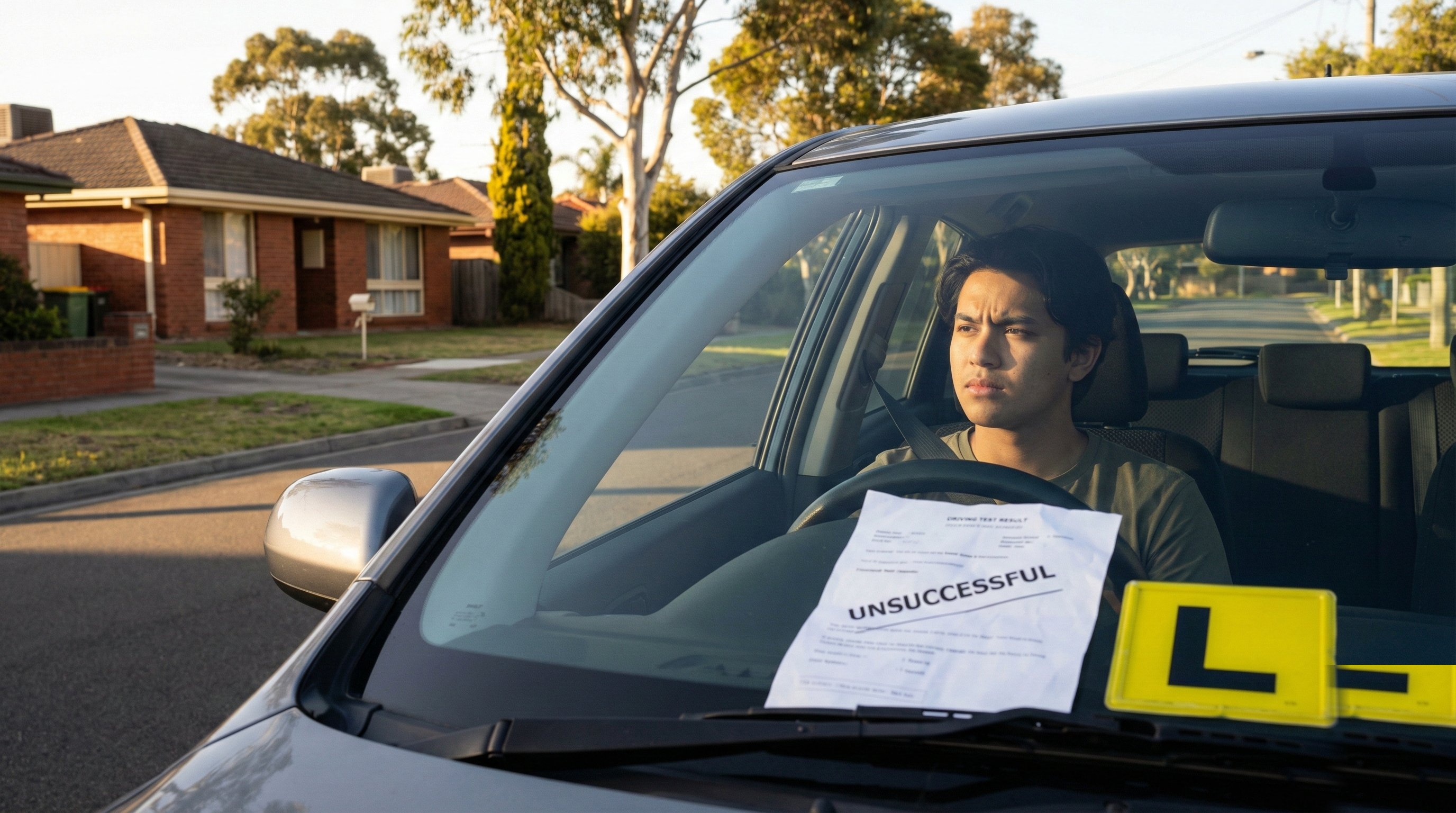
You're in Good Company
Somewhere between 35% and 65% of candidates fail their first driving test, depending on the state. In Western Australia, about 65% fail first time. In the ACT, it's over 70%. Failing doesn't mean you're a bad driver, it means you made mistakes that the examiner has to mark.
The difference between people who pass on their second attempt and people who fail again is almost always preparation, not talent.
What Happens Right After You Fail
The examiner will explain why you failed and hand you a written test report. This report lists every error, critical and minor, with the location and type of fault.
Keep this report. It's the most useful tool you have for your next attempt. It tells you exactly what the examiner saw, which is often different from what you think went wrong.
Your accompanying driver (or instructor) then drives you home. You don't drive the car after a failed test.
Waiting Periods and Retest Fees
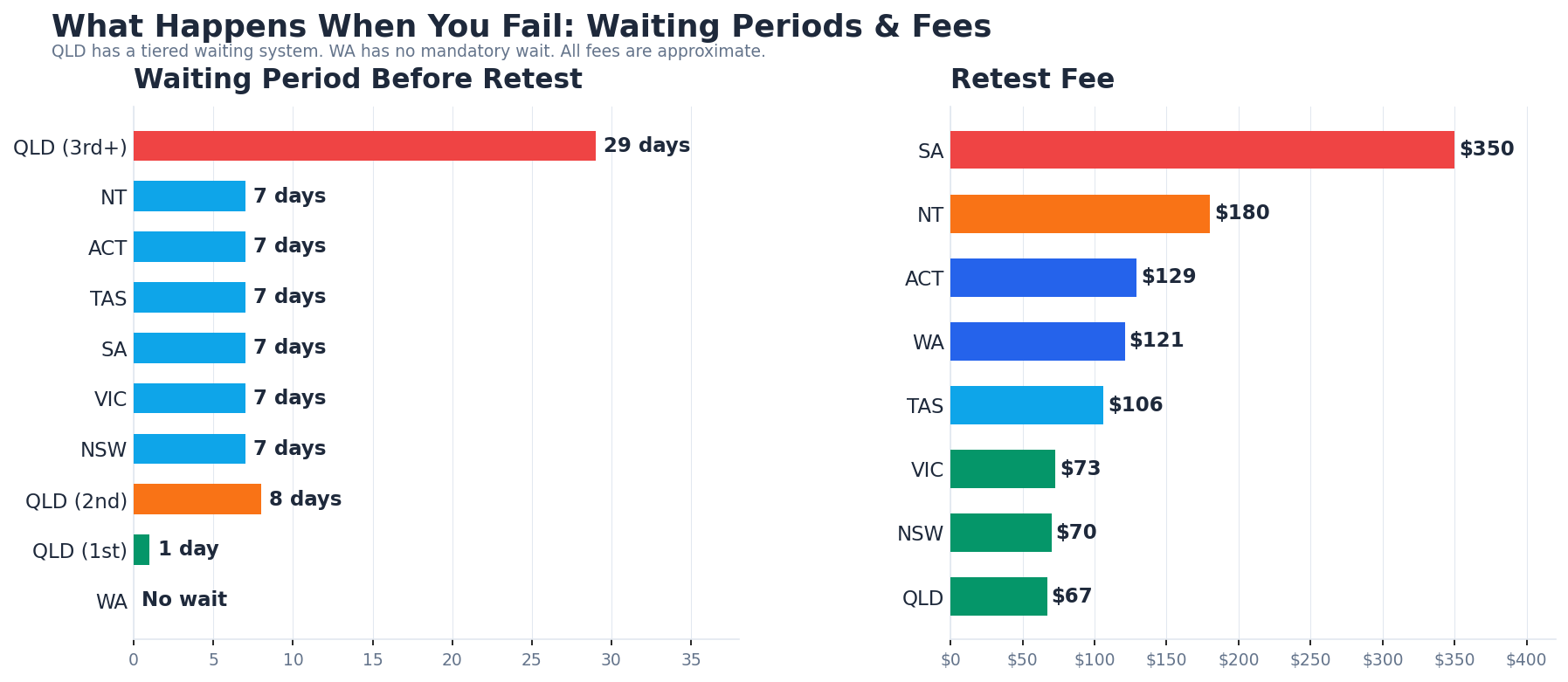
Waiting periods and retest fees by Australian state
| State | Wait Before Retest | Retest Fee |
|---|---|---|
| NSW | 7 days | ~$70 |
| VIC | 7 days | ~$73 |
| QLD | Next day (1st fail), 8 days (2nd), 29 days (3rd+) | ~$67 |
| WA | No mandatory wait | ~$121 |
| SA | 7 days | ~$350 |
| TAS | 7 days | ~$106 |
| ACT | 7 days | ~$129 |
| NT | 7 days | ~$180 |
You pay the full fee again for every retest. There's no discount, and there's no limit on how many times you can attempt.
In WA, there's no mandatory waiting period, you can technically rebook for the next available slot. In practice, though, availability usually means a wait of several weeks.
QLD has a tiered system: fail once and you can try again the next day. Fail a second time and you wait 8 days. After a third failure, the wait extends to 29 days.
QLD: Overseas Licence Warning
If you're converting an overseas licence in Queensland and you fail the Q-SAFE test, you lose the right to drive on your overseas licence in Queensland immediately. You can still use the overseas licence for your next test attempt, but you cannot use it to practise driving. If you need practice before retesting, you'll have to get a QLD learner licence and find a supervising driver.
This is unique to Queensland and catches many overseas drivers off guard. If you hold an overseas licence and are taking the Q-SAFE, prepare thoroughly before your first attempt.
How to Read Your Test Report
Critical (Instant Fail) Errors
If your report shows a critical error, that single mistake ended your test regardless of everything else. Common critical errors:
- Exceeding the speed limit (even by a small margin in most states)
- Running a red light or rolling through a stop sign
- Failing to give way when required, creating danger
- Making a lane change without a head check that would have been unsafe
- Examiner had to intervene (verbally or physically)
If you failed on a critical error, the fix is usually straightforward: you need to turn that specific behaviour into an unbreakable habit.
Pattern of Minor Errors
If you didn't have a critical error but still failed, you accumulated too many minor faults. Look for patterns:
- Multiple mirror or head check errors? Your observation habit isn't automatic yet.
- Several speed-related faults? You're not scanning for speed signs consistently.
- Errors concentrated in roundabouts? You need more practice with signalling and lane selection at roundabouts specifically.
The pattern tells you where to focus your practice. Random spread of errors across different categories usually means general nervousness rather than a specific skill gap.
How to Pass Next Time
1. Get Professional Help with Your Weak Points
Even one or two hours with a qualified instructor, focused specifically on the errors from your test report, can make a big difference. Tell them what you failed on and ask them to target those areas. A good instructor will also drive the likely test routes and point out the spots where candidates commonly lose marks.
2. Drive the Test Routes Until They're Boring
Most test centres use a predictable set of routes. When you know the roads, the speed zones, the tricky intersections, the roundabouts, the stop signs, you can focus entirely on driving technique instead of worrying about what's coming next.
AUDrive has GPS practice routes for test centres across Australia. Use them to practise the exact roads your test will cover.
3. Target Your Specific Errors
Don't just "practise more." Practise the specific things that cost you marks:
- Head checks: Exaggerate the head turn on every single practice drive until it's automatic
- Speed management: Practise holding 2–3 km/h below the limit at all times, actively scanning for speed signs
- Roundabouts: Practise the full sequence, approach signal, give way, exit signal, head check, until it's muscle memory
- Stop signs: Make a full, complete stop every single time, count "one thousand," then go
4. Simulate Test Conditions
Have someone sit in the passenger seat and give you directions without warning, exactly like an examiner would. No chatting, no helping, no reminders. The closer your practice feels to the real test, the less nervous you'll be on the day.
5. Consider a Different Test Centre
If your centre has a very low pass rate or particularly difficult roads, it's worth looking at alternatives. But only switch if you're willing to thoroughly learn the new routes first. A "higher pass rate" centre means nothing if you don't know the roads.
Dealing with Test Anxiety
Some people fail not because of skill, but because of nerves. If that's you:
Before the test:
- Arrive 15–20 minutes early. Sit in the car, adjust your mirrors, take a few slow breaths.
- Do a short warm-up drive around the area before your appointment time.
- Remind yourself: the examiner isn't trying to trick you. They want you to pass.
During the test:
- Focus on one action at a time. Mirror. Signal. Head check. Turn. Don't think about the outcome, just execute each step.
- If you make a small mistake, let it go. One minor error doesn't mean you've failed. Dwelling on it leads to more mistakes.
- The examiner will be quiet most of the time. That's normal, silence doesn't mean you're doing badly.
Between attempts:
- Failing once (or twice) doesn't say anything about your driving ability long-term. Most fully licensed drivers failed at least once.
- Each failed attempt teaches you something specific. Use it.
How Many Attempts Does It Usually Take?
There's no reliable national statistic on this, but driving schools consistently report that most people who fail once pass on their second or third attempt, provided they actually address the specific errors from their report rather than just booking again and hoping for the best.
The people who fail repeatedly tend to have one of two problems: they're not practising the specific skills that caused the fail, or they're not practising on the actual test routes.
Frequently Asked Questions
How long do I have to wait before retaking the driving test?
Most states require 7 days. QLD has a tiered system: next day after the first fail, 8 days after the second, 29 days after the third. WA has no mandatory waiting period.
Do I pay the full fee again?
Yes. Every retest costs the full fee. There is no discount and no limit on attempts.
Can I go to a different test centre for my retest?
Yes, in most states you can book at any centre. But only switch if you are willing to practise extensively on the new centre's roads first. A higher pass rate centre is not helpful if you do not know the routes.
What if I failed because of nerves, not skill?
This is common. Arrive early, do a short warm-up drive, and focus on one action at a time during the test. If you make a small mistake, let it go. Most people who pass make about 5 minor faults.
Should I get professional lessons before retesting?
Yes. Even one or two hours with an instructor focused on the specific errors from your test report can make a big difference. Tell them exactly what you failed on.
Related Guides
- Best Time to Book Your Driving Test: Time your retest for lighter traffic and fewer school zones.
- Head Check and Mirror Technique Guide: If observation errors caused your fail, this guide covers how to build the habit.