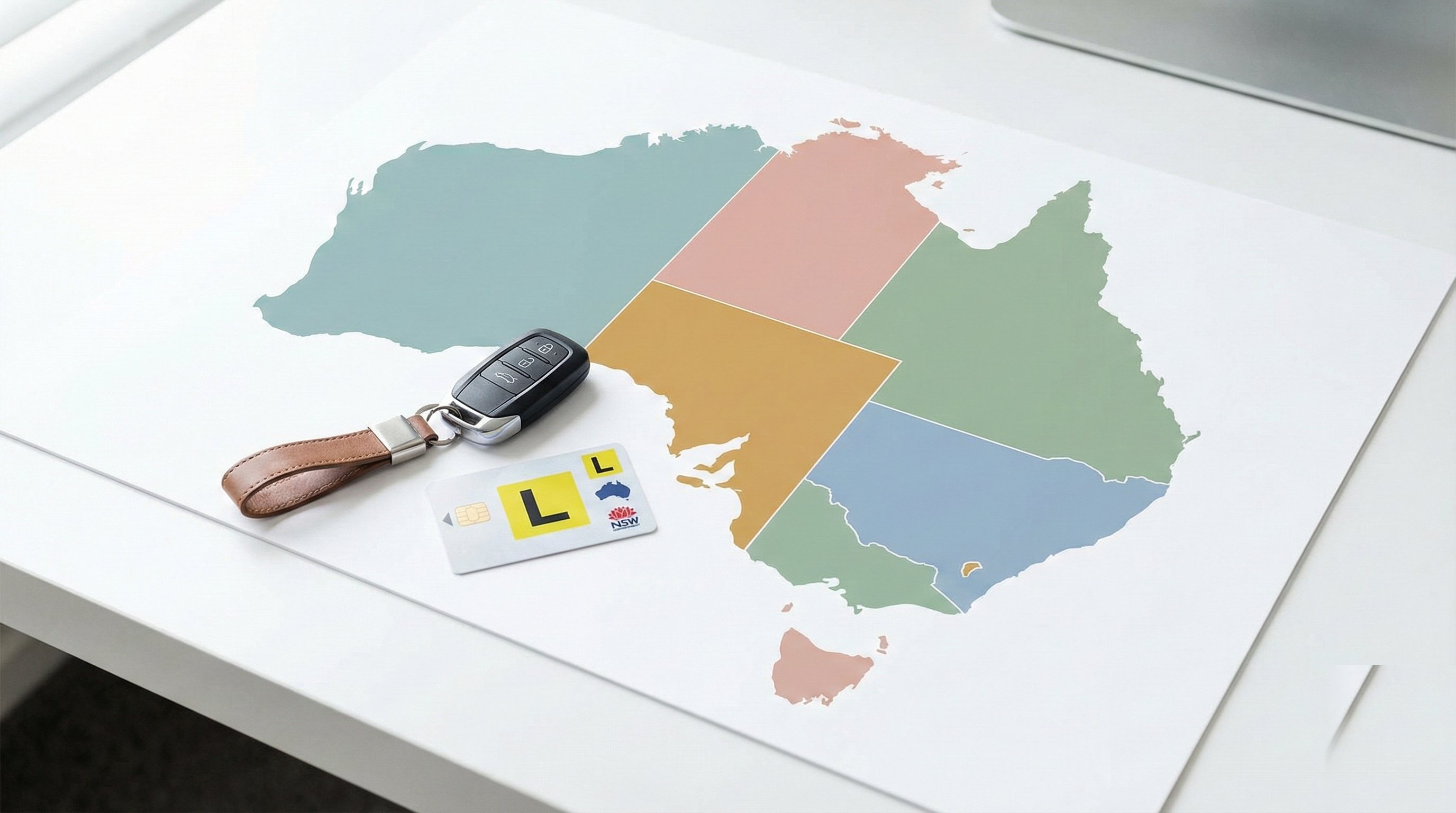
Eight States, Eight Different Tests
There's no national driving test in Australia. Each state and territory runs its own system with different fees, different hours requirements, different pass rates, and different marking criteria. A learner in Western Australia needs 50 supervised hours. A learner in New South Wales needs 120. The ACT pass rate sits at 28%, the lowest in the country. WA is next at 42.3%. Victoria leads at 75%.
This guide puts all eight jurisdictions side by side so you can see exactly what applies to you.
The Full Comparison
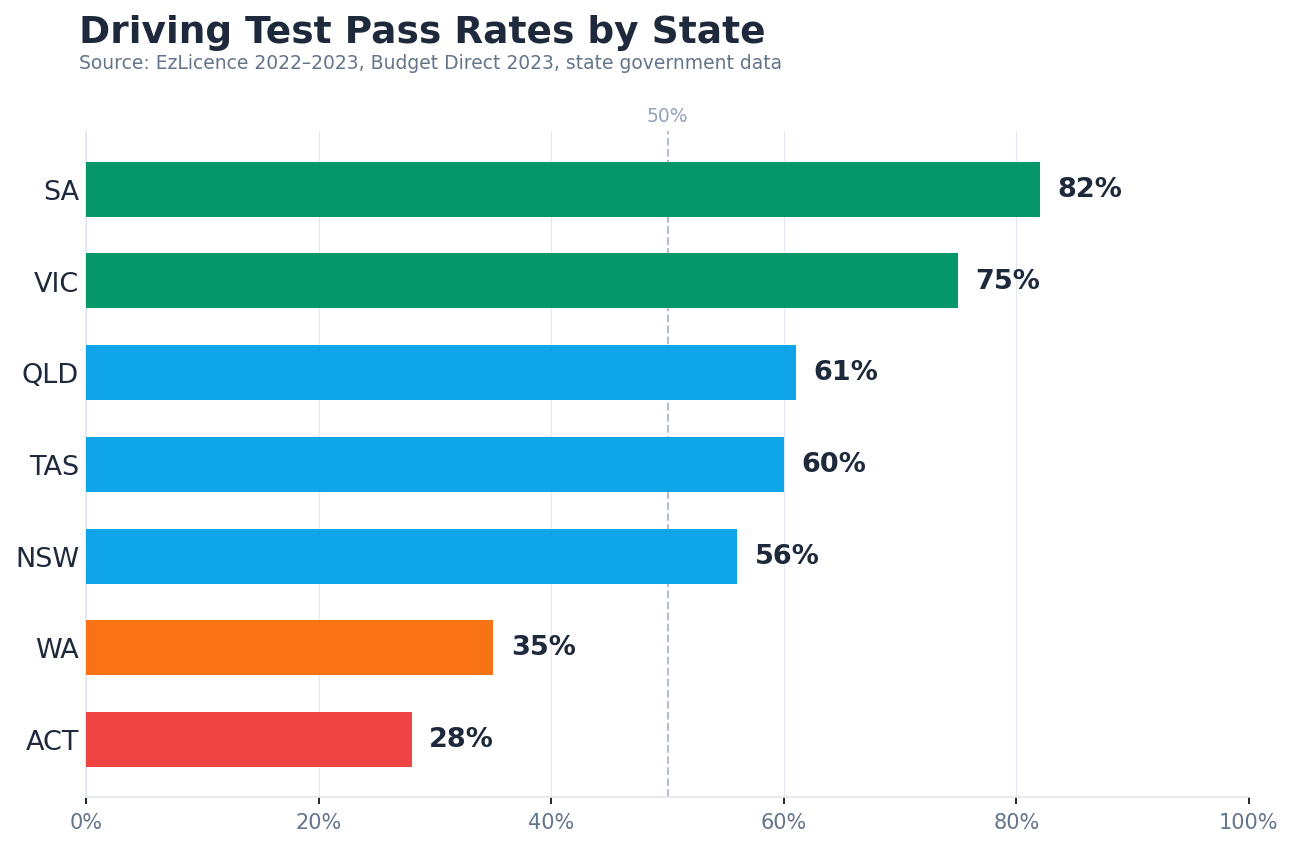
Pass rates range from 28% (ACT) to 82% (SA). WA updated to 42.3% based on official FOI data.
| NSW | VIC | QLD | WA | SA | TAS | ACT | NT | |
|---|---|---|---|---|---|---|---|---|
| Pass Rate | ~56% | ~75% | ~61% | 42.3% | ~82% | ~60% | ~28% | N/A |
| Test Fee | ~$70 | ~$73 | ~$67 | Free (1st)* | ~$350 | ~$106 | ~$129 | ~$180 |
| Supervised Hours | 120 (20 night) | 120 (20 night) | 100 (10 night) | 50 (5 night) | 75 (15 night) | 80 (15 night) | None | None |
| Logbook Required | Yes | Yes | Yes | Yes | Yes | Yes | No | No |
| Min. Learner Period | 12 months | 12 months | 12 months | 6 months | 12 months | 12 months | 6 months | 6 months |
| Test Duration | 40–45 min | ~30 min | 40–45 min | 45–50 min | 30–40 min | ~40 min | 30–40 min | 30–40 min |
| HPT Required | No | Yes | No | No | No | Yes | No | No |
| P1 Speed Limit | 90 km/h | None | 100 km/h | None | 100 km/h | 100 km/h | None | 100 km/h |
WA: first PDA is included in the $143 learner permit fee. Re-tests cost ~$121. HPT = Hazard Perception Test. WA pass rate is official government data (DoT FOI 2026-0140, 292,253 tests). Other pass rates are based on publicly available data (EzLicence 2022-2023, Budget Direct 2023, state government data). SA pass rate reflects the VORT pathway. NT does not widely publish pass rate data.
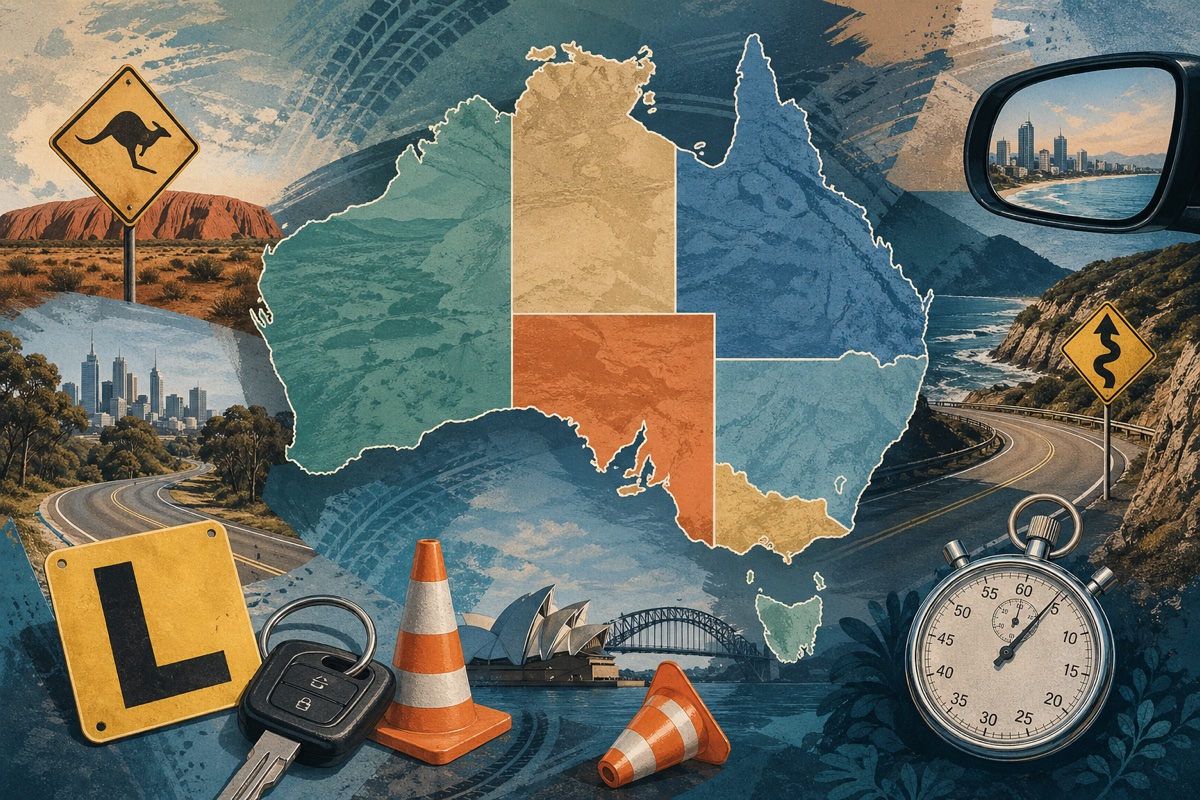
Eight states, eight different systems. Fees, hours, pass rates, and test formats vary widely across Australia.
State-by-State Details
New South Wales
NSW has one of the most structured systems in the country. If you're under 25, you need 120 supervised driving hours (including 20 at night) logged in a certified logbook over at least 12 months. The test itself lasts 40–45 minutes and uses a demerit-style scoring system, and you need at least 90% with no critical errors.
The statewide pass rate is around 56%, but it varies widely between centres. Some western Sydney centres sit below 45%, while parts of regional NSW are above 65%.
Test fee: approximately $70.
Victoria
Victoria requires the same 120 hours as NSW, plus a Hazard Perception Test (HPT) before you can book the practical test. The drive test itself is about 30 minutes, shorter than most other states.
VIC has the highest pass rate of the states with comparable data, at around 75%. Even the lowest-performing centre (Dandenong, ~67%) sits above the national average. Frankston (~80%) has one of the highest pass rates in the country.
Test fee: approximately $73 (drive test + appointment fee). The VIC government's "Free Ls and Free Ps" scheme (from August 2025) waives learner permit and probationary licence fees, though the drive test booking fee still applies.
Queensland
QLD requires 100 supervised hours (including 10 at night). The Q-SAFE test is conducted by accredited private assessors rather than government examiners, so you book through a driving school, not Transport and Main Roads directly.
The pass rate is around 61%, but it varies a lot by centre. Cleveland (~76%) and Logan City (~70%) perform well, while some north Brisbane centres sit around 53%.
The examiner picks 3 manoeuvres from a list of 5, and you won't know which three until the test.
Test fee: approximately $67.
Important note: If you hold an overseas licence and fail the Q-SAFE test, your overseas licence may be immediately cancelled. This is unique to Queensland.
Western Australia
WA has the lowest published pass rate at 42.3%, based on 292,253 official government tests (DoT FOI 2026-0140). WA also has the lowest supervised hours requirement (50 hours, including 5 at night) and a shorter learner period (6 months).
The Practical Driving Assessment (PDA) runs 45-50 minutes, one of the longest in Australia. The strict marking criteria, combined with less mandatory practice time, likely explains the low pass rate. Official data also shows a stark metro vs regional split: Perth metro centres average 39%, while regional WA averages 54%.
Your first PDA is included in the $143 learner permit fee. Re-tests cost approximately $121 each.
South Australia
SA uses the Vehicle On-Road Test (VORT), conducted by private accredited assessors, similar to Queensland's model. The VORT costs approximately $350 (paid to the assessor), making SA the most expensive state for testing.
SA requires 75 supervised hours (including 15 at night). The pass rate is approximately 82%, though this figure includes candidates who chose the VORT pathway (SA also offers a logbook pathway that avoids a formal test). The pre-drive vehicle check is part of the assessment, and you'll need to demonstrate basic vehicle safety knowledge.
Tasmania
Tasmania requires 80 supervised hours (for those under 25) and a Hazard Perception Test before the practical test. The drive test lasts about 40 minutes and costs approximately $106.
TAS has one of the higher pass rates among Australian states, around 60%. Tasmania's system is comparable to Victoria's but with fewer supervised hours required.
Australian Capital Territory
The ACT has the lowest pass rate in Australia at around 28%. It doesn't mandate specific supervised hours, but requires a pre-learner course (Road Ready) and a 6-month learner period. The assessment is competency-based rather than points-based.
The combination of no minimum hours, a competency-based system, and Canberra's extensive roundabout network contributes to the low pass rate. The test costs approximately $129.
Northern Territory
The NT has the most relaxed requirements: no mandatory logbook, no minimum supervised hours, and a 6-month learner period. The test costs approximately $180 and is video recorded throughout.
The NT does not publish pass rate statistics. With no hour requirements, the system relies on candidates and their supervisors to ensure readiness.
The Biggest Differences
Hours: 120 vs. None
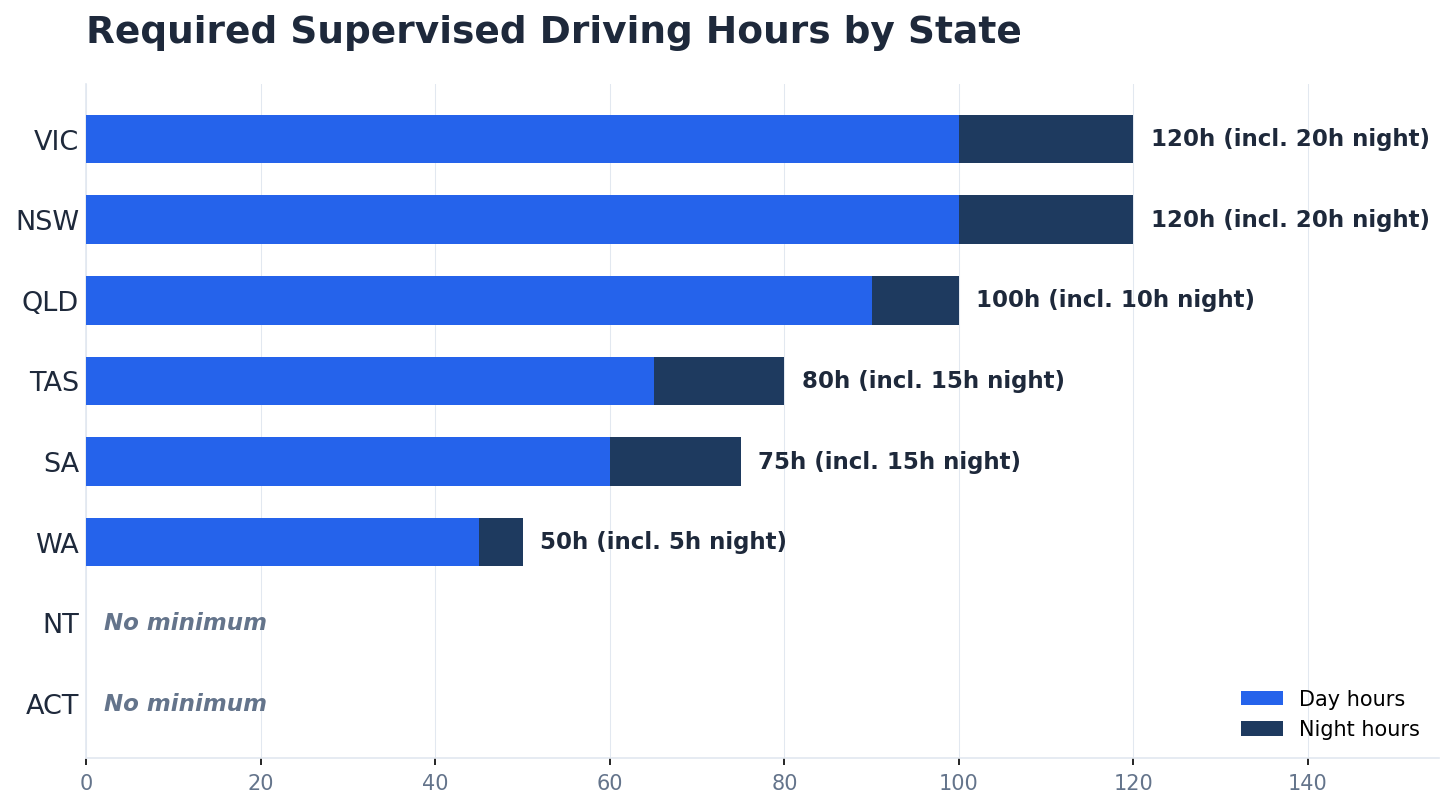
NSW and VIC require 120 hours. WA requires 50. The ACT and NT have no minimum. States with more hours tend to have higher pass rates.
NSW and VIC sit at the top with 120 mandatory supervised hours. QLD is next at 100, followed by TAS (80), SA (75), and WA (50). The ACT and NT don't specify a minimum at all.
More hours doesn't always mean better, but the data suggests a connection. VIC (120 hours, 75% pass rate) and NSW (120 hours, 56% pass rate) both outperform WA (50 hours, 42.3% pass rate).
Cost: Free to $350+
WA's first test is technically free (bundled into the learner permit). QLD ($67) and VIC ($73) are the cheapest standalone test fees. SA's VORT at ~$350 is far more expensive than anywhere else.
Pass Rates: 28% to 82%
The range is enormous. SA reports ~82% (though with the VORT pathway caveat), VIC sits at ~75%, and QLD at ~61%. At the other end, WA is 42.3% and ACT is ~28%.
These numbers don't mean the test is "harder" in WA or ACT. Factors like minimum practice hours, candidate preparation, test centre road conditions, and assessment methodology all play a role.
Speed Limits on P-Plates
Once you pass, your freedom varies by state:
| P1 Speed Limit | P1 Duration | |
|---|---|---|
| NSW | 90 km/h | 12 months |
| VIC | No restriction | 12 months |
| QLD | 100 km/h | 12 months |
| WA | No restriction | 6 months |
| SA | 100 km/h | 12 months |
| TAS | 100 km/h | 12 months |
| ACT | No restriction | 3 years (P total) |
| NT | 100 km/h | Variable |
Instant Fail Items (All States)
While the specific lists vary, these actions will end your test immediately in every state:
- Exceeding the speed limit by a significant margin
- Running a red light
- Failing to stop at a stop sign
- Causing or nearly causing an accident
- Examiner has to physically intervene (grab the wheel or apply the dual brake)
- Driving on the wrong side of the road
- Dangerous failure to give way
Some states also fail you instantly for mounting the kerb during a manoeuvre, making an illegal turn, or repeated failure to check blind spots.
Can You Choose Your State?
No. You must test where you hold your learner licence. But within your state, you can often choose your test centre. Pass rates vary significantly between centres, so it's worth researching your options.
More importantly than choosing a "high pass rate" centre: practise on the roads around your chosen centre. Familiarity with the speed zones, roundabouts, and tricky intersections makes a bigger difference than the centre's average pass rate.
Tips That Work Everywhere
-
Practise on actual test routes. Every test centre uses roads in its local area. Driving those roads until they're familiar takes away one major source of stress. AUDrive has GPS practice routes for test centres across every state.
-
Make head checks obvious. This is the top fail reason in most states. Turn your head clearly so the examiner can see it.
-
Stay just under the speed limit. Aim for 2–3 km/h below. Even 1 km/h over can be marked, and significantly over is usually an instant fail.
-
Stop completely at every stop sign. Wheels must stop turning entirely. Count "one thousand" after stopping.
-
Don't let one mistake derail you. A minor error doesn't mean you've failed. Stay calm and keep driving well. Most people pass despite a few faults.
Frequently Asked Questions
Which Australian state has the highest driving test pass rate?
South Australia reports the highest pass rate at approximately 82% through the VORT pathway, though this figure includes candidates who chose the assessor-led route. Victoria is next at around 75%.
Which state has the lowest pass rate?
The ACT has the lowest at around 28%, followed by Western Australia at 42.3% (based on 292,253 official government tests). Both states have fewer mandatory supervised driving hours than NSW or VIC.
Can I take my driving test in a different state?
No. You must sit the test in the state or territory where you hold your learner licence. However, you can usually choose which test centre to use within your state.
Why do pass rates vary so much between states?
Several factors contribute: the number of mandatory supervised hours, test duration, marking criteria, road complexity around test centres, and whether the test is government-run or conducted by private assessors.
Is the driving test harder in some states than others?
The tests differ in structure and duration rather than difficulty. WA's test runs 45-50 minutes with strict marking, while VIC's is about 30 minutes. States with more required practice hours (like NSW and VIC at 120 hours) tend to have higher pass rates.
Related Guides
- Converting an Overseas Licence in Australia
- Best Time to Book Your Driving Test
- Head Checks and Mirror Technique Guide