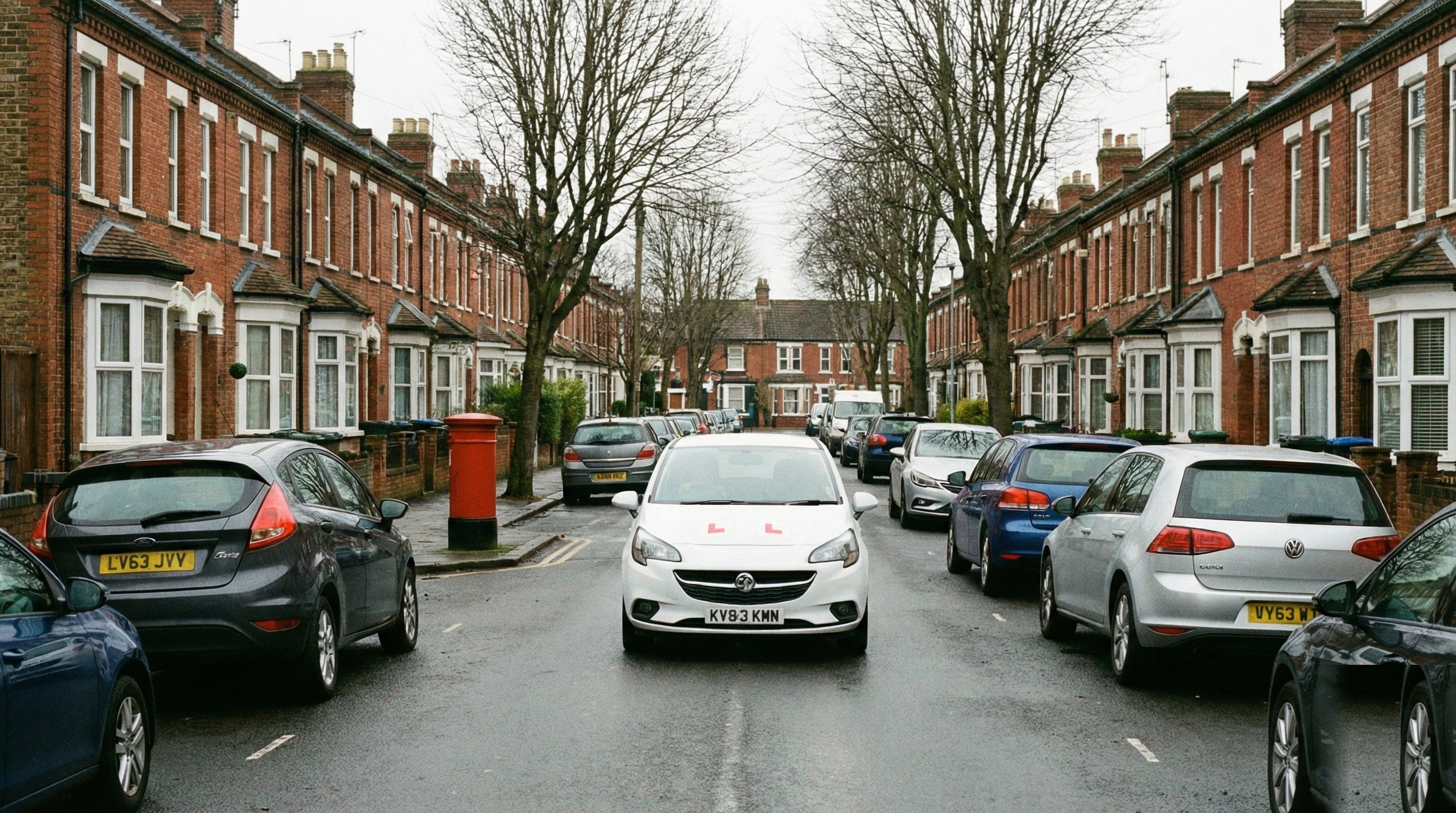
Overview
The UK driving test is administered by the DVSA (Driver and Vehicle Standards Agency) and covers England, Scotland, and Wales. Northern Ireland has a separate system managed by the DVA. The national average pass rate sits at around 48.5% (2024/25), making the UK test one of the more challenging driving assessments globally, fewer than half of all candidates pass on their first attempt.
The test lasts approximately 40 minutes and includes an eyesight check, two vehicle safety questions (show me/tell me), around 20 minutes of normal driving, around 20 minutes of independent driving using a sat nav, one reversing manoeuvre, and possibly an emergency stop. This official DVSA video walks you through the entire test:
Getting Your UK Driving Licence
Step 1: Provisional Driving Licence
- Minimum age: 17 years (you can apply from 15 years and 11 months)
- Cost: £34 (online) or £43 (by post)
- Conditions: Must always be accompanied by a qualified driver (full licence held for 3+ years, aged 21 or over), must display L plates, zero alcohol limit for most new drivers
Step 2: Theory Test
- Format: 50 multiple-choice questions (pass mark: 43/50) plus 14 hazard perception video clips (pass mark: 44/75)
- Cost: £23
- Validity: 2 years, you must pass the practical test within this period, or you will need to retake the theory test
- Languages: Available in English and Welsh only
Step 3: Practical Driving Test
- Cost: £62 (weekdays) or £75 (evenings, weekends, and bank holidays)
- Duration: Approximately 40 minutes
- Where: Over 300 test centres across England, Scotland, and Wales
Step 4: Full Driving Licence
Once you pass the practical test, your full licence is issued. New drivers are subject to a 2-year probationary period, if you accumulate 6 or more penalty points within 2 years, your licence is revoked and you must retake both the theory and practical tests.
What the Test Covers
Eyesight Check
Before you get in the car, the examiner will ask you to read a number plate from a distance of 20 metres. If you need glasses or contact lenses to do this, you must wear them throughout the test.
Show Me, Tell Me Questions
The examiner will ask 2 vehicle safety questions from a bank of 21 possible questions (14 "tell me" + 7 "show me"):
- Tell me questions are answered verbally (asked before you drive)
- Show me questions require you to demonstrate something while driving (e.g. how to wash the windscreen)
Each incorrect answer counts as 1 minor fault. These are not difficult but require preparation, common questions cover topics like checking tyre pressure, brake fluid, coolant levels, and headlights.
Normal Driving (About 20 Minutes)
The examiner will give you directions as you drive through a variety of road types:
- Residential streets
- Main roads with higher speed limits
- Roundabouts (single and multi-lane)
- Junctions with traffic lights, stop signs, and give way signs
- Pedestrian crossings
Independent Driving (About 20 Minutes)
You will follow directions from a sat nav provided by the examiner (approximately 4 out of 5 tests use a sat nav; the rest use road signs). This section tests whether you can drive safely while making your own navigation decisions. Taking a wrong turn is not penalised, only unsafe driving is marked.
Reversing Manoeuvre (One of Three)
You will be asked to perform one of the following:
- Parallel parking on the left behind a parked vehicle
- Bay parking: driving in and reversing out, or reversing in and driving out
- Pulling up on the right, reversing 2 car lengths, then rejoining traffic
Emergency Stop (1 in 3 Chance)
Approximately one-third of tests include an emergency stop. The examiner will tell you in advance that they may ask you to stop, then signal by raising their hand and saying "stop."
How Scoring Works
- Minor faults (driving faults): Up to 15 minor faults are allowed. The average pass has 5.3 minor faults.
- Serious faults: Any 1 serious fault results in an immediate fail.
- Dangerous faults: Any 1 dangerous fault results in an immediate fail.
- Repeated minors: If you make the same minor fault repeatedly, it may be recorded as a serious fault.
The average candidate who fails has 9.7 minor faults plus at least one serious or dangerous fault.
Most Common Reasons for Failing
DVSA statistics reveal the most frequent serious faults across all test centres:
Top 5 Serious Faults (National Data)
- Junctions, observation: Failing to look properly before emerging from a junction. This is the single most common reason for failing the UK driving test.
- Mirrors, change direction: Not checking mirrors before changing direction, turning, or changing lanes.
- Control, steering: Poor steering technique, including crossing hands on the wheel or letting the wheel spin back through the fingers.
- Positioning, normal driving: Poor lane positioning, particularly on roundabouts and dual carriageways.
- Response to signals, traffic lights: Failing to respond correctly to traffic lights and road markings.
Common Issues for Overseas Drivers
Drivers from countries that drive on the right frequently struggle with:
- Roundabouts: The UK has extensive roundabout networks, and correct lane choice plus observation is critical
- Mirror checking habits: UK examiners expect systematic mirror use (interior mirror, exterior mirror, signal, manoeuvre)
- Speed awareness across zones: UK speed limits change frequently (20, 30, 40, 50, 60, 70 mph), and knowing when each applies requires familiarity
- Junction observation: Looking right-left-right at junctions (opposite to right-hand-drive countries)
Pass Rates
National Statistics (2024/25)
| Metric | Rate |
|---|---|
| National average pass rate | ~48.5% |
| Male pass rate | 43.1% |
| Female pass rate | 47.2% |
| Average minor faults (pass) | 5.3 |
| Average minor faults (fail) | 9.7 |
In Q1 2025, the pass rate rose to 49.0% (up from 46.9% the year before), though fewer tests were conducted overall, 162,259 in March 2025 versus 184,317 in March 2024.
Pass Rates by Location
Pass rates vary dramatically depending on where you take your test:
| Location Type | Typical Pass Rate |
|---|---|
| Rural test centres (e.g. Dorchester) | ~60-65% |
| Suburban test centres | ~50-55% |
| City centres (e.g. London, Birmingham) | ~35-45% |
London Test Centres
| Test Centre | Pass Rate |
|---|---|
| Sidcup (highest in London) | ~59% |
| Belvedere (lowest in London) | ~38% |
The difference is explained by road complexity and traffic density, not examiner strictness. DVSA assessment criteria are standardised nationally.
Costs
| Item | Cost |
|---|---|
| Provisional licence (online) | £34 |
| Theory test | £23 |
| Practical test (weekday) | £62 |
| Practical test (evening/weekend) | £75 |
| Minimum official total | £119 |
| ADI instructor lessons (typical) | £30-45/hour |
| Typical total including lessons | £1,500-2,500 |
DVSA recommends approximately 45 hours of professional instruction plus 22 hours of private practice before taking the test.
How to Book Your Test
Booking
- Online: gov.uk/book-driving-test (fastest method)
- Phone: 0300 200 1122
Wait Times
As of early 2025, learners wait an average of 21.9 weeks (over 5 months) to take their practical test. Wait times vary significantly by location:
- Rural areas: 2-4 weeks
- Towns and suburbs: 4-8 weeks
- Major cities (London, Birmingham, Manchester): 4-7 months
Booking Tips
- Test slots are released weekly. check early on Monday mornings for new availability
- You can change your test date and time online as long as you give at least 3 working days' notice
- Cancellations create new openings regularly, check back frequently if no slots are available
Spring 2026 Booking Rule Changes
From spring 2026, DVSA is implementing major booking changes to combat automated bots and test slot resellers:
- Only learners can book: driving instructors will no longer be able to book on a pupil's behalf
- Maximum 2 changes per booking (down from 6), and only to a nearby test centre
- Anti-bot measures: DVSA handled over 50 million bot requests per day in September 2025 (up from 10 million a year earlier). A DVSA survey found 31% of candidates used third-party resellers, some paying up to £500 for a £62 test slot
- 36 military driving examiners from the Ministry of Defence will conduct one day of civilian tests per week for 12 months, delivering approximately 6,500 additional tests
After Failing
- You must wait at least 10 working days before retaking the test
- No limit on the number of attempts
- Your theory test must still be valid (within 2 years)
UK-Specific Rules to Know
Speed Limits
| Road Type | Speed Limit |
|---|---|
| Built-up areas (street lights) | 30 mph |
| Single carriageway | 60 mph |
| Dual carriageway | 70 mph |
| Motorway | 70 mph |
Note: 20 mph zones are increasingly common in urban areas, particularly near schools. Look for repeater signs, 20 and 40 mph zones have repeater signs every few lamp posts, while 30 mph (national limit in built-up areas) and national speed limit zones do not.
Roundabouts
Roundabouts are fundamental to UK driving. Key rules:
- Give way to traffic already on the roundabout (approaching from your right)
- Signal left when leaving the roundabout
- Choose the correct lane before entering, left lane for 1st and 2nd exits, right lane for 3rd+ exits (on standard roundabouts)
- Mini roundabouts follow the same give-way rules
Pedestrian Crossings
- Zebra crossings: You must stop for any pedestrian waiting to cross
- Pelican/puffin crossings: Traffic light controlled, stop on red, proceed on green only when clear
- Give way to pedestrians when turning into a side road, if they have started to cross
Converting an Overseas Licence
Designated Countries (Direct Exchange)
Drivers from designated countries, including Australia, New Zealand, Canada, Japan, South Korea, Singapore, Hong Kong, South Africa, Taiwan, Switzerland, UAE, and most EU/EEA nations, can exchange their licence for a UK licence for £43 without taking any tests.
Non-Designated Countries (Including China)
You must complete the full process:
- Apply for a Provisional Driving Licence
- Pass the Theory Test
- Pass the Practical Driving Test
Driving on your overseas licence: You can drive in the UK on your overseas licence (with an IDP if needed) for up to 12 months after becoming a UK resident. After 12 months, you must have a UK licence.
Tips for Passing First Time
Preparation
- Professional instruction is highly recommended. DVSA data shows that candidates with approximately 45 hours of professional lessons have the best outcomes.
- Practise in your test area. Drive the streets around your chosen test centre until you know every roundabout, junction, and speed change by heart.
- Use YouTube resources. The DVSA official channel has a comprehensive test guide. Channels like Conquer Driving and DGN Driving provide extensive mock test footage.
- Book for a quiet time. Mid-morning on a weekday typically means less traffic. Avoid school run times (8-9 am and 3-4 pm).
During the Test
- Mirror checks must be systematic: interior mirror, relevant exterior mirror, then signal. Make this sequence a habit.
- Junction observation is critical: look right-left-right at every junction, and make it obvious to the examiner.
- Speed awareness: know when 20, 30, 40, and 50 mph zones apply. Accelerate promptly when entering a higher speed zone; slow down before entering a lower one.
- Roundabout positioning: this is where many candidates fail. Practice correct lane choice and signalling for all exit positions.
- Independent driving: if you take a wrong turn, do not panic. The examiner will redirect you, and navigation errors are not faulted.
- Stay calm after a minor fault. Most people who pass make 5 minor faults. One mistake does not end your test.
Frequently Asked Questions
How long is the UK driving test?
Approximately 40 minutes.
How much does it cost?
£62 on weekdays, £75 on evenings/weekends.
What is the pass rate?
Around 48.5% nationally. Rural centres can reach 65%, while some London centres drop below 40%.
How many minor faults can I get?
Up to 15 minor faults are allowed, provided you have no serious or dangerous faults.
Do I need to take lessons with an instructor?
It is not legally required, but DVSA recommends approximately 45 hours of professional instruction. You can also practise with any qualified driver (full licence held for 3+ years, aged 21+).
Can I use an automatic car?
Yes. If you pass in an automatic, your licence will be restricted to automatic vehicles only. Passing in a manual covers both.
What happens if my theory test expires?
If you do not pass the practical test within 2 years of your theory test pass date, you must retake the theory test.
How do I find available test slots?
Check gov.uk/book-driving-test regularly. New slots appear on Monday mornings, and cancellations create openings throughout the week.
Related Guides
- UK Test Centre Comparison: Pass rates and tips for choosing the right DVSA test centre.
- London Test Centre Comparison: Detailed breakdown of London test centres from Sidcup (59%) to Belvedere (38%).
- Head Check and Mirror Technique Guide: Master the mirror-signal-manoeuvre sequence UK examiners expect.