Victoria's drive test pass rate is 72.2%. We know that because we asked VicRoads for the raw numbers under Freedom of Information and got them: 492,504 tests from January 2024 to April 2026.
That figure is lower than the 75% to 90% you will see quoted elsewhere, and the gap is worth understanding before you book. It comes down to what happens to a test that gets stopped part-way through. More on that below.
The harder question is which centre to book. We have to be straight with you here: per-centre pass rates for all Victorian drivers do not exist publicly. VicRoads told us in its FOI decision that test centre level data cannot be extracted from its systems without external contractors, and refused that part of our request under section 19 of the FOI Act. The per-centre numbers in this guide come from a driving school's own students, not from the whole testing population. We label exactly which is which.
The state-wide picture (official VicRoads data)
Source: Victorian Department of Transport and Planning, FOI CS019502, released 15 July 2026. 492,504 car drive tests, January 2024 to April 2026.
| Outcome | Tests | Share |
|---|---|---|
| Passed | 355,364 | 72.2% |
| Completed the test but did not meet the standard | 28,138 | 5.7% |
| Test stopped before completion | 109,002 | 22.1% |
The third row is the one nobody talks about. Roughly four out of five unsuccessful tests never reach the end - the assessment is stopped and recorded as incomplete, and a re-test is required. Quote a pass rate that leaves those out and you get 92.7%, which is where the cheerier numbers in circulation come from.
Melbourne pass rates by centre
⚠️ Read the source line before you use these. These figures are from EzLicence, calculated from learners who booked through an EzLicence driving test package between January 2022 and December 2023. That is a self-selected group: they had paid lessons and sat the test in an instructor's car. It is not a random sample of Victorian test candidates, and it is not government data. Expect it to run higher than the population figure above.
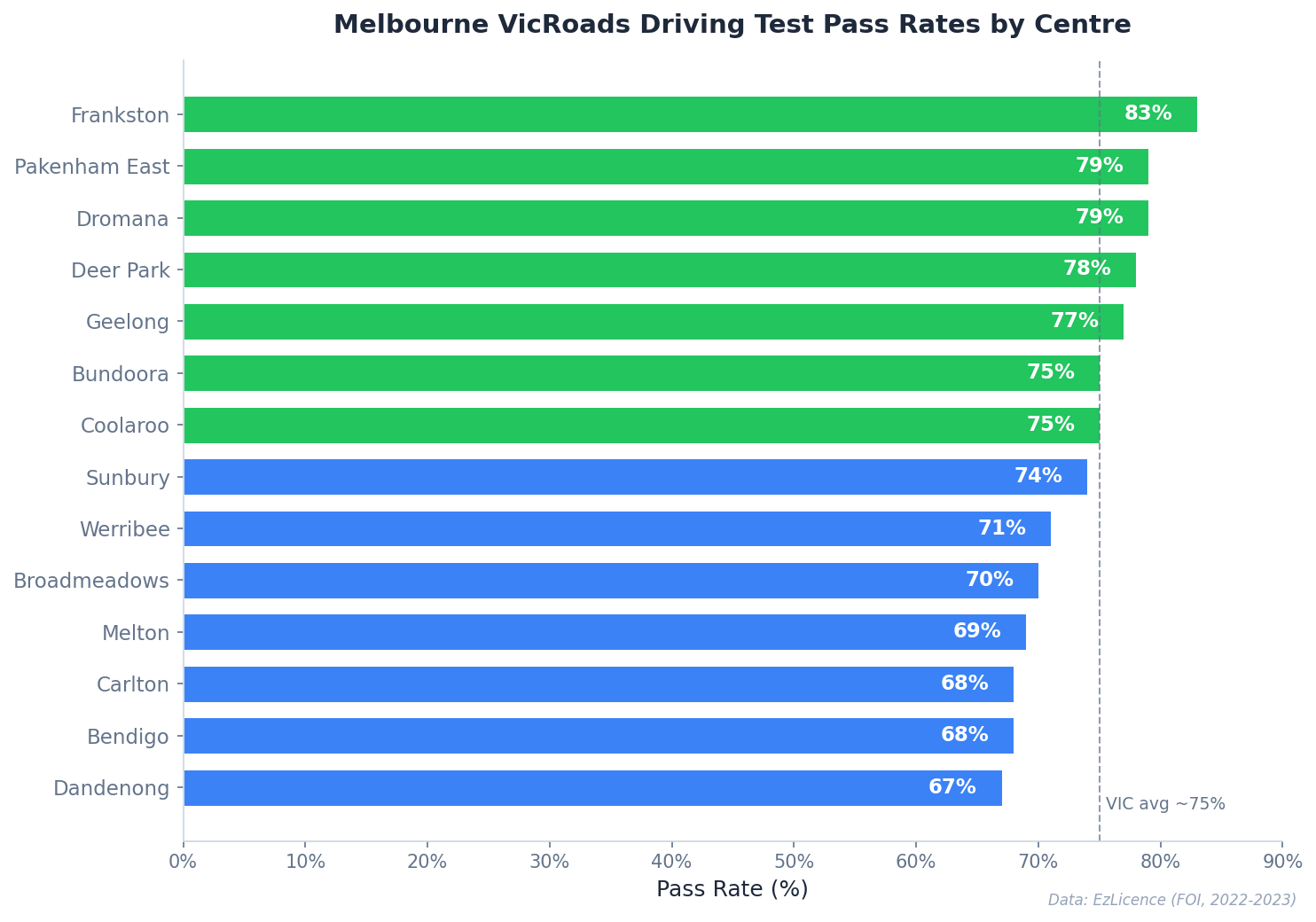
Melbourne VIC driving test pass rates by centre (EzLicence driving school students, 2022-2023)
| Centre | EzLicence students | Area |
|---|---|---|
| Frankston | 83% | Southeast Melbourne |
| Dromana | 79% | Mornington Peninsula |
| Geelong | 77% | Geelong |
| Bundoora | 75% | Northeast Melbourne |
| Coolaroo | 75% | North Melbourne |
| Sunbury | 74% | Northwest (outer) |
| Werribee | 71% | West Melbourne |
| Broadmeadows | 70% | North Melbourne |
| Melton | 69% | West (outer) |
| Carlton | 68% | Inner Melbourne |
| Bendigo | 68% | Regional VIC |
| Dandenong | 67% | Southeast Melbourne |
No pass rate data of any kind: Pakenham East, Deer Park, Heatherton, Ringwood (Mitcham), and Moorabbin. These are popular centres and we cover their routes below, but we are not going to put a number next to them that we cannot source.
Note that every centre in the table sits above the 72.2% state figure. That is the driving-school-student effect, not evidence that Melbourne centres are easier than the rest of Victoria.
Top Centres
Frankston: 83%
Frankston tops the VIC rankings at 83%, and may be one of the highest pass rates in all of Australia. Located in Seaford's industrial area, Frankston offers a mix of suburban streets and peninsula-bound arterials.
Test routes follow a two-stage format: Stage 1 covers residential streets (50 km/h) with parallel parking or a three-point turn, then Stage 2 moves onto faster roads (60-80 km/h) including Hartnett Drive, Seaford Road, Austin Road, and Peninsula Boulevard. The main challenge is merging onto Nepean Highway, where traffic moves fast.
The roads are well-maintained and clearly signed, and traffic is calmer than inner-city options, especially during afternoon slots and school holidays.
Common traps: Merging onto Nepean Highway without sufficient speed, large multi-lane roundabouts.
Best for: Southeast and peninsula residents looking for the best statistical odds in VIC.
Pakenham East: no published pass rate
Pakenham East is in Melbourne's outer southeast at 129 Treloar Lane, where suburban development is still spreading. Roads are newer, wider, and generally well-marked. Traffic is lighter than inner suburbs.
Routes connect Pakenham to surrounding suburbs via multi-lane roads with roundabouts at various speed limits. Stage 2 heads into semi-rural areas at 80 km/h. Key road: Ahern Road, signal early and show confident positioning when turning.
Best for: Southeast Melbourne residents. The quieter road environment suits nervous candidates.
Dromana: 79%
Dromana sits at the base of the Mornington Peninsula, about 75 km south of the CBD. Traffic is light, roads are straightforward, and the pace of driving is noticeably slower than metropolitan Melbourne. Test routes include quiet residential streets and sections of the main peninsula road.
The trade-off is the distance, it's a long drive from most of Melbourne, and unfamiliarity with the area could offset the pass rate advantage.
Best for: Peninsula residents or candidates willing to spend time practising in the area before test day.
Deer Park: no published pass rate
Deer Park sits in Melbourne's west. Routes cover about 9.8 km in around 20 minutes, running through residential streets, Robinsons Road (industrial zone), and Mt Derrimut Road (70 km/h).
The biggest trap at Deer Park is speed: the built-up area around the centre defaults to 50 km/h, but many candidates assume it's 60 km/h. This misjudgement is one of the most common reasons people fail here. Also watch for the complex intersection near the M80 freeway overpass.
Common traps: Assuming 60 km/h in a 50 km/h zone, complex turns near the M80 overpass, lane changes on Mt Derrimut Road with mixed local and through traffic.
Best for: Western suburbs residents who want a route mix that is easier to rehearse than the inner suburbs.
Bundoora: 75%
Bundoora is one of Melbourne's most popular test centres, sitting in the northeast near La Trobe University. The area has a mix of residential streets, main roads (Plenty Road at 60-70 km/h), and plenty of roundabouts. Bundoora is known for testing roundabout skills thoroughly.
Routes often head through University Hill (Graduate Road, Scholar Drive, Enterprise Drive) where pedestrian activity picks up during university hours. Multiple 40 km/h zones around the campus and nearby schools keep you on your toes.
The number one fail reason at Bundoora: not giving way when turning right, you must let all oncoming traffic through before completing your turn. Slip lanes (angled left turns onto multi-lane roads) also cause issues.
Common traps: Right turn give way errors, speeding through 40 km/h zones, pedestrian crossings near the university and shops.
Best booking time: 2:00-3:00 PM. Avoid Monday mornings and Friday afternoons.
Best for: Candidates confident with roundabouts who've practised the Bundoora area extensively.
Coolaroo: 75%
Coolaroo sits in Melbourne's north, close to Broadmeadows but with a slightly better pass rate. The centre is known for one particular feature: a busy two-lane roundabout that appears on most test routes. If you can handle that roundabout confidently, you're in good shape.
Test routes include Pascoe Vale Road (80 km/h dropping to 60 km/h) and residential streets with permanent 40 km/h zones. Watch for speed limit changes, they're frequent.
Common traps: Mounting the kerb when leaving the car park, incorrect turns, speeding through 40 km/h zones.
Best for: Northern suburbs candidates comfortable with multi-lane roundabouts and variable speed limits.
Mid-Range Centres
Broadmeadows: 70%
Often described as "easy" in online forums, Broadmeadows sits at 70%, decent but below the VIC average. The area around the VicRoads office is congested, especially near the Broadmeadows Shopping Centre and train station. Speed limits vary frequently along the test routes (40/50/60/70/80 km/h), and missing a change is a common error.
Common traps: Speed limit changes on Camp Road and Pascoe Vale Road, congestion near the shops, tight corners near the car park.
Carlton: 68%
Carlton records a low pass rate for VIC, tied with Bendigo, though it's actually improved significantly from just 39% back in 2013. Being inner-city, test routes pass through Lygon Street and surrounding streets with trams, narrow lanes, cyclists, and heavy pedestrian traffic.
The number one fail reason at Carlton: tram track violations. You must check behind for approaching trams before turning right across tracks, give way to passengers when tram doors open, and understand hook turn rules at marked intersections. The 40 km/h school zones switching to 60 km/h zones also catch people.
Common traps: Tram-related errors (the biggest one), cyclist interactions on Lygon Street, narrow lane positioning, 40/60 km/h speed zone transitions.
Dandenong: 67%
Dandenong has the lowest pass rate in VIC at 67%. The centre is in Melbourne's southeast, an area with heavy traffic, busy intersections, and a dense commercial district around Dandenong Plaza. Test routes often include multi-lane roads with frequent speed changes and high pedestrian activity near the shopping area.
The roads around Dandenong can be confusing: one-way sections, bus lanes, and complex intersections near the train station create an environment where errors add up quickly.
Common traps: Speed limit changes near the shopping centre, heavy traffic on Princes Highway, pedestrian activity, complex intersections near the station.
Popular Centres Without Pass Rate Data
Ringwood (Mitcham TIC): No Published Pass Rate
Officially called the "Mitcham Testing & Inspection Centre," Ringwood opened in April 2022 on Heatherdale Road and quickly became one of Melbourne's busiest centres, processing over 1,000 appointments and 600 driving tests per week.
Routes head from Heatherdale Road into surrounding Mitcham suburbs, mixing residential streets (50 km/h) with busier arterials. The permanent 40 km/h zone near the centre and Eastland Shopping Centre catches a lot of people. Test routes include roundabouts, traffic lights, merge lanes, and some hilly areas.
Watch this full test recording from Ringwood. It shows the actual test format including the pre-drive check:
Best for: Eastern suburbs residents. High capacity means shorter waiting times for bookings.
Heatherton: no published pass rate
Heatherton is in Melbourne's southeast. Routes mix industrial and residential areas with relatively few pedestrians.
The key roads are Warrigal Road (70 km/h) and Dingley Bypass (80 km/h). Heatherton has a unique quirk: three locations require turning right from the left lane, an unusual manoeuvre that catches unprepared candidates. Routes also include U-turns on 70 km/h roads and industrial-area sections with heavy vehicle traffic.
Common traps: "Right turn from left lane" manoeuvres, 40 km/h school zones (avoid booking at 8:30 AM or 3:00-3:30 PM), the complex Warrigal Road/Corporate Drive intersection.
Best booking time: 1:30-2:30 PM when traffic is lightest.
Best for: Southeast Melbourne residents who practise the specific tricky turns in the area.
VIC Drive Test Format
The VIC drive test lasts approximately 30-45 minutes and covers:
- Low-speed manoeuvres: Parallel parking and/or three-point turn (mandatory)
- Urban driving: Residential streets, main roads, traffic lights, roundabouts
- Speed management: Multiple speed zones, school zones during school hours
- Lane changes and merges
- Hazard response
What Fails You Instantly
- Exceeding the speed limit
- Running a red light or stop sign
- Failing to give way when required (especially at roundabouts)
- Dangerous action requiring the examiner to intervene
- Mounting the kerb during manoeuvres
Most Common Errors (VIC-specific)
- Give way at roundabouts: the #1 reason for failure in VIC
- Speed zone changes: missing the transition from 60 to 40 km/h
- School zones: forgetting the 40 km/h limit during school hours (8:00-9:30 AM, 2:30-4:00 PM on school days)
- Insufficient observation: not doing head checks when changing lanes or turning
- Parallel parking errors: ending up too far from the kerb or hitting it
How to Choose Your Centre
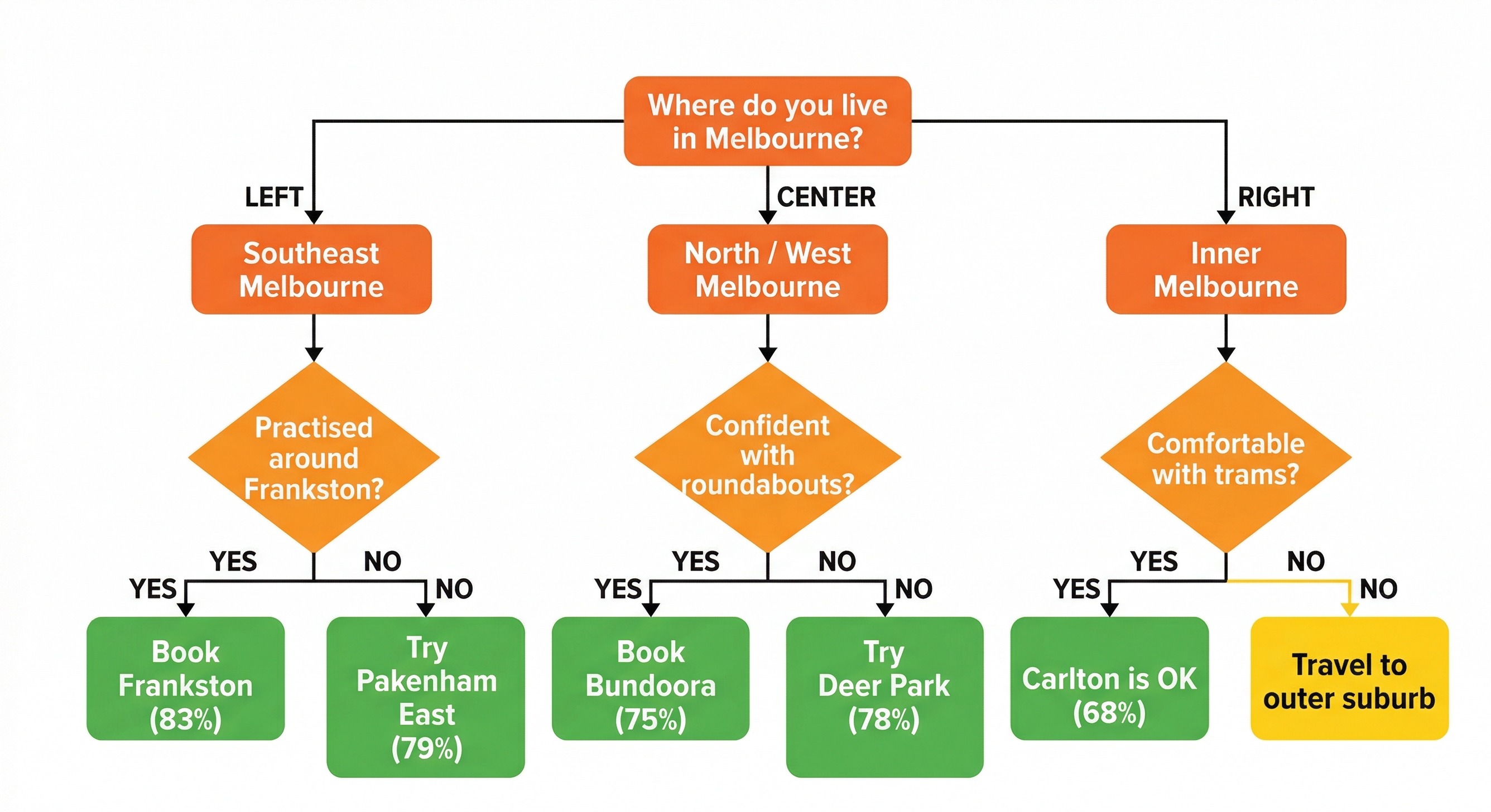
How to choose a Melbourne test centre based on location and confidence
Look at the data first
The spread between Frankston (83%) and Dandenong (67%) in the EzLicence student data is real, but remember what that data is: driving school students, not everyone. The only number that covers every Victorian candidate is the state figure, 72.2%, and it is not broken down by centre because VicRoads says it cannot extract that.
Prioritise familiarity
A candidate who has done 50 hours of supervised driving around Broadmeadows will almost certainly do better there than at an unfamiliar Frankston, even though Frankston has a 13-point higher pass rate.
Practise on test routes
This is the single most impactful thing you can do. Drive the roads around your chosen centre until you know every speed zone, every tricky intersection, and every roundabout by heart.
Use AUDrive to explore driving test routes at Melbourne VicRoads centres, we map the actual routes used during tests so you can practise them before test day.
Book at quieter times
Avoid school run times (8:00-9:30 AM, 2:30-4:00 PM) and Friday afternoons. Mid-morning Tuesday to Thursday is usually the calmest.
Centre-Specific Fail Reasons
Each centre has its own signature pitfall. Knowing yours before test day is half the battle.
| Centre | #1 Fail Reason |
|---|---|
| Bundoora | Not giving way when turning right |
| Carlton | Tram track violations |
| Deer Park | Assuming 60 km/h in a 50 km/h default zone |
| Heatherton | "Right turn from left lane" manoeuvres |
| Coolaroo | Poor lane discipline at Barry Road roundabout |
| Frankston | Merging onto Nepean Highway without sufficient speed |
Booking Your Test
Waiting time: Typically about 3 weeks for a booking slot. Weekend slots fill up faster. Book 4-6 weeks ahead if you want a specific centre or time.
2025 policy change: You now need to cancel or change your booking at least 72 hours in advance. Cancelling without sufficient notice may affect your rebooking priority.
Book through VicRoads:
- Online: vicroads.vic.gov.au
- Phone: 13 11 71
| Item | Cost |
|---|---|
| Drive test (P1 licence) | $73.30 ($51.80 test + $21.50 appointment) |
| Learner permit (online knowledge test free) | Free under Free Ls scheme |
Arrive 30 minutes before your appointment to complete paperwork and vehicle checks.
VIC Free Ps Program: If you hold a valid Healthcare Card, the VicRoads practical drive test fee may be covered under the Free Ls and Ps program. Check vicroads.vic.gov.au for eligibility.
Frequently Asked Questions
What is the highest pass rate driving test centre in Melbourne?
Frankston, at 83%, tops the only per-centre figures that exist publicly: EzLicence's 2022-2023 data covering its own driving school students, not the whole testing population. Dromana is next at 79%. There is no official per-centre pass rate for Victoria; VicRoads refused that part of our FOI request on the basis that the data cannot be extracted from its systems.
How long is the VIC driving test?
The VIC drive test takes approximately 30 to 45 minutes. It includes low-speed manoeuvres (parallel parking or three-point turn) and on-road driving through residential streets, main roads, roundabouts, and various speed zones.
How much does the VicRoads driving test cost?
The VicRoads drive test for a P1 licence costs $73.30 ($51.80 test fee + $21.50 appointment fee). Under the Free Ls and Ps scheme, the first online learner permit knowledge test and hazard perception test are free.
What fails you instantly on the VIC driving test?
Exceeding the speed limit, running a red light or stop sign, failing to give way when required, any dangerous action requiring the examiner to intervene, and mounting the kerb during manoeuvres all result in an immediate fail.
What is the most common reason for failing in Victoria?
Give way errors at roundabouts are the number one reason for failure in VIC. Speed zone changes (missing the transition from 60 to 40 km/h) and insufficient head checks when changing lanes or turning are also top fail reasons.
Should I choose a test centre with a higher pass rate?
Higher pass rates help, but familiarity with the roads matters more. A candidate who has done 50 hours of practice around Broadmeadows will almost certainly do better there than at an unfamiliar centre like Frankston, even with a 13-point pass rate difference.
Related Guides
- VIC Driving Test Complete Guide: Full breakdown of the VIC drive test format, scoring, and what to expect.
- Head Check and Mirror Technique Guide: The number one fail reason in Australia and how to build proper observation habits.
- Best Time to Book Your Driving Test: When to book for the least traffic and best conditions.
Summary
Two things are worth carrying away. First, the honest Victoria-wide number is 72.2%, from 492,504 official VicRoads tests, and more than one in five tests is stopped before it finishes. Second, the per-centre ranking you see everywhere, Frankston 83% down to Dandenong 67%, comes from one driving school's students rather than from government data, so treat it as a hint about road environments rather than as your odds. The pattern it hints at is plausible: outer-suburban and peninsula centres with quieter roads look better, inner centres like Carlton and busy southeast centres like Dandenong look worse.
Pick your centre based on where you've practised, check if a nearby option has noticeably better numbers, and book a mid-morning weekday slot. With VIC's already high baseline pass rates, solid preparation on local routes is the difference between passing and having to rebook.