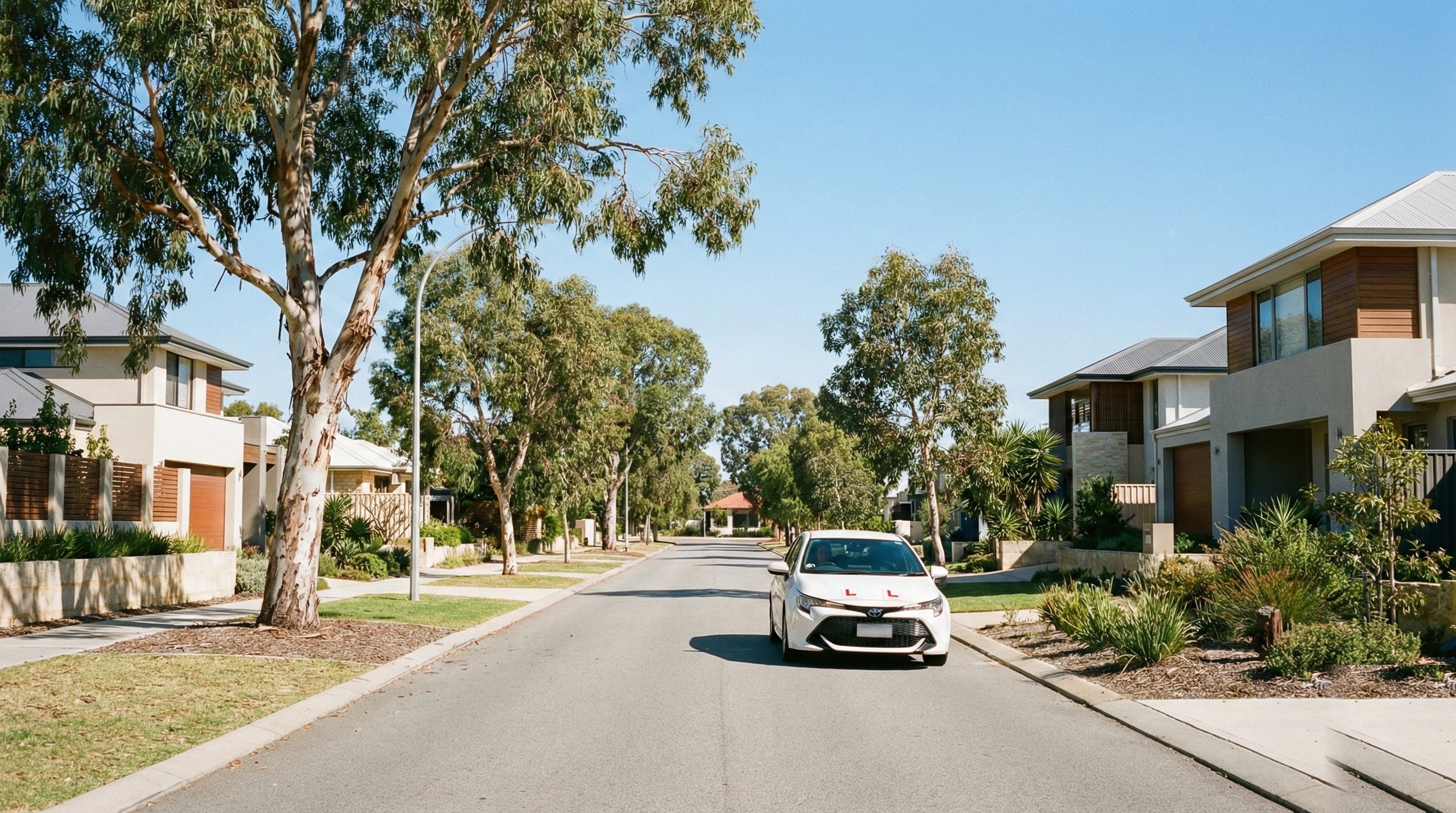
Perth driving test centres have the lowest pass rates in Australia. Official government data puts the Western Australia state average at 42.3% (DoT FOI 2026-0140), the lowest of any Australian state. A separate per-centre breakdown covers 244,557 tests across 25 locations. This guide examines the data behind each centre and provides practical advice to help you beat the odds.
Why Does WA Have Australia's Lowest Pass Rate?
Before looking at individual centres, it helps to understand why WA's pass rates are so much lower than other states:
- Fewer mandatory practice hours: WA requires only 50 supervised driving hours, compared to 100 hours in Queensland and 120 hours in Victoria and NSW.
- Less experienced candidates: The lower hour requirement means many learners sit the test before they have developed sufficient skills and road awareness.
- Strict assessment criteria: WA's PDA uses a section-based system where candidates must pass 4 out of 5 sections with no critical errors.
The low pass rate is not because Perth roads are inherently more dangerous. It reflects a systemic gap between the minimum required preparation and the actual skill level needed to pass.
State-by-State Comparison
| State | Average Pass Rate | Mandatory Practice Hours |
|---|---|---|
| Victoria | 72.6%* | 120 hours |
| Queensland | 71.1% | 100 hours |
| NSW | 61.7% | 120 hours |
| Western Australia | 42.3% | 50 hours |
*VIC figure from third-party platform data, not official government statistics. FOI request pending.
Perth Test Centre Pass Rates at a Glance
The following pass rates are from official WA Department of Transport data, obtained via Freedom of Information request (FOI 2026-0140). The data covers 244,557 Class C Practical Driving Assessments across 22 major WA centres from January 2024 to March 2026. Three additional locations in the FOI data (Success DVS with only 41 tests, Fitzroy Crossing with 9 tests, and a "Remote Areas Licensing" category) are excluded due to small sample sizes.
All Perth Metro Centres
| Rank | Test Centre | Pass Rate | Tests | Trend (2024 vs 2025) |
|---|---|---|---|---|
| 1 | Cannington DVS | 56.4% | 12,766 | 60.8% → 55.1% (↓5.7) |
| 2 | Mandurah DVS | 43.1% | 10,686 | 41.3% → 44.3% (↑3.0) |
| 3 | Joondalup DVS | 42.8% | 52,901 | 44.8% → 40.9% (↓3.9) |
| 4 | Butler DVS | 41.6% | 14,434 | 38.4% → 44.6% (↑6.2) |
| 5 | Kelmscott DVS | 39.3% | 44,087 | 42.9% → 36.3% (↓6.5) |
| 6 | Rockingham DVS | 38.3% | 21,421 | 38.9% → 37.7% (↓1.2) |
| 7 | City West Perth DVS | 34.1% | 18,878 | 35.5% → 32.9% (↓2.6) |
| 8 | Mirrabooka DVS | 31.3% | 19,563 | 28.1% → 34.2% (↑6.0) |
| 9 | Midland DVS | 28.3% | 20,326 | 29.3% → 27.5% (↓1.8) |
Metro average: 39.2% across 215,062 tests. Midland (28.3%) is the hardest major test centre in Australia. Cannington (56.4%) is the clear best choice in Perth, but its rate is declining fast.
Regional WA Centres
| Centre | Pass Rate | Tests |
|---|---|---|
| Exmouth | 79.3% | 241 |
| Carnarvon | 73.7% | 384 |
| Kununurra | 73.6% | 416 |
| Broome | 70.1% | 1,394 |
| Geraldton | 64.7% | 3,287 |
| Newman | 64.2% | 425 |
| Albany | 62.6% | 3,502 |
| Esperance | 60.0% | 1,057 |
| Tom Price | 57.8% | 427 |
| Karratha | 55.7% | 2,063 |
| Busselton | 50.6% | 2,597 |
| Kalgoorlie | 47.6% | 4,553 |
| Bunbury | 36.4% | 7,587 |
Regional average: 53.6% across 26,332 tests. A 14.4-point gap between metro and regional. Bunbury is the notable outlier: a regional centre with metro-level difficulty.
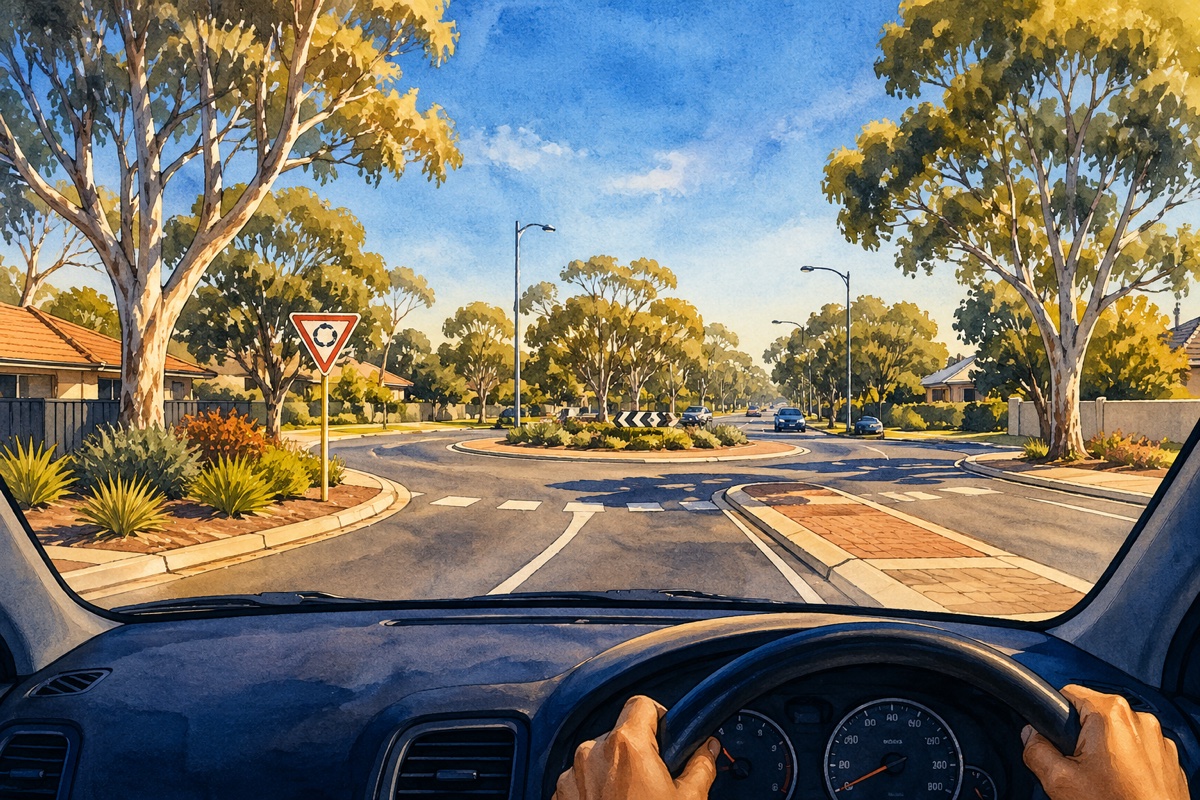
Wide residential streets and roundabouts are typical of Perth test routes. Familiarity with your centre's roads matters more than the centre's average pass rate.
Detailed Centre Analysis
Cannington DVS Centre (56.4% Pass Rate)
Cannington is Perth's top performer by a wide margin and should be the first choice for most candidates. Located in the southern suburbs, the test area features well-planned residential streets with wide roads, good visibility, and manageable traffic levels. Roundabouts are present but tend to be single-lane and straightforward. The suburban layout gives candidates room to demonstrate their skills without the pressure of congested traffic or complex intersections.
Key tips from successful candidates:
- Stop completely at every stop sign, even when no traffic is visible. rolling stops are an instant fail.
- At give way signs, observe carefully in both directions before proceeding.
- Make head checks extremely obvious when turning or changing lanes. turn your head far enough to see through the rear side window.
- Check your centre mirror frequently: before slowing, before turning, and at red lights.
- When the examiner instructs consecutive turns (such as left then immediately right), position yourself in the correct lane during the first turn.
Warning: Cannington's rate is declining: 60.8% in 2024, 55.1% in 2025, 49.2% in Q1 2026. It is still the best option, but the gap is narrowing.
Best for: All candidates, especially those prioritising the highest statistical chance of passing.
Butler DVS Centre (41.6% Pass Rate)
Butler, in Perth's far northern suburbs, is an improving option. Its pass rate climbed from 38.4% in 2024 to 44.6% in 2025, one of the biggest jumps among Perth centres. The surrounding area is relatively new residential development, meaning roads are wide, well-marked, and generally in good condition. Traffic tends to be lighter than at more central locations, and the road layout is modern and predictable.
Best for: Candidates in Perth's northern corridor who want a favourable test environment.
Mandurah DVS Centre (43.1% Pass Rate)
Mandurah has improved significantly from its earlier reputation. At 43.1%, it now sits above the metro average. The rate climbed from 41.3% in 2024 to 44.3% in 2025. Located about 70 km south of Perth's CBD, it offers a less congested test environment than inner-city centres.
Best for: Candidates in Perth's southern corridor. No longer the worst option it once was.
Joondalup DVS Centre (42.8% Pass Rate)
Joondalup is Perth's busiest centre by far with 52,901 tests in the dataset. At 42.8%, it sits near the state average. The pass rate has dipped from 44.8% in 2024 to 40.9% in 2025.
Best for: Northern suburbs candidates who want a large, well-established centre.
Kelmscott DVS Centre (39.3% Pass Rate)
Kelmscott, in Perth's southeastern foothills, has seen the biggest decline among metro centres: from 42.9% in 2024 to 36.3% in 2025 (a 6.5-point drop). The test area includes some hilly sections and a mix of suburban and semi-rural roads. There are reports that assessment standards at Kelmscott have been tightened recently after a period of higher pass rates, so candidates should be prepared for a thorough examination.
Important note: Some driving instructors report that the 45-degree reverse parking manoeuvre can be assessed differently at Kelmscott. If your car's front extends past the right-hand corner during the manoeuvre, certain examiners may mark it as driving on the wrong side of the road. Clarify the expected technique with your instructor before testing here.
Best for: Candidates who live locally and have practised extensively in the foothills area.
Rockingham DVS Centre (38.3% Pass Rate)
Rockingham, south of Perth, sits below the metro average. Despite being a coastal suburb with some quieter residential areas, the pass rate remains low. Speed management and observation skills are commonly cited areas where candidates fall short.
City West Perth DVS Centre (34.1% Pass Rate)
City West Perth presents an urban test environment with all the challenges that come with inner-city driving: narrow lanes, heavy traffic, complex intersections, and abundant pedestrians. The pass rate of 34.1% reflects the demanding conditions and has slipped further from 35.5% in 2024 to 32.9% in 2025. Most driving schools advise against choosing this centre unless you specifically need a city-centre location.
Why it's harder: Dense traffic, complex road layouts, heavy pedestrian activity, and limited margin for error in tight urban streets.
Mirrabooka DVS Centre (31.3% Pass Rate)
Mirrabooka, in Perth's northern suburbs, is one of the harder centres. However, it showed a notable improvement from 28.1% in 2024 to 34.2% in 2025 (+6.0pp). The area features a mix of residential and commercial zones with moderate to heavy traffic.
Best for: Only if you live locally and have done extensive preparation in the area.
Midland DVS Centre (28.3% Pass Rate. Australia's Hardest)
Midland is the hardest major test centre in Australia. Fewer than 3 in 10 candidates pass here, and the rate is still declining (29.3% → 27.5%). The area includes a mix of older suburban roads and some arterial connections with unpredictable traffic. Unless you live in Midland and cannot travel elsewhere, the data strongly suggests looking at other centres.
Common Reasons for Failure in Perth
Based on driving instructor feedback and community reports, these are the most frequent causes of failure at Perth test centres:
- Speeding by more than 5 km/h. any amount of speeding can fail you, but exceeding by 5+ km/h is almost guaranteed failure.
- Not stopping completely at stop signs. you must come to a full stop and observe before proceeding.
- Right of way confusion. yielding when you have right of way, or failing to yield when you should.
- Examiner intervention. if the examiner brakes, steers, or verbally intervenes with "stop," it is an immediate fail.
- Not giving way to buses. a bus signalling to pull out from a stop must be given way.
- Running amber or red lights. if you are far enough away to stop safely, you must stop.
- Not yielding to pedestrians at crossings. including pedestrians who have reached a refuge island.
- Insufficient observation. not checking mirrors and blind spots frequently enough.
- Missing examiner instructions repeatedly. if you cannot hear or understand, ask the examiner to repeat.
- Poor observation when reversing. including over-reliance on reversing cameras (glancing at the camera is acceptable, but staring at it is not).
Important: Do not wave pedestrians across the road. While it might seem polite, examiners may view it as interfering with traffic flow, and it can result in marks against you.
The "Left Something Behind" Manoeuvre
A test element that surprises some candidates at Perth centres is the "left something behind" instruction. After pulling over, the examiner will say something like "You left something behind." This means you need to find a safe place to make a U-turn or three-point turn and drive back to your original stopping point. It tests your ability to safely reverse your direction in traffic.
How to Choose the Right Centre
1. Cannington Should Be Your Default Choice
With a 56.4% pass rate, 28 points higher than Midland, Cannington is the statistically strongest option for almost every Perth candidate. If you can travel there, it should be your first choice. Note that the rate is declining, so don't delay.
2. Mandurah and Butler as Alternatives
Mandurah (43.1%) and Butler (41.6%) are both improving and sit above the metro average. Mandurah works for southern suburbs, Butler for northern.
3. Avoid Midland, Mirrabooka, and City West Perth
Unless you have a compelling reason (such as living immediately next to one of these centres), the data strongly suggests looking elsewhere. Midland at 28.3% means nearly 3 out of 4 candidates fail.
4. Invest in Extra Practice Hours
Given WA's low mandatory hour requirement, the single most effective thing you can do is exceed the minimum significantly. Driving instructors recommend 80-100 hours of supervised driving rather than the 50-hour minimum. The data supports this: the states with higher hour requirements have dramatically better pass rates.
5. Take Professional Lessons
At least 5-10 hours of professional instruction, ideally with an instructor who knows your chosen test centre, can make a critical difference. They will know the specific routes, common trouble spots, and what examiners look for.
Booking Your Driving Test
You can book your WA Practical Driving Assessment through:
- Online: DoTDirect (transport.wa.gov.au)
- Phone: 13 11 56
- In person: Any Driver and Vehicle Services (DVS) centre or regional agent
Your first PDA attempt is included in the $143.30 learner permit fee at no extra cost. If you do not pass, each re-test costs approximately $120.50.
Transmission note: If you take your PDA in an automatic vehicle, your licence will be restricted to automatic vehicles only for the first 12 months. A manual licence covers both manual and automatic.
Key Reminders for Your WA Driving Test
- The PDA lasts approximately 45 to 50 minutes.
- You must pass 4 out of 5 sections with no critical ("Discontinue" or "Fail") endorsements.
- Critical errors include running red lights, speeding, stop sign violations, failing to give way, and causing danger.
- Make all observation checks (mirrors, head checks, blind spots) exaggerated and obvious.
- Follow the Mirror-Signal-Manoeuvre sequence strictly.
- Use the free Learn&Log app via Service WA to track your practice hours digitally.
What We'd Do
Book Cannington. 56.4% is still below the national average, but it's double the rate at Midland. If you're in the northern suburbs, Butler (41.6%) or Joondalup (42.8%) are fine. If you're in the south, Mandurah (43.1%) has improved significantly.
Do not book Midland unless you literally live there. 28.3% means nearly 3 out of 4 people fail. That's not just bad luck.
And the single biggest thing you can do: drive more than 50 hours. Way more. The states that require 100-120 hours have pass rates above 60%. WA requires 50 and gets 42%. The math speaks for itself.
Related Guides
- WA Driving Test Complete Guide: Full breakdown of the WA Practical Driving Assessment, from eligibility rules to what the examiner scores you on.
- Head Check and Mirror Technique Guide: How to make your mirror checks and head checks obvious enough that the examiner can't miss them.
- Best Time to Book Your Driving Test: When to book for lighter traffic and shorter wait times, based on data from Australian test centres.
Frequently Asked Questions
What is the easiest driving test centre in Perth?
Cannington DVS Centre has the highest pass rate in Perth at 56.4%, based on official WA Department of Transport data (FOI 2026-0140, 244,557 tests). Mandurah (43.1%) and Joondalup (42.8%) are the next best options.
Why is Perth's driving test pass rate so low?
Western Australia's official state average is 42.3% (DoT FOI 2026-0140), compared to 72.6% in Victoria and 71.1% in Queensland. The main reason for WA's low rate is that WA only requires 50 supervised driving hours, while Victoria and NSW require 120 hours. Many candidates sit the test before they have built enough skill and road awareness.
Which Perth test centre should I avoid?
Midland DVS Centre has the lowest pass rate of any major test centre in Australia at 28.3%, meaning nearly 3 out of 4 candidates fail there. Mirrabooka (31.3%), City West Perth (34.1%), and Bunbury (36.4%) also fall well below the state average. Unless you live right next to one of these centres, the data suggests looking elsewhere.
How long does the Perth driving test take?
The WA Practical Driving Assessment (PDA) lasts approximately 45 to 50 minutes. You must pass 4 out of 5 sections with no critical errors. Critical errors include running red lights, speeding, stop sign violations, failing to give way, and causing danger.
How much does it cost to take the driving test in Perth?
Your first PDA attempt is included in the $143.30 learner permit fee at no extra cost. If you do not pass, each re-test costs approximately $120.50. Book through DoTDirect at transport.wa.gov.au, by phone at 13 11 56, or in person at any DVS centre.
How many practice hours do I actually need to pass in Perth?
WA's minimum is 50 supervised hours, but driving instructors recommend 80-100 hours given the low state pass rate. The data backs this up: states with higher mandatory hour requirements (Victoria at 120 hours, Queensland at 100 hours) have dramatically better pass rates.
Data source: Official WA Department of Transport data, FOI 2026-0140. State average (42.3%) from aggregate dataset covering 292,253 tests. Per-centre breakdown covers 244,557 tests across 25 locations, January 2024 to March 2026. The difference reflects a shorter date range in the per-centre release.
Explore driving test routes near your chosen centre with AUDrive. our interactive map helps you practise the exact roads you will encounter on test day.
Disclaimer: This article is for informational purposes only. Pass rates are based on third-party data and do not guarantee individual outcomes. Always refer to the WA Department of Transport for the latest official test requirements and booking information.