What You're Dealing With
The Queensland practical driving test, officially called the Q-SAFE (Queensland Safe) assessment, takes 30 to 45 minutes and is run by Transport and Main Roads (TMR). About 61% of candidates pass statewide, which puts Queensland just below the national average.
What makes QLD different from other states: there's no fixed pass mark or percentage score. The examiner decides whether you drive safely and consistently. One critical error ends the test, and too many minor errors add up to a fail even if nothing seems dramatic on its own.
Two other things to know upfront: QLD has the harshest penalty for overseas licence holders who fail (your driving authority is immediately withdrawn), and school zones here start at 7:00 am, earlier than most other states.
QLD Licence System
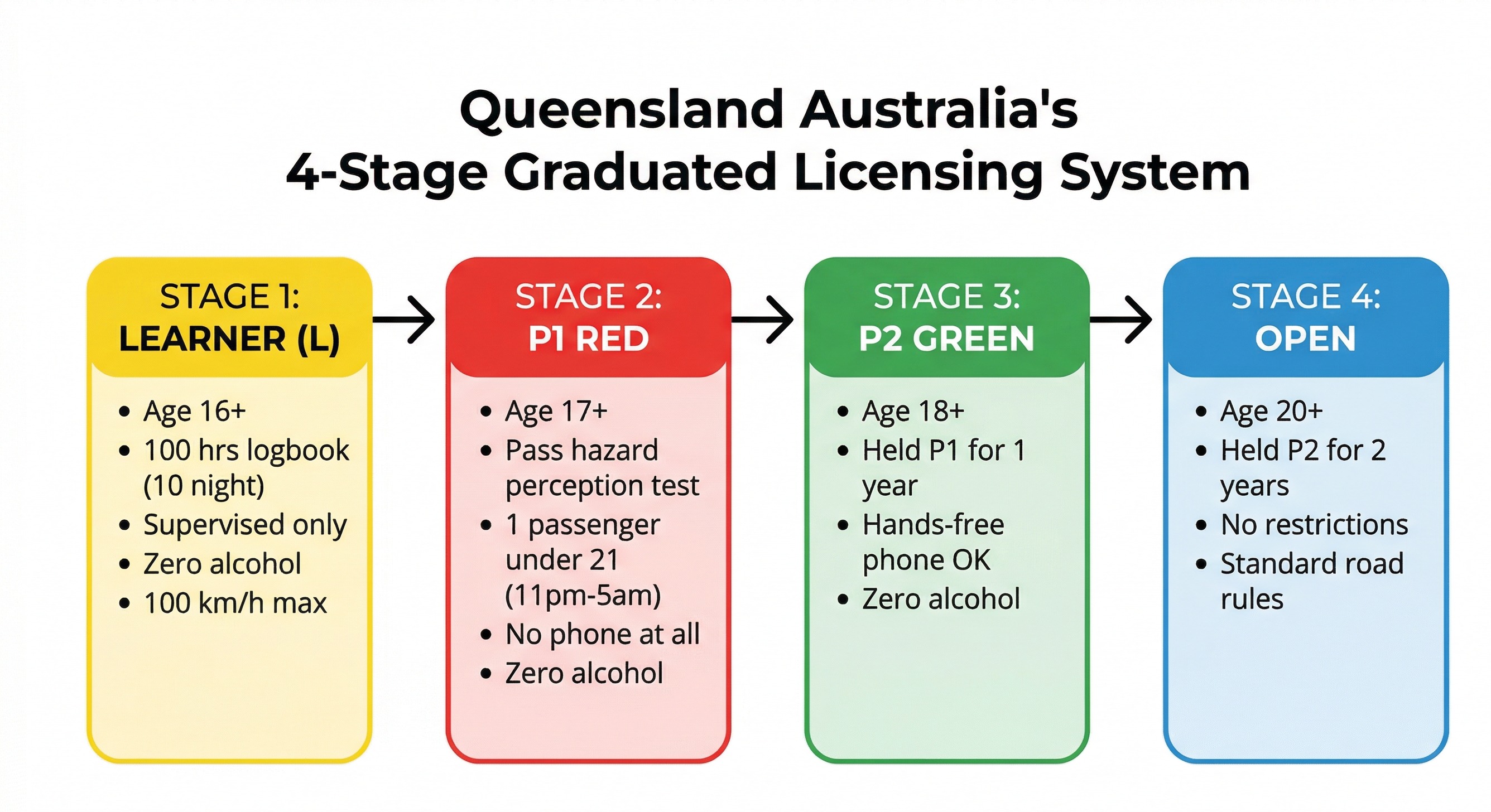
Queensland graduated licensing system: Learner to Open licence
Queensland uses a four-stage system. Here's what each stage involves.
| Stage | Min Age | Speed Cap | Duration | Key Points |
|---|---|---|---|---|
| Learner (L) | 16 | 100 km/h | 12 months (under 25) | 100 hrs supervised driving |
| P1 (Red P's) | 17 | 100 km/h | 12 months min | Passenger & phone restrictions |
| P2 (Green P's) | 18 | 100 km/h | 24 months min (if P1 before 23) | Hands-free phone OK |
| Open | 20 | Posted limit | Ongoing | No restrictions |
Getting Your Learner Licence
Pass the written road rules test at a TMR customer service centre, it costs $28.70. You'll receive a learner licence valid for 3 years ($77.55).
Building Your Hours (Under 25 Only)
You need 100 hours in your logbook, including 10 hours at night (between sunset and sunrise).
QLD has a 3-for-1 bonus: each hour with a certified driving instructor counts as 3 logbook hours, up to 10 instructor hours = 30 logbook hours.
Watch out: Night lessons with an instructor can count as either 3 hours of daytime driving OR 1 hour of night driving, not both. If you need night hours, log some instructor lessons as night hours rather than tripling them.
Important: You must submit your logbook to TMR at least 12 business days before your test. You can submit through the QLD Learner Logbook app or drop a paper logbook at Australia Post (they'll forward it to TMR). If your test is on a Monday, you need to submit roughly two and a half weeks earlier, accounting for weekends and public holidays. Late submission = cancelled test.
If you're 25 or older, there's no logbook, no minimum hours, and no minimum holding period.
P1 Restrictions
Once you pass, you're on red P's for at least 12 months:
- 100 km/h maximum, even on highways posted at 110
- Zero alcohol
- No phone at all (under 25): Not hands-free, not Bluetooth, not mounted as GPS, not as a music player. Don't touch it. P1 holders 25+ can use hands-free in a fixed mount.
- Passenger restriction (under 25): Between 11 pm and 5 am, maximum 1 passenger under 21 who is not an immediate family member
- High-powered vehicle restrictions apply (under 25)
What the Test Actually Looks Like
This video from Driving Test Australia walks through how examiners actually mark the Q-SAFE, including the marking sheet and what counts as critical vs non-critical errors:
Part 1: Pre-Drive Checks (~5 minutes)
The examiner asks you to locate and demonstrate vehicle controls: headlights, indicators, hazard lights, wipers, horn, demisters, handbrake, seatbelt. They'll also check your vehicle is roadworthy.
This part is easy if you've practised it once. Failing to start the engine or forgetting to release the handbrake can end your test before it starts.
Part 2: Low-Speed Manoeuvres
You'll perform controlled manoeuvres at low speed:
- Three-point turn, turning the vehicle around on a narrow road
- Reverse parallel parking, between two vehicles or markers
- Kerb-side stop, pulling over safely to the left
- Hill start, if your route includes hills (common at centres like Toowong)
- U-turn, if the examiner requests one
The examiner looks for control, observation, and correct use of mirrors and indicators. This video demonstrates all 6 QLD manoeuvres:
Part 3: Traffic Driving (~25-30 minutes)
This is where most people pass or fail. You'll drive through a mix of:
- Intersections, traffic lights, stop signs, give way signs, uncontrolled
- Roundabouts, correct lane, giving way, signalling left when exiting
- Lane changes, mirror, signal, head check, maintain speed
- Speed zones, multiple transitions between 40, 50, 60, 80, 100
- Following distance, maintaining a safe gap
- Hazard response, scanning for pedestrians, cyclists, and potential dangers
How Scoring Works
The Q-SAFE uses competency-based assessment, there's no fixed percentage or point system. The examiner evaluates whether you consistently demonstrate safe driving behaviour across all competency areas.
- Critical errors = immediate fail (1 is enough)
- Non-critical errors = you can accumulate up to 8 and still pass, but 9 or more non-critical errors across different areas will fail you
This means you need to drive well throughout the entire test, not just avoid one big mistake.
Instant Fail Items
One critical error = automatic failure. It doesn't matter how well you drove for the other 40 minutes.
These end your test immediately:
- Running a red light, including entering on amber when you could have safely stopped
- Speeding, exceeding the posted limit by any amount, even 1 km/h
- Stop sign violation, not coming to a complete stop, or stopping past the white line
- Failing to give way, at intersections, to pedestrians, or to emergency vehicles
- Causing danger, forcing another road user to brake, swerve, or take evasive action
- Hitting anything, vehicles, kerbs, bollards, objects
- Examiner intervention, if they speak up, grab the wheel, or use the brake
- Crossing solid lines unsafely
- Missing a head check, failing to visibly turn your head when changing lanes or merging
Why People Actually Fail
These are the mistakes that cause the most failures in Queensland. Every one is avoidable.
1. Head checks. The single most common fail reason. A mirror glance isn't enough, the examiner must see you physically turn your head past your shoulder before every lane change, merge, or pull-out. Make it obvious.
2. Poor mirror habits. Check your mirrors every 5 to 8 seconds during normal driving. Move your head slightly so the examiner can see you're looking. Many candidates focus so heavily on the road ahead that they neglect mirrors entirely.
3. Stop signs. Come to a complete stop. Your wheels must stop moving entirely. Count "one-one-thousand, two-one-thousand, three-one-thousand" before checking and proceeding. Rolling through, even slowly, is a critical error.
4. Speed management. Too fast is an instant fail. But too slow, holding up traffic by driving 45 in a 60 zone, also costs marks and suggests a lack of confidence. Aim for 2-5 km/h below the posted limit.
5. Roundabout errors. Wrong lane, failing to give way to vehicles already on the roundabout (approaching from your right), and forgetting to signal left when exiting. Practice these until they're automatic.
6. Lane positioning. Drifting within your lane or failing to stay centred, particularly on curves, raises concerns about vehicle control.
7. Indicator timing. Signal at least 5 seconds before turning or changing lanes. Count it out: "one thousand, two thousand, three thousand, four thousand, five thousand." Many people signal too late or forget entirely.
Pass Rates by Test Centre
Pass rates vary significantly across Queensland. Statewide, about 61% of candidates pass. In Brisbane, the range goes from roughly 53% to 76% depending on which centre you choose.
Brisbane Region
| Centre | Approx. Pass Rate | Notes |
|---|---|---|
| Cleveland TMR | ~76% | Quieter suburban roads, less complex traffic |
| Logan City (Site 2) | ~70% | Suburban assessment centre |
| Wynnum TMR | ~68% | Eastern suburbs, manageable routes |
| Sherwood TMR | ~67% | Inner-west, moderate traffic |
| Logan TMR | ~65% | South Brisbane, well-known routes |
| Toowong TMR | ~59% | Hilly terrain, manual transmission is harder here |
| Caboolture TMR | ~53% | North Brisbane, busier roads |
| Strathpine TMR | ~54% | North Brisbane |
| Carseldine TMR | ~54% | North Brisbane |
| Zillmere TMR | ~54% | North Brisbane |
Data sourced from analysis of QLD Government open data, January 2022 to December 2023.
City-Level Averages
| Region | Pass Rate |
|---|---|
| Brisbane | 63% |
| Gold Coast | 59% |
| Sunshine Coast | 58% |
What the Numbers Tell You
- South and east Brisbane consistently outperform the north. Cleveland, Logan, and Wynnum have quieter roads and simpler routes.
- North Brisbane (Caboolture, Strathpine, Carseldine, Zillmere) clusters around 53-54%, well below the state average.
- Toowong is known for steep hills. If you're driving manual, the gradient + traffic lights combo is challenging.
- Under 20 pass rate is 65%; 40+ drops to 52%.
- Automatic has a slightly higher pass rate (63%) than manual (59%).
Tip: Choose a centre where you've actually practised. Travelling to a "high pass rate" centre in an unfamiliar area can do more harm than good.
QLD Rules That Catch People Out
School Zones
| Time | Speed Limit | When |
|---|---|---|
| 7:00 - 9:00 AM | 40 km/h | School days only |
| 2:00 - 4:00 PM | 40 km/h | School days only |
QLD school zones start at 7:00 am, a full hour earlier than NSW, VIC, TAS, and ACT. If you've practised in another state, don't let this catch you.
Some split-campus schools have all-day zones (7 am - 4 pm). Watch for electronic flashing signs, when the lights flash, the zone is active regardless of the time shown.
U-Turns
- On regular roads: U-turns are allowed as long as you have a clear view and can do it safely
- At traffic lights: U-turns are banned unless a U-turn permitted sign is displayed (same rule as NSW)
- You must give way to all other vehicles and pedestrians when making any U-turn
- Choose a location with clear visibility in both directions
Roundabouts
- Give way to vehicles already in the roundabout (traffic approaching from your right)
- Signal left when exiting, regardless of which exit you take
- Be in the correct lane before entering a multi-lane roundabout
- Maintain steady speed through the roundabout
Mobile Phone Rules
| Licence | Phone Use |
|---|---|
| L and P1 (under 25) | Completely banned, no hands-free, Bluetooth, GPS, or music. Don't even touch it. |
| P1 (25+) and P2 | Hands-free only (fixed mount or untouched) |
| Open | Hands-free permitted |
Note: Your passengers can't use a phone on loudspeaker while you're driving either. If they do, they (not you) can be fined, but it's still a distraction you don't need on test day.
Vehicle Requirements
Your vehicle must meet these requirements or the examiner will refuse to test you:
Must have:
- Current Queensland registration
- Working seatbelts, headlights, brake lights, indicators
- Clean windscreen and mirrors
- Speedometer visible from the passenger seat
- L plates displayed front and rear
- No dashboard warning lights
- Adequate fuel
Must not have:
- Cracked or damaged windscreen
- Bald or damaged tyres
- Loose items in the cabin
- Personally imported vehicles with recalled Takata airbags
Arrive early on test day so you have time to check. A rejected vehicle means a wasted booking.
Costs (Current as of 1 July 2025)
| Item | Cost |
|---|---|
| Written road rules test | $28.70 |
| Q-SAFE practical driving test | $67.15 |
| Hazard Perception Test (P1 → P2) | $41.30 |
| Learner licence (3 years) | $77.55 |
| Provisional/Open licence (1 year) | $91.55 |
| Provisional/Open licence (3 years) | $157.95 |
| Provisional/Open licence (5 years) | $205.05 |
Total minimum cost from learner to P1: $173.40 (road rules test + Q-SAFE + learner licence)
How to Book
- Online: qld.gov.au/transport
- Phone: 13 23 80
- In person: Any TMR customer service centre
Note for overseas licence holders: You may need to book by phone only (13 23 80), not online. The online booking system may not accept overseas licence numbers.
If You Fail
- Wait at least 7 days before rebooking
- Full fee ($67.15) each attempt
- No limit on attempts
- If you're under 25, your logbook may need resubmission
Converting an Overseas Licence
Recognised Countries (Direct Swap, No Tests)
Drivers from about 28 countries can convert directly: Austria, Belgium, Canada, Croatia, Denmark, Finland, France, Germany, Ireland, Italy, Japan, Netherlands, New Zealand, Norway, Portugal, Singapore, Spain, Sweden, Switzerland, United Kingdom, United States, and others.
EDR Reform (November 2025)
Since 29 November 2025, the Experienced Driver Recognition (EDR) pathway has been removed in Queensland. Drivers aged 25+ from "EDR countries", including Taiwan, Hong Kong, and South Korea, now must pass both the written and practical tests. Previously, they could convert directly.
Non-Recognised Countries (Including China)
You must pass both:
- Written road rules test, $28.70
- Q-SAFE practical driving test, $67.15
The QLD Fail Penalty, Read This Carefully
If you fail the Q-SAFE while driving on your overseas licence, your authority to drive in Queensland is immediately withdrawn. You cannot drive at all, not to work, not to the shops, not anywhere, until you get a Queensland learner licence and pass the test. This consequence is unique to QLD. No other state does this.
What happens after failing:
- Your overseas licence becomes instantly invalid for driving in Queensland
- You must purchase a Queensland learner licence ($77.55 for 3 years)
- You need a supervising driver with an open licence held for at least 1 year
- You must pass a Hazard Perception Test ($41.30) before rebooking the practical
- L plates must be displayed at all times
If you're not fully confident, reschedule. The consequences of failing on an overseas licence are far more severe than simply rebooking. A few more weeks of practice is worth it.
Documents You'll Need
- Original overseas licence (not a copy)
- NAATI-certified English translation (if licence is not in English)
- Passport and visa
- Proof of Queensland address
- Payment for test and licence fees
Deadline
- Australian citizens and permanent residents: Convert within 3 months of obtaining a Queensland address
- Visitors: May drive on a valid overseas licence for the duration of their visit
Tips for Passing First Time
Before the Test
- Take professional lessons. Even experienced drivers benefit from 3-5 lessons with an instructor who knows your test centre's routes. Budget around $60-70 per hour in Brisbane.
- Practice near your chosen centre. Drive the surrounding streets repeatedly so the roads feel familiar. Use GPS-guided routes: Cleveland, Logan, Wynnum, or all QLD centres.
- Book smart. Mid-week between 10 am and 2 pm, lighter traffic, no active school zones.
- Submit your logbook early (under 25). At least 12 business days. Set a calendar reminder.
- Choose your centre wisely. Cleveland (~76%) and Logan City (~70%) consistently outperform Caboolture (~53%) and Strathpine (~54%).
On Test Day
- Arrive 15 minutes early
- Bring L plates and P plates, you'll swap them if you pass
- Do a final vehicle check: lights, indicators, tyres, fuel, dashboard, clean windscreen
- Bring all documents: learner licence, logbook receipt (if applicable)
- Take a short warm-up drive in the area before your appointment
- Put your phone away, not on silent, away
During the Test
- Mirror-Signal-Manoeuvre, every time, in this order
- Head checks: Turn your head past your shoulder. Be obvious.
- Indicators: Count to 5 before making your move
- Stop signs: Full stop. Count to three. Then check and go.
- Speed: Stay 2-5 km/h below the limit. Don't creep up and don't dawdle.
- Roundabouts: Signal left when exiting. Always.
- Don't slow down to change lanes. Maintain speed while merging.
- If you make a mistake: Keep driving. One minor error rarely fails a test. Losing focus over a previous mistake causes bigger problems.
- If you don't understand: Ask the examiner to repeat. They won't mark you down for asking.
Recommended Resources
- Q-SAFE Driving Test Guide (PDF), the official TMR guide covering exactly what the examiner assesses, including the examiners' manual
- TMR Practice Road Rules Test, free online practice for the written test
- AUDrive, GPS-guided practice on real driving test routes near Queensland TMR centres
This video covers what the examiner tells you right before the test starts, worth watching so there are no surprises:
Related Guides
- Head Checks and Mirrors. Observation errors make up 36.5% of QLD test faults. This is the technique to fix that.
- Driving Test Checklist. What to bring on test day.
- Overseas Licence Conversion. If you're converting from an overseas licence, read the QLD warning about immediate withdrawal on failure.
- Best Time to Book. When to schedule for the best chance.
FAQ
How long is the Q-SAFE test?
30 to 45 minutes, including pre-drive checks, low-speed manoeuvres, and traffic driving.
What is the QLD driving test pass rate?
About 61% statewide. In Brisbane, it ranges from roughly 53% (Caboolture) to 76% (Cleveland).
How many times can I retake the Q-SAFE?
Unlimited. Minimum 7-day wait between attempts. Full fee each time.
Can I use an automatic for the QLD driving test?
Yes. Automatic has a slightly higher pass rate (63% vs 59% manual). Your licence is valid for both transmission types regardless.
Do I need 100 hours of practice if I'm over 25?
No. The logbook and hour requirements only apply to learners under 25.
What happens if I fail the Q-SAFE on an overseas licence?
Your overseas driving authority in Queensland is immediately withdrawn. You must get a QLD learner licence and a supervising driver before you can practise again. No other state does this.
Which QLD test centre should I choose?
Cleveland (~76%), Logan City (~70%), and Wynnum (~68%) are the strongest choices in Brisbane. North Brisbane centres cluster around 53-54%.
Can I do a U-turn during the test?
The examiner may ask you to. U-turns are legal on regular roads with clear visibility. At traffic lights, only if a "U-turn permitted" sign is displayed.