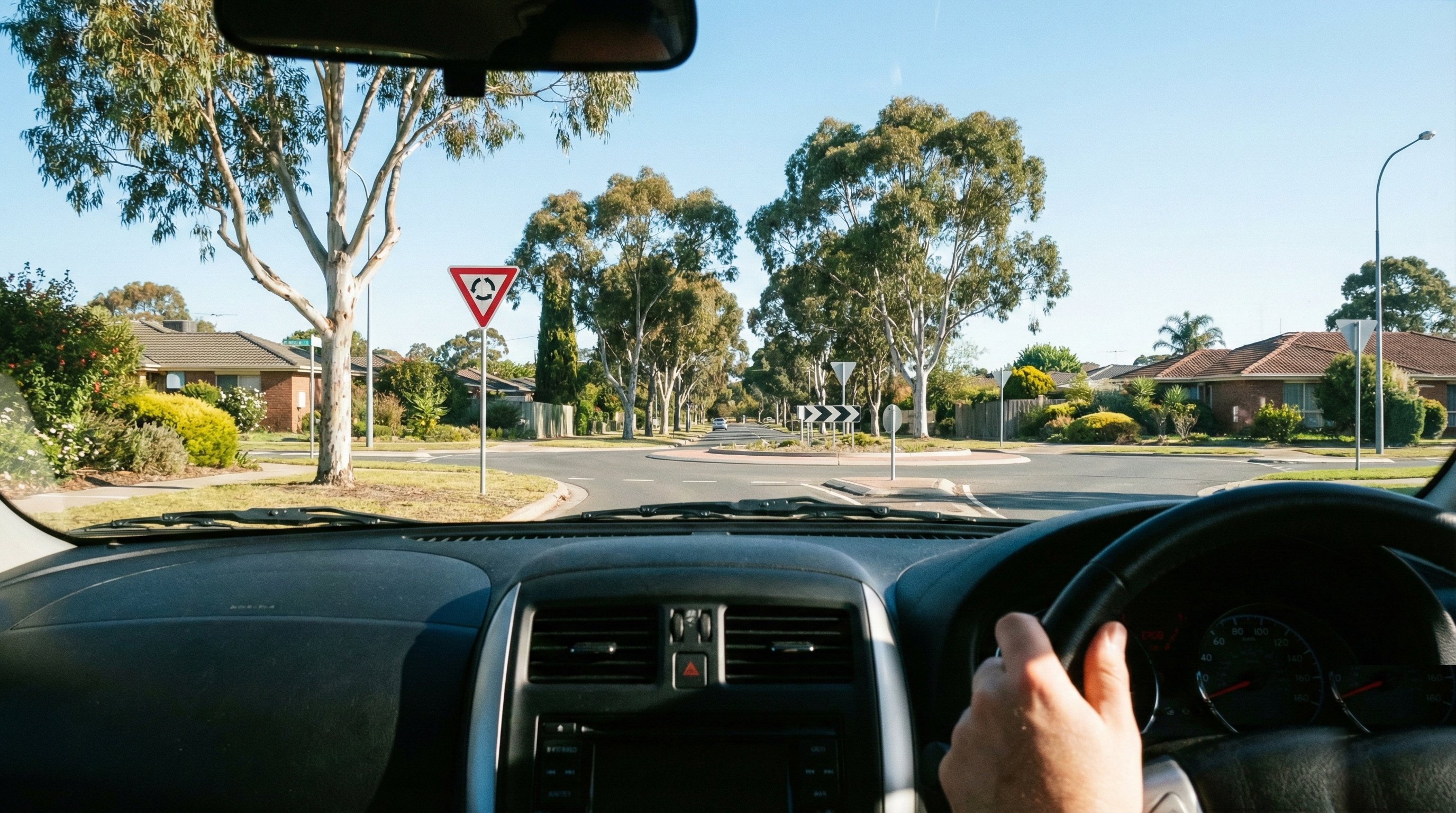
Why Roundabouts Catch So Many People Out
Roundabouts are everywhere in Australia, and they're one of the most common reasons people fail their driving test, particularly in Victoria, Queensland, and the ACT (where Canberra is famous for having roundabouts at nearly every intersection).
The rules themselves aren't complicated. But when you combine give way decisions, signalling, lane choice, mirror checks, and head checks all within a few seconds, mistakes stack up fast. This guide covers everything you need to get roundabouts right on test day.
The One Rule That Matters Most
Give way to any vehicle already in the roundabout.
That's it. If a vehicle is already circulating, regardless of which direction it came from, you wait. You don't enter if it would force another vehicle to brake or change course. Getting this wrong can be an immediate fail if it creates a dangerous situation.
A common misunderstanding is that you only give way to vehicles "from your right." That's a simplification. In practice, you give way to all traffic already on the roundabout. Since Australian roundabouts flow clockwise, most vehicles you'll need to give way to will be approaching from your right, but if a vehicle has already entered from any direction and is in your path, you yield.
Single-Lane Roundabouts
Turning Left (First Exit)
- Signal left as you approach
- Slow down, check for vehicles already in the roundabout
- Give way if needed, then enter
- Keep your left indicator on and exit
- Check left mirror and head check before exiting
Going Straight Ahead (Second Exit)
- No indicator on approach
- Slow down and give way to vehicles already circulating
- Enter the roundabout
- As you pass the exit before yours, signal left
- Check left mirror and head check, then exit
Turning Right (Third Exit or Beyond)
- Signal right as you approach
- Give way and enter
- Keep your right indicator on as you travel around
- As you pass the exit before yours, switch to left indicator
- Check left mirror and head check, then exit
U-Turn
- Signal right on approach
- Travel around with right indicator on
- Switch to left indicator as you approach your exit (the road you came from, opposite direction)
- Check left mirror and head check, then exit
For all directions: You need a mirror check and head check before exiting. This is where many people drop marks, they get the signalling right but forget the observation.
Multi-Lane Roundabouts
Lane Selection
| Direction | Which Lane |
|---|---|
| Turning left (1st exit) | Left lane |
| Going straight (2nd exit) | Either lane (unless signs or road markings say otherwise) |
| Turning right (3rd+ exit) | Right lane |
| U-turn | Right lane |
Road markings override these defaults. Always check for painted arrows on the road as you approach, they tell you which lanes are valid for which exits. If the arrows say something different from the table above, follow the arrows.
Lane Discipline Inside the Roundabout
Stay in the lane you entered in. While Australian road rules technically allow lane changes inside a roundabout (with indicator, give way, and only where there's a broken line), doing so during a driving test is risky and unnecessary. Examiners want to see you pick the right lane before entering and stick with it.
When exiting from the right lane of a multi-lane roundabout, be extra careful. Vehicles in the left lane may exit at the same point as you. Always check your left mirror and do a head check before moving across to exit.
Going Straight from the Right Lane
If you used the right lane to go straight ahead (which is allowed at most multi-lane roundabouts), you'll need to move to the left lane as you exit. Signal left, check your left mirror and blind spot, and merge across smoothly.
Signalling Quick Reference
| Manoeuvre | Signal on Approach | Signal When Exiting |
|---|---|---|
| Left turn (1st exit) | Left | Left (maintained) |
| Straight (2nd exit) | None | Left (as you pass the exit before yours) |
| Right turn (3rd+ exit) | Right | Left (as you pass the exit before yours) |
| U-turn | Right | Left (as you pass the exit before yours) |
The exit signal, switching to left indicator before you leave, is the most commonly forgotten signal on the driving test. Build a mental trigger: every time you pass an exit that isn't yours, check if the next one is. If it is, signal left immediately.
Watch: Roundabout Rules and Techniques
This video has over 4 million views and clearly explains Australian roundabout rules with animations:
And this one from Driving School WA covers roundabout tips specifically for the driving test, with real on-road examples:
Common Roundabout Mistakes on the Test
1. Not Giving Way
Entering when a vehicle already in the roundabout has priority. If it forces another vehicle to brake, it's potentially an immediate fail. When in doubt, wait.
2. Forgetting the Exit Signal
Most people remember to signal on approach but forget to indicate left when exiting. The examiner marks this every time.
3. Wrong Lane at Multi-Lane Roundabouts
Approaching in the left lane to turn right, or the right lane to turn left. Check road markings early, by the time you're at the give way line, it's too late to change lanes safely.
4. Coming in Too Fast
Approaching at full speed and braking hard at the last moment shows poor planning. Start slowing early. Even if the roundabout looks clear, reduce your speed enough to stop if a vehicle appears from a side road.
5. Stopping When It's Clear
The opposite mistake: coming to a full stop when no other vehicles are anywhere near the roundabout. If you can clearly see there's no traffic approaching, slow down but keep rolling through. Stopping unnecessarily can hold up traffic behind you and costs marks.
6. Missing the Observation
Forgetting mirror checks and head checks before exiting. This one catches people who've focused entirely on getting the signalling right and forget that exiting a roundabout involves a lateral movement, which means you need a head check.
7. Driving Over the Central Island
Even at mini-roundabouts (the small painted circles on the road), you must drive around the circle in a clockwise direction. Cutting straight across is an error. Large vehicles like trucks can cross the painted area if they physically can't fit around it, but regular cars can't.
8. Forgetting Pedestrians
Always check for pedestrians crossing the road you're about to enter or exit. Failing to give way to a pedestrian at a roundabout exit is a serious error.
Special Situations
Mini-roundabouts: Every rule still applies, give way, signal, drive clockwise. The only difference is you can travel over the painted centre circle if your vehicle physically needs to (large vehicles only).
Roundabouts with traffic lights: Follow the lights when they're operating. When the lights are off or flashing yellow, switch to standard give way rules.
Emergency vehicles: Don't stop inside the roundabout. Continue through to your exit, leave the roundabout, then pull over to the left and let the emergency vehicle pass.
Multiple roundabouts in a row: Treat each one independently. Signal, observe, and give way fresh at each roundabout, don't assume the next one is clear because the last one was.
State-Specific Notes
- VIC: Melbourne has many complex multi-lane roundabouts that appear on test routes. Practice these specifically, they're a top fail area in Victoria.
- QLD: South-east Queensland roundabouts carry heavy traffic. Gap selection at busy roundabouts is a common test challenge.
- WA: Some test routes include roundabouts on 60–70 km/h roads, so you need to be confident managing speed on approach.
- ACT: Canberra is built around roundabouts, you'll encounter multiple on any test route. The ACT pass rate (~28%) partly reflects how many opportunities there are to make roundabout errors.
- SA: The SA government's driving handbook has detailed roundabout diagrams that match exactly what examiners look for.
Practice Tips
- Start with quiet single-lane roundabouts. Practise all four directions (left, straight, right, u-turn) until signalling and observation are completely automatic.
- Graduate to multi-lane roundabouts once you're confident with single-lane ones.
- Talk through your actions out loud: "Right indicator, checking right, entering right lane, passing first exit, left indicator, head check, exiting." This builds the sequence into muscle memory.
- Practise at different times of day. A roundabout that's easy at 10am can be a completely different challenge during afternoon traffic.
- Drive your test centre routes. Get familiar with the specific roundabouts near your test centre. AUDrive has GPS practice routes that include the roundabouts you're likely to encounter on test day.
Quick Reference
Three things to get right at every roundabout:
- Give way to vehicles already circulating
- Choose the correct lane before you reach the entry point
- Signal your intentions: on approach and on exit
Get those three right, add proper mirror checks and head checks, and roundabouts become one of the easier parts of your test.
Frequently Asked Questions
Do I only give way to vehicles from my right at a roundabout?
That is a simplification. The actual rule is: give way to any vehicle already in the roundabout, regardless of where it entered. Since Australian roundabouts flow clockwise, most vehicles you yield to will come from your right, but the rule is broader.
Do I need to signal when going straight through a roundabout?
No signal on approach. But you must signal left as you pass the exit before yours. This exit signal is the most commonly forgotten signal on the driving test.
Can I change lanes inside a roundabout?
Technically yes (with indicator, give way, and only where there is a broken line), but doing so during a driving test is risky and unnecessary. Pick the right lane before entering and stick with it.
Do mini-roundabouts follow the same rules?
Yes. Give way, signal, and drive clockwise. The only difference is that large vehicles can drive over the painted centre circle if they physically cannot fit around it. Regular cars cannot.
What if an emergency vehicle approaches while I am in a roundabout?
Do not stop inside the roundabout. Continue through to your exit, leave the roundabout, then pull over to the left and let the emergency vehicle pass.
Related Guides
- Head Check and Mirror Technique Guide: Mirror checks and head checks before exiting roundabouts are where many people drop marks.
- Give Way Rules Australia: Roundabout give way is part of the broader give way framework.