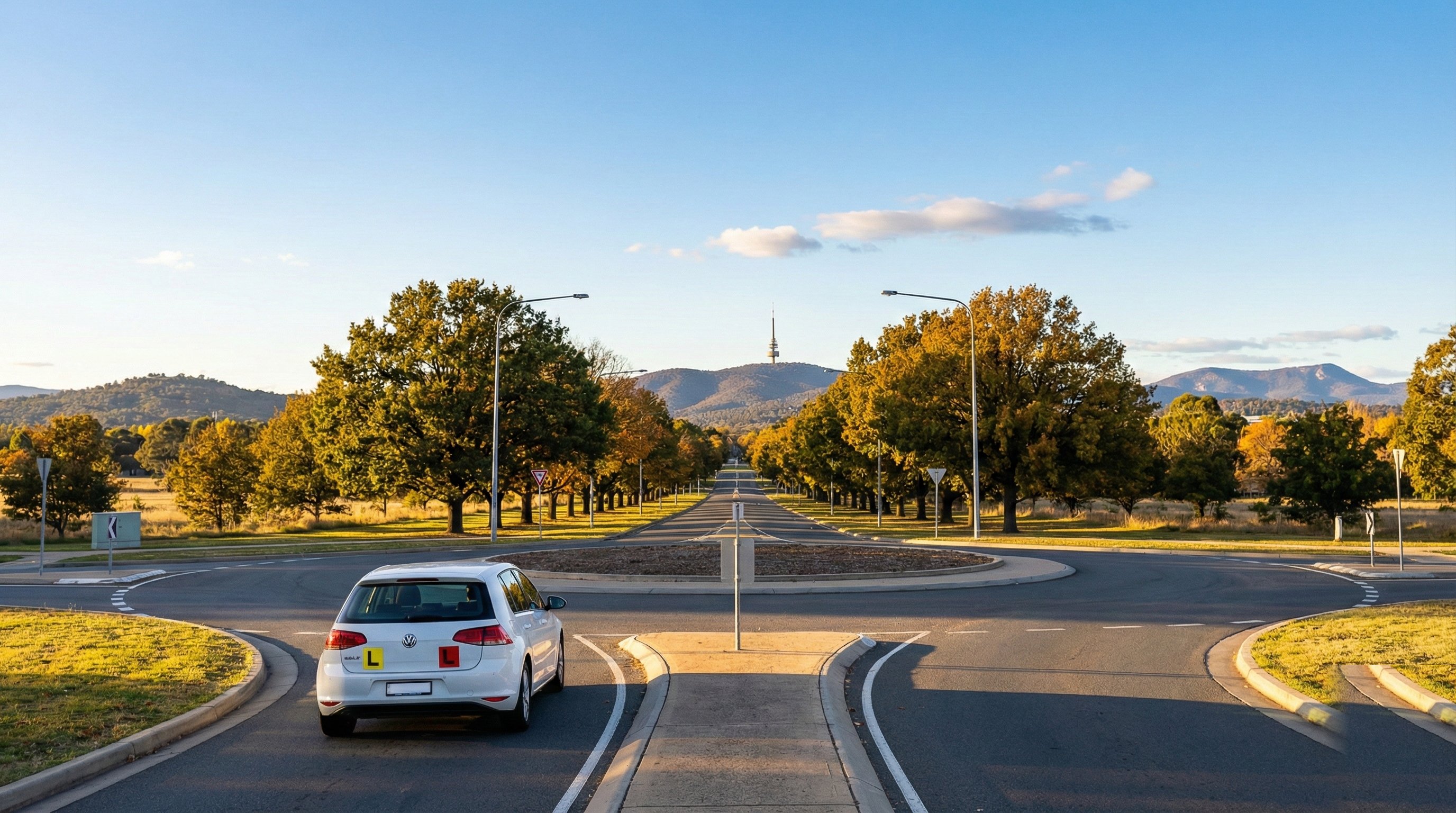
Overview
The Tasmania driving test is administered by Transport Services (Department of State Growth) through Service Tasmania centres across the state. With an estimated first-time pass rate of approximately 86%, Tasmania is one of the easiest places in Australia to obtain your licence. The combination of lighter traffic, straightforward road layouts, and shorter test routes makes it an achievable goal for well-prepared candidates. This guide covers the test format, what to expect on the day, and how to avoid the common mistakes that trip up the other 14%.
TAS Graduated Licensing System
Tasmania uses a standard graduated licensing system.
Learner Licence (L)
- Minimum age: 16 years
- How to get it: Pass the knowledge test at a Service Tasmania centre
- Must hold for: 12 months minimum
- Supervised driving: 80 hours including 15 night hours (if under 25)
- Speed limit: 90 km/h (even on roads with higher posted limits)
- BAC limit: Zero
Instructor Bonus Hours
Professional driving lessons count double in Tasmania:
- 1 hour with a certified instructor = 2 hours in your logbook
- Maximum benefit: 10 instructor hours = 20 logbook hours
- Completing a RYDA (Rotary Youth Driver Awareness) program earns 5 hours credit
Provisional P1
- Minimum age: 17 years
- How to get it: Complete the Hazard Perception Test (HPT) and pass the practical driving assessment
- Duration: 12 months minimum
- Speed limit: 100 km/h
Provisional P2
- How to get it: Hold P1 for 12 months
- Duration: 24 months minimum (or until age 20, whichever comes first)
- Speed limit: 100 km/h
Full Licence
- Available after completing the P2 period
- Minimum age: 20 years
What the Test Covers
The practical driving assessment in Tasmania takes approximately 25 to 35 minutes and covers a route of around 10 km through suburban streets.
Assessment Components
The test evaluates your ability to perform the following safely and competently:
Basic Vehicle Control
- Moving off smoothly and stopping
- Steering control and lane positioning
- Speed management for road and traffic conditions
Required Manoeuvres
- Pulling over and stopping (typically twice during the test)
- U-turns or three-point turns (typically three turning manoeuvres)
- Reverse parallel parking (one attempt)
- Merging and lane changes on roads with speeds of 80 km/h or above
Traffic Skills
- Intersections, including give-way and stop signs
- Roundabouts with correct signalling and give-way
- Responding to pedestrians, cyclists, and other vulnerable road users
- Speed bumps and reduced speed zones (25 km/h zones are common near residential areas)
A Typical Hobart Route
Based on community reports, a common test route from the Hobart Service Tasmania centre covers approximately 9.9 km and takes about 26 minutes. Routes typically go through suburbs such as New Town, Mount Stuart, and North Hobart, with varied road types including residential streets, main roads, and areas with roundabouts.
The specific streets used for turning manoeuvres are randomised, but approximately 60% of the route overlaps between different tests. Practising in the test area beforehand is highly beneficial. You can explore real test routes with GPS navigation on AUDrive:
- Hobart driving test routes
- Launceston driving test routes
- Devonport driving test routes
- Burnie driving test routes
Pass Rates
| Metric | Rate |
|---|---|
| TAS first-time pass rate | ~86% |
| National average | ~62% |
Tasmania's high pass rate can be attributed to several factors:
- Lower traffic volumes. Tasmania has a population of approximately 570,000, resulting in quieter roads
- Simpler road networks. Fewer multi-lane highways and complex interchanges
- Shorter test routes. Approximately 10 km compared to longer routes in mainland states
- Supportive testing environment. Examiners are generally reported as calm and clear in their instructions
Most Common Reasons for Failing
Even with an 86% pass rate, some candidates still fail. The most common errors are:
- Head check failures during three-point turns. You must perform a head check at each stage of a three-point turn. Three direction changes means three head checks. This is the single most common reason for losing marks.
- Incorrect indicator use. The three-point turn requires signalling three times (once for each direction change). Forgetting to signal during manoeuvres like U-turns or when pulling back onto the road after stopping is also common.
- Roundabout errors. Incorrect signalling or failing to give way to vehicles already in the roundabout.
- Speed management. Driving too slowly out of nervousness is a frequent issue. Examiners will prompt you if you are significantly under the limit. Conversely, exceeding the limit through speed bumps or 25 km/h zones will result in marks lost.
- Stopping unnecessarily for hesitant pedestrians. If a pedestrian is hesitating on the footpath and has not stepped onto the road, stopping and waiting can disrupt traffic flow and may be marked down.
- Turning with wheels crossing solid lines. Examiners will note if your wheels clip a lane line during turns.
- Not understanding examiner instructions. Particularly on higher-speed roads where instructions may be given quickly. If you miss an instruction, ask the examiner to repeat it rather than guessing.
The Three-Point Turn: Get This Right
This full guide from Driving Test Australia covers the three-point turn step by step, including the observation checks examiners look for:
The three-point turn is where many TAS candidates lose marks. Here is the correct procedure:
- Signal right, perform a head check to the right, then steer right across the road
- Stop before the kerb. Signal left, perform a head check to the left, then reverse to the left
- Stop before the opposite kerb. Signal right (or appropriate direction), perform a head check, then drive forward
Key points:
- Three direction changes, three signals, three head checks
- You may use a resident's driveway to turn, but your entire rear must enter the driveway
- On narrow streets, use a three-point turn. On wide streets, the examiner may expect a U-turn
- If there is a dashed centre line at an intersection, you cannot turn there. Unmarked residential streets are generally fine
Learning Resources
Official YouTube Channel
The Tasmanian government operates an official YouTube channel called "Learn to Drive in Tasmania" through the State Growth department. It contains 24 educational videos covering topics such as:
- Blind spots and mirrors
- Roundabout rules and signalling
- Crash avoidance
- General safe driving practices
This channel is widely recommended by driving instructors and candidates as a primary study resource. Search for "Learn to Drive in Tasmania" on YouTube.
Additional Resources
- The Whirlpool forums contain threads discussing Tasmanian driving test experiences
- General Australian driving test videos on YouTube (covering parallel parking, head checks, and mirror technique) are applicable to the TAS test
Costs
| Item | Cost (approx.) |
|---|---|
| Knowledge test | Free |
| Learner licence issue | $39.65 |
| P1 practical driving assessment | $106.16 (incl. GST) |
| P1 + P2 licence issue | $66.39 |
| Overseas licence conversion assessment | $49.66 |
Tasmania's test fees are among the most affordable in Australia, comparable to Victoria ($73) and Queensland ($70), and far less than South Australia (~$350).
Converting an Overseas Licence in Tasmania
For a broader overview of the conversion process across all states, see our overseas licence conversion guide.
Recognised Countries
Drivers from recognised countries can convert their licence without sitting a driving test.
EDR Reform (November 2025)
Since 1 November 2025, the Experienced Driver Recognition (EDR) pathway has been removed in Tasmania. Drivers aged 25+ from 16 "EDR countries" (including Hong Kong, Taiwan, South Korea, and South Africa) now must pass the same tests as any other non-recognised country.
Non-Recognised Countries (Including China)
If your country is not on the recognised list, you must pass:
- A knowledge test
- A Hazard Perception Test (HPT)
- A practical driving assessment (includes 6 assessment sections and 2 driving exercises)
Time Limits
- Permanent residents: Must convert within 6 months of arriving in Tasmania
- Temporary visa holders: Can drive using their overseas licence plus an International Driving Permit (IDP) or certified English translation
Tips for Passing First Time
Before the Test
- Complete your 80 supervised hours thoroughly. Practise in varied conditions including wet roads, night driving, and different times of day
- Watch the official YouTube videos. The "Learn to Drive in Tasmania" series covers the exact skills assessed in the test
- Practise around the test area. Drive the suburbs near your Service Tasmania centre to become familiar with the roundabouts, speed zones, and common turning streets
- Master the three-point turn. Practise on both narrow and wide streets until the signal-check-steer sequence is automatic
On Test Day
Make sure you have everything ready. Our driving test checklist covers all documents and vehicle checks you need.
- Arrive early and ensure your vehicle is registered, roadworthy, and displaying L plates
- Keep the interior clean and uncluttered
- Let the examiner know if English is your second language. They will adjust their pace
During the Test
- Exaggerate your head checks. Turn your head clearly past your shoulder so the examiner can see you checking your blind spot
- Signal for every manoeuvre, including when pulling back onto the road after stopping, exiting roundabouts, and every stage of a three-point turn
- Maintain the speed limit. If the limit is 50 km/h, drive at 45 to 50. Driving at 35 in a 50 zone will draw a comment from the examiner
- Stay calm after mistakes. If you feel you have made an error, keep driving safely. Many candidates who think they have failed end up passing because the error was minor
- Do not stop for hesitant pedestrians on the footpath. Only stop if they have stepped onto the road or are at a marked crossing
- If you miss a turn or take a wrong direction, do not panic. The examiner will redirect you. This is not penalised as long as you drive safely
Frequently Asked Questions
What age can you take the driving test in Tasmania? You can get your learner licence at 16 years old. The minimum age for the practical driving test (P1) is 17 years old. You must hold your learner licence for at least 12 months and complete 80 supervised hours (including 15 at night) before sitting the test.
How do I book a driving test in Tasmania? Book your practical driving assessment through a Service Tasmania centre. You will need to have passed the Hazard Perception Test (HPT) before you can book. Tests are conducted at Service Tasmania centres across the state, with common locations in Hobart, Launceston, and Devonport.
Is the driving test hard in Tasmania? Tasmania has the highest first-time pass rate in Australia at approximately 86%, compared to the national average of 62%. The combination of lighter traffic, simpler road layouts, and shorter test routes (about 10 km, 25 to 35 minutes) makes it one of the most achievable tests in the country. The most common reason for failing is missing head checks during three-point turns.
What does the TAS driving test cover? The practical assessment takes 25 to 35 minutes and covers pulling over and stopping, U-turns or three-point turns (typically three turning manoeuvres), reverse parallel parking, merging and lane changes, intersections, and roundabouts. You must also pass a Hazard Perception Test (HPT) before booking the practical test.
How much does the TAS driving test cost? The practical driving assessment costs $106.16 including GST. The knowledge test is free, and the learner licence costs $39.65. Tasmania's fees are among the most affordable in Australia, far less than South Australia's $340+ VORT.
What speed am I limited to on L plates in Tasmania? 90 km/h, which is lower than most other states (typically 100 km/h). This applies even on roads with higher posted speed limits. Professional instructor lessons count double in your logbook, up to a maximum of 10 instructor hours (20 logbook hours).