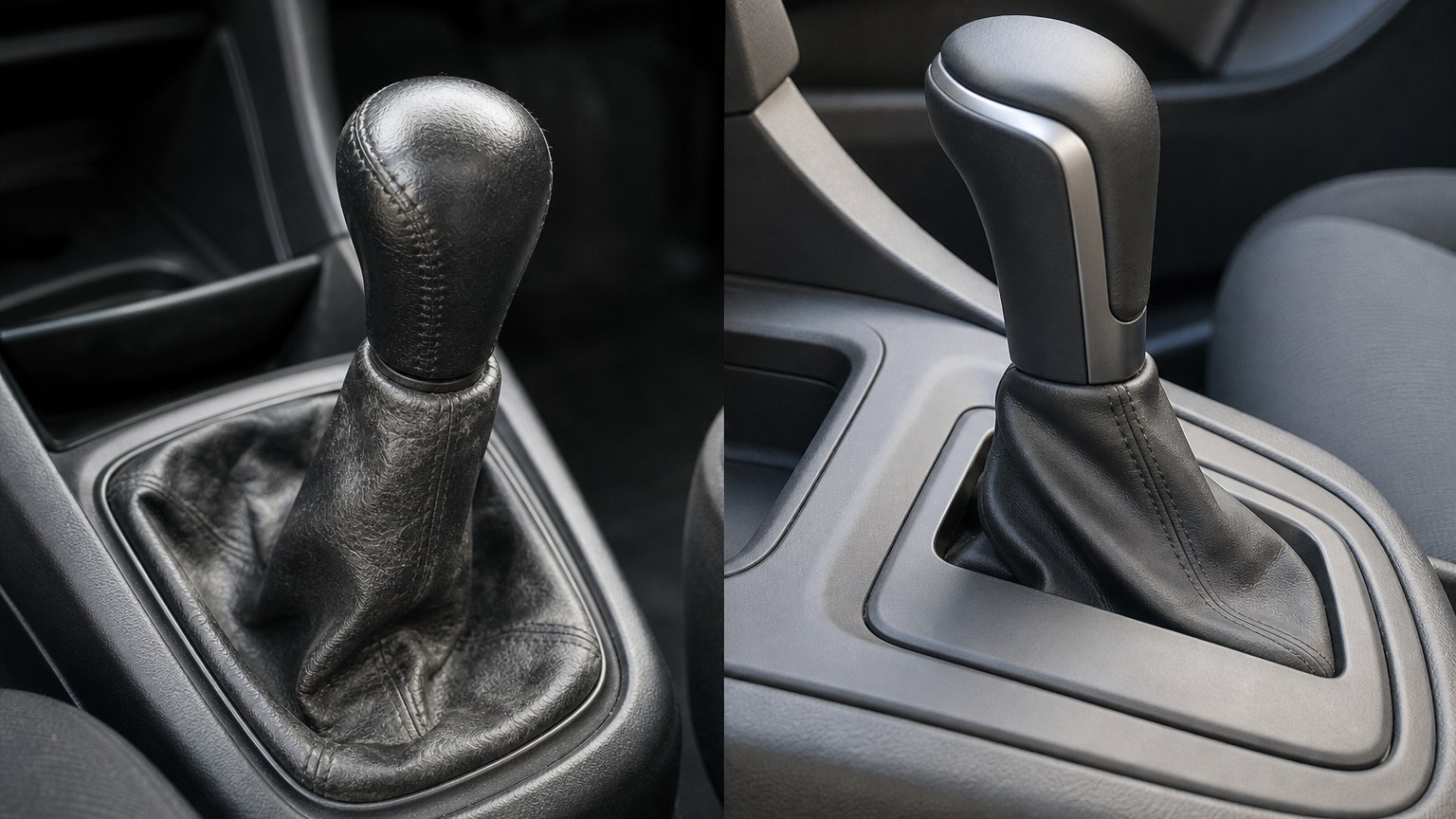
Conventional wisdom says take the test in an automatic. One less thing to think about, no stalling, no hill starts, no clutch to get wrong under pressure.
The official numbers say the opposite. We obtained 492,504 Victorian drive test records from the Department of Transport and Planning under Freedom of Information, split by transmission:
| Transmission | Pass rate | Tests |
|---|---|---|
| Manual | 81.6% | 28,799 |
| Automatic | 71.6% | 463,705 |
Ten points. And it is not a small-sample artefact: nearly twenty-nine thousand manual tests over 28 months.
The car is not doing the work
The obvious reading, that manual cars somehow make the test easier, is clearly wrong. Manual adds tasks. It cannot subtract difficulty.
What the gap measures is who chooses each option.
Only about 6% of Victorian drive tests are now taken in a manual. Learning manual in 2026 is a deliberate choice, and the people who make it tend to be the people who have decided to learn driving properly rather than learn the test: more hours, often a family member's car and a lot of unhurried practice, frequently a specific reason such as work, farm or trade requirements.
The automatic group, at 94% of tests, is essentially everybody. It contains the well-prepared teenagers and also every rushed booking, every overseas licence conversion, every candidate who has done the legal minimum.
So this is not evidence that you should switch to manual to improve your odds. Switching would put you in the manual column without giving you any of the things that make that column look good.
What the gap is actually useful for
It is a clean measure of preparation depth.
Both groups sit the same test, on the same routes, assessed against the same criteria, by the same testing officers. The main systematic difference between them is how much unhurried practice sits behind the booking. That difference is worth ten percentage points.
This lines up with everything else in the dataset. In Victoria, 79.5% of unsuccessful tests are stopped before they finish rather than completed and marked down, which means failure is usually one disqualifying action rather than an accumulation of small faults. Depth of practice is exactly what removes those single points of failure, and shallow preparation is exactly what leaves them in place.
The 18-20 age group, which passes at 82.9%, tells the same story from a different angle. Learner permit holders under 21 in Victoria must log 120 hours of supervised driving, including 20 at night, before they can sit the test, a requirement that does not apply to candidates 21 and over. That group's pass rate is almost identical to the manual group's.
Two very different populations, one thing in common: hours.
If you are choosing right now
Take the test in whatever you have practised most in. That is the whole recommendation, and it is what the data actually supports.
A note worth knowing regardless: passing in an automatic puts an automatic-only condition (an "A" on your licence card) on your Victorian probationary licence. It is not permanent. The condition is removed automatically when your probationary period ends, with no further test. You only need to sit a separate manual test if you want to drive a manual while still on your Ps.
Source and limits
492,504 Victorian car drive test records, January 2024 to April 2026, released to us by the Department of Transport and Planning under FOI (reference CS019502). Manual is test type MP, automatic is PP.
Pass rate means passes divided by all tests, including tests stopped before completion. Some published Victorian figures exclude stopped tests and therefore run much higher; we explain that in the missing 109,000 tests.
This is an observational split, not a controlled comparison. The dataset records transmission, result, age, gender and attempt number, but nothing about practice hours, so the explanation offered above is an interpretation of the gap rather than something the data proves.