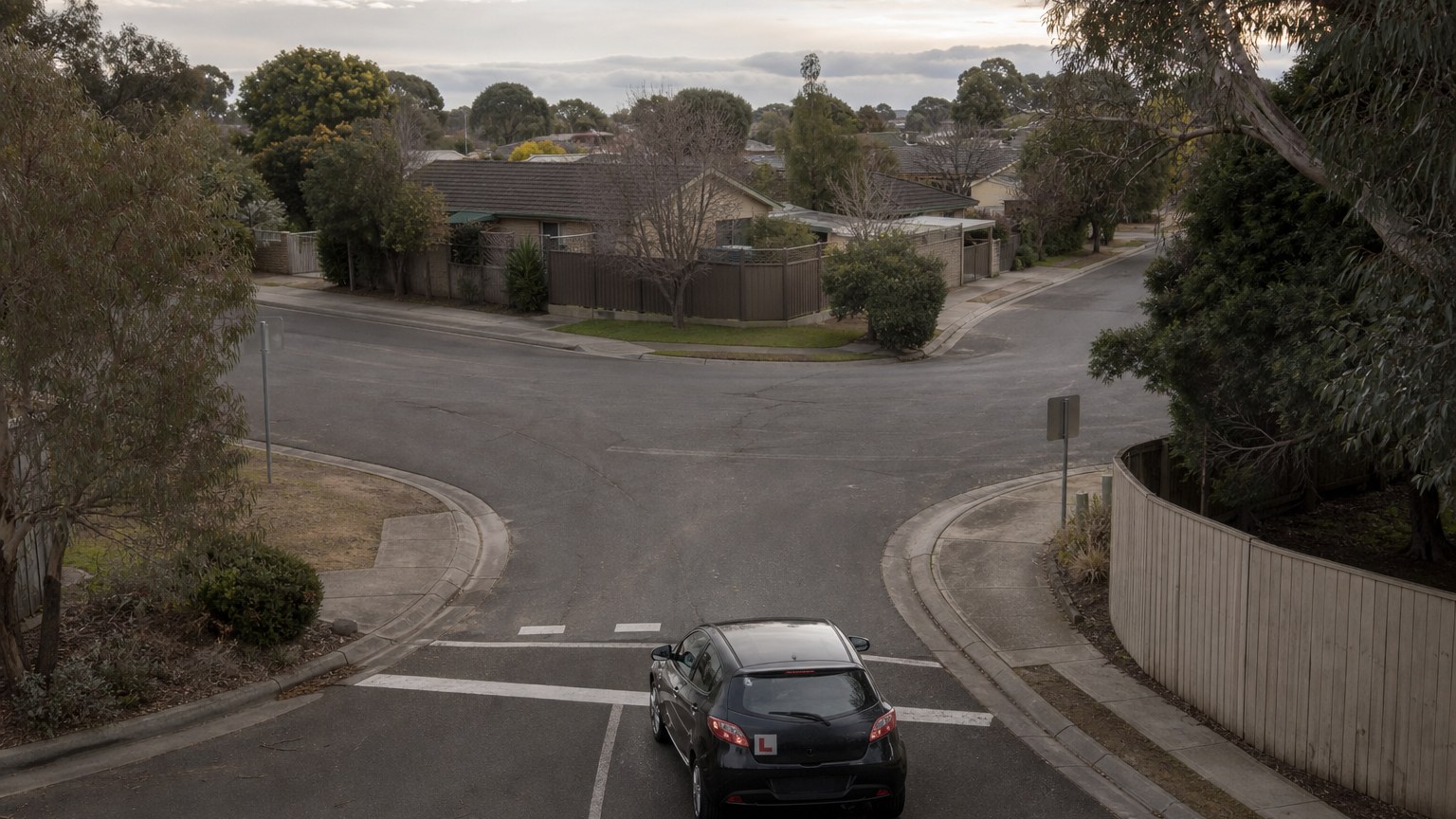
You would expect people to get better at the driving test. More practice, one test already survived, nerves under control. The second attempt should go better than the first.
It does not. We obtained 492,504 Victorian drive test records from the Department of Transport and Planning under Freedom of Information, including how many times each candidate had sat the test. Pass rates fall with every single retry.
Pass rate by attempt number
| Attempt | Pass rate | Tests |
|---|---|---|
| 1st | 74.2% | 360,893 |
| 2nd | 68.7% | 89,969 |
| 3rd | 64.7% | 26,614 |
| 4th | 60.9% | 8,925 |
| 5th or later | 51.7% | 6,103 |
By the fifth attempt it is a coin toss.
The decline is smooth, it holds across the whole 28-month period, and the sample sizes are large enough that this is not noise. Even the smallest bucket covers more than six thousand tests.
What this does and does not mean
The honest reading is not "retaking makes you worse". It is selection.
Everyone who finds the test easy has already left the sample. The people still booking a fifth attempt are, by definition, the people for whom something has not been working. Each round of retesting filters out the candidates who were nearly ready, leaving a group with more stubborn problems.
That distinction matters, because it changes the advice. If retesting genuinely damaged your chances, the answer would be to space out attempts and calm down. Since it is selection, the answer is different and more uncomfortable: if you have failed twice, the thing that failed you has probably not changed.
Booking again quickly, with the same preparation, is on this data a losing strategy. The 5.5 point drop from first to second attempt is the cost of assuming the first failure was bad luck.
The same pattern shows up with age
| Age group | Pass rate | Tests |
|---|---|---|
| 18-20 | 82.9% | 193,375 |
| 21-24 | 71.0% | 86,260 |
| 25-29 | 66.4% | 76,452 |
| 30-34 | 64.6% | 54,282 |
| 35-39 | 62.4% | 34,890 |
| 40-44 | 59.9% | 20,197 |
| 45-49 | 55.2% | 10,423 |
| 50-54 | 52.7% | 6,082 |
| 55-59 | 49.5% | 4,176 |
| 60-64 | 50.7% | 3,300 |
| 65-69 | 46.0% | 1,981 |
| 70-74 | 44.8% | 813 |
An 18-year-old passes at 82.9%. A 45-year-old passes at 55.2%. That is a 28 point gap, and the curve declines almost monotonically the whole way down.
The 18-20 group is not just the best performing, it is nearly 40% of all tests. Victoria's headline pass rate is heavily propped up by young candidates coming through the standard learner permit pathway, which for under-21s requires 120 logged hours of supervised driving including 20 at night before they can sit the test.
Older candidates are presumably a different population, though we have to flag that we cannot show this from the data. We specifically asked the department to break results down by pathway, probationary licence versus overseas licence conversion, and that breakdown was not provided. So the common explanation, that older candidates are largely overseas licence holders being assessed against unfamiliar Victorian criteria, is plausible and widely assumed but is not something this dataset demonstrates. What the dataset does show is the age gradient itself.
There is a gender gap in the same dataset too, smaller but real: men pass at 74.4%, women at 69.6%. We are not going to speculate about why from test records alone.
What to actually do differently on a retest
Two things follow from all of this.
Find out precisely what stopped you. In Victoria, failing is usually not a slow accumulation of minor faults. Across the whole dataset, 79.5% of unsuccessful tests are stopped before they finish rather than completed and marked down. That means there is almost always one specific disqualifying action. Get the report, identify it, and treat it as the only thing that matters until it is fixed.
Change the practice, not just the date. If the failure was a head check, more general driving will not fix it, because you can drive for another twenty hours and never rehearse the exact moment you skip it. Rehearse the moment.
The candidates who break the pattern in this data are the ones who came back different, not just later.
Source and limits
492,504 Victorian car drive test records, January 2024 to April 2026, released to us by the Department of Transport and Planning under FOI (reference CS019502).
Pass rate here means passes divided by all tests, including tests that were stopped before completion. We explain that choice, and why some published figures are much higher, in the missing 109,000 tests.
The data has no test centre breakdown. VicRoads refused that part of our request under section 19 of the FOI Act. Age groups below 18 and above 74 are omitted here because sample sizes get too small to report responsibly.