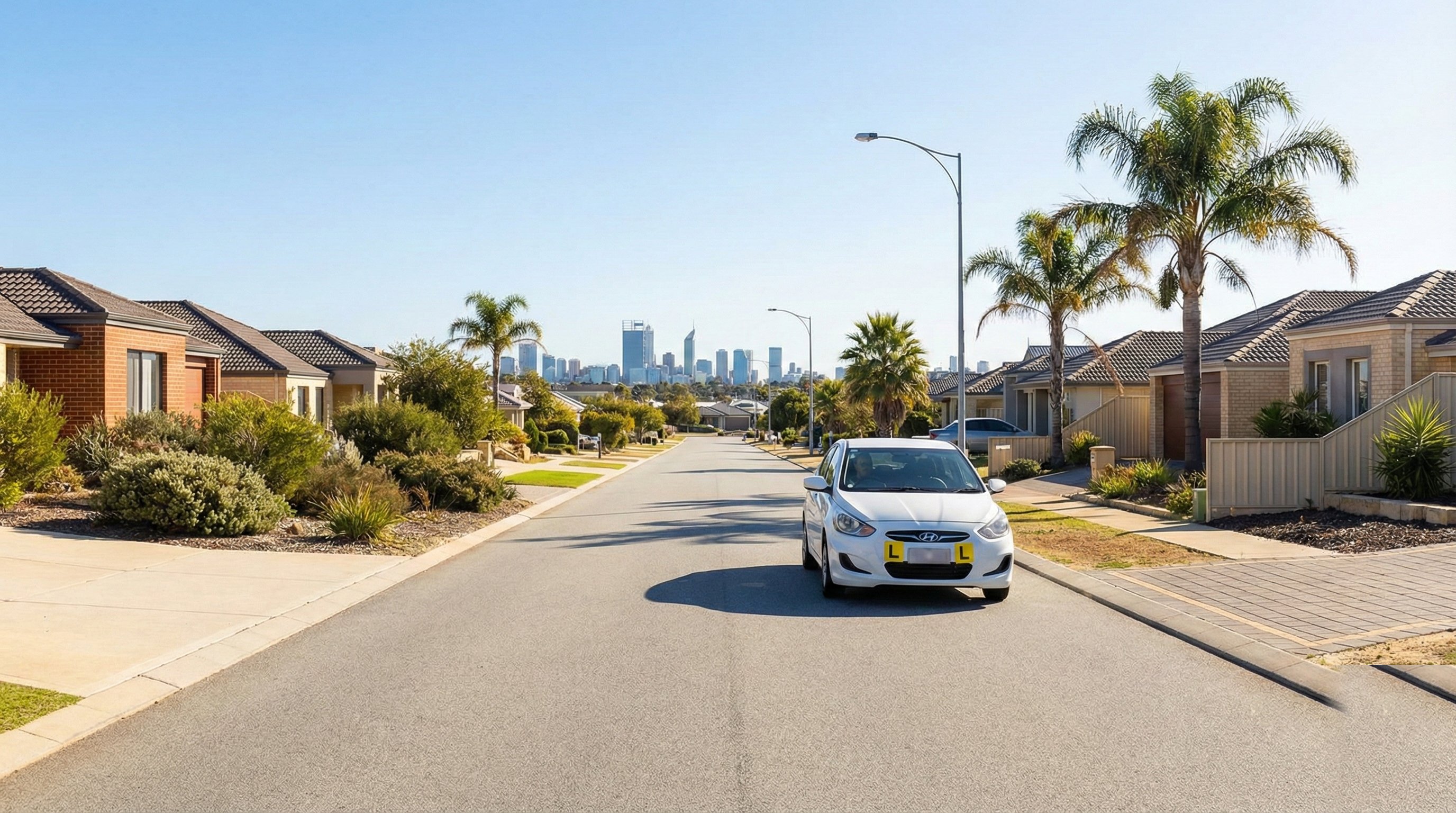
What You're Up Against
In 2025, 39.9% of the 122,795 car Practical Driving Assessments (PDAs) at WA's Driver and Vehicle Services sites were passes, down from 41.9% in 2024. Across Perth's 10 metro centres it was 38.1%, from 55.1% at Cannington down to 27.5% at Midland. (Department of Transport data released under FOI 2026-0140; the figures count assessments, not people.)
WA requires 50 hours of supervised driving before the test, compared to 100 hours in QLD and 120 in NSW and VIC. Treat the 50 hours as a minimum, not a target. For tips on picking the right test slot, see our guide on the best time to book a driving test.
The good news: your first PDA attempt is free (included in the learner's permit fee). So if you prepare properly, you won't even pay for the test.
WA Licence System
| Stage | Min Age | Speed Cap | Duration | Key Points |
|---|---|---|---|---|
| Learner (L) | 16 | 100 km/h | 6 months min | 50 hrs supervised (5 night) |
| P1 (Red P's) | 17 | Posted limit | 6 months min | Zero alcohol, 1 passenger, midnight curfew |
| P2 (Green P's) | - | Posted limit | 18 months min (or until 19) | Zero alcohol |
| Full | - | Posted limit | After 2 yrs on P plates | No restrictions |
Getting Your Learner's Permit
- Pass the Computerised Theory Test (CTT) (30 questions, need 24 correct / 80%)
- Pass a vision test
- Pay the learner's permit fee ($150.80 when checked on 17 November 2026; it includes your first PDA)
The learner's permit is valid for 3 years. If you're under 25, you must hold it for at least 6 months before you can sit the PDA.
Building Your Hours
If you're under 25, you need 50 hours of supervised driving, including 5 hours at night. Log them via the Learn&Log feature in the Service WA app.
50 hours is the legal minimum. We recommend aiming for 80 to 100 hours before you sit the PDA.
If you're 25 or older, there's no logbook or hour requirement.
Before You Can Book the PDA
You must also pass the Hazard Perception Test ($23.60) before booking your PDA. Many candidates don't realise this until they try to book.
P1 Restrictions (Tom's Law, from 1 December 2024)
- One passenger only for the first 6 months (exemptions: immediate family, a fully licensed driver with 4+ years experience, or work-related passengers). Penalty: $200 fine + 2 demerit points.
- No driving midnight to 5 AM for the first 6 months
- Zero alcohol
- No phone at all (not hands-free, not Bluetooth, not as GPS)
- High-powered vehicle restrictions apply
The PDA Test Format
The PDA takes about 35 to 50 minutes and is divided into five sections. How each section is scored is set out in the Department of Transport's PDA guidance; check it rather than relying on a summary.
This video from Driving School WA walks through the full test procedures at the Success centre:
Section 1: Pre-Drive Checks Demonstrate your vehicle controls: headlights, indicators, hazards, washers, horn, handbrake, demisters. Simple if you've practised once.
Section 2: Basic Vehicle Control Moving off smoothly, stopping safely, controlled steering. The basics.
Section 3: Low-Speed Manoeuvres Reverse parking (90-degree or 45-degree), three-point turn, or kerb-side stop. Some centres include a "Stop for Shopping" reverse bay task. You may glance at a reversing camera but must not rely on it. Primary observation must be through mirrors and shoulder checks.
Section 4: Traffic Driving The longest and most important section. Intersections, roundabouts, lane changes, speed management, merging. This is where most people fail.
Section 5: Hazard Perception and Response Scanning ahead, mirror checks, decision-making, adjusting to changing conditions. The examiner assesses whether you're actively reading the road.
Instant Fail Items
One critical error = immediate termination. The rest of your driving doesn't matter.
These end your test on the spot:
- Running a red light, including entering on a stale amber when you could stop safely
- Speeding, even 1 km/h over the posted limit
- Stop sign violation. You must come to a complete stop, even if no traffic is visible
- Failing to give way when required
- Causing danger by forcing another road user to brake or swerve
- Any collision with vehicles, objects, kerbs, or people
- Examiner intervention (dual brake, grabbing the wheel, verbal stop)
- Missing blind spot checks before lane changes or merging
- Dangerous lane changing
- Not yielding to emergency vehicles
- Not giving way to a bus pulling out with its right indicator on (roads 70 km/h or less)
Why People Fail
1. Head Checks
The single biggest fail reason in WA. Examiners require obvious, exaggerated head turns, not a quick eye flick. For a full breakdown of proper technique, see our head check and mirror technique guide. You must physically turn your head far enough to see through the rear passenger window. Required before every lane change, merge, and pull-away.
2. Mirror Discipline
Check your rear-view mirror every 5 to 8 seconds. Additional checks are expected before braking, turning, at traffic lights, and after clearing an intersection. Make the head movement visible.
3. Speed Management
Even 1 km/h over ends the test. But driving more than 10 km/h below the limit without good reason loses marks for impeding traffic. Stay 2-3 km/h below the posted limit.
4. Roundabout Errors
Wrong lane, failing to give way to vehicles already in the roundabout, forgetting to signal left when exiting. Multi-lane roundabouts in particular require correct lane positioning before entry.
5. Following Distance
Maintain at least a 2-second gap behind the vehicle ahead. In wet conditions, double it.
6. Indicator Timing
Signal early enough that other road users can see it before you turn or change lanes. Too late or not at all is a common error.
7. Waving at Pedestrians
Don't gesture for pedestrians to cross. This can be counted as interfering with traffic flow. Let the road rules determine right of way.
Pass Rates by Test Centre
Pass rates of car PDAs, Department of Transport data released under FOI 2026-0140. "Overall" is January 2024 to March 2026. For every centre by year, see the Perth test centre comparison.
Perth Centres
| Centre | 2025 | Overall |
|---|---|---|
| Cannington | 55.1% | 56.4% |
| Butler | 44.6% | 41.6% |
| Mandurah | 44.3% | 43.1% |
| Joondalup | 40.9% | 42.8% |
| Rockingham | 37.7% | 38.3% |
| Success | 37.1% | 40.3% |
| Kelmscott | 36.3% | 39.3% |
| Mirrabooka | 34.2% | 31.3% |
| City West (West Perth) | 32.9% | 34.1% |
| Midland | 27.5% | 28.3% |
A centre's rate mixes its roads with who books there and how many are resitting, so treat the table as a guide to the odds, not a ranking of difficulty. Practise in the area where you book.
Regional centres in Albany, Bunbury, Geraldton, and Kalgoorlie may offer shorter wait times.
WA-Specific Rules
School Zones
| Time | Speed Limit | When |
|---|---|---|
| 7:30 - 9:00 AM | 40 km/h | School days only |
| 2:30 - 4:00 PM | 40 km/h | School days only |
Watch for electronic flashing signs. When the lights flash, the zone is active.
U-Turns
- Allowed unless a sign prohibits them
- Cannot make a U-turn at traffic lights unless a sign specifically permits it
- Must give way to all traffic and pedestrians
Keep Left Rule
Must keep left on roads with speed limits over 90 km/h or where "Keep Left Unless Overtaking" is signed.
Giving Way to Buses
On roads 70 km/h or less, you must give way to a bus pulling out with its right indicator on.
Automatic vs Manual
If you pass in an automatic, your licence gets an "A" condition restricting you to automatics for 12 months. To remove it sooner, you must pass the PDA again in a manual vehicle. This is different from NSW and QLD, where your licence covers both regardless.
Unless you specifically need a manual licence, test in automatic. Industry data suggests automatic candidates pass at slightly higher rates than manual nationally.
Costs
| Item | Cost |
|---|---|
| Learner's permit (includes first PDA) | $150.80 |
| CTT re-sit (if you fail the theory test) | $18.20 |
| Hazard Perception Test | $23.60 |
| PDA re-test (second attempt onwards) | $120.50 |
| Driver licence (varies by duration) | ~$50 to $165 |
Your first PDA is free because its cost is included in the learner's permit fee. The learner's permit fee was checked on the Department of Transport site on 17 November 2026; check the other fees there too, as they change each year.
If you fail and need re-tests, each attempt costs $120.50.
How to Book
- Online: DoTDirect (you need a DoTDirect account)
- In person: regional DTMI service centres or agents only, not metropolitan centres
- Phone: 13 11 56 is for cancelling or rescheduling
You must give at least 48 hours' notice to cancel or reschedule, or you're charged for a new PDA.
If You Fail
- Full re-test fee ($120.50) each attempt
- No limit on total attempts
- Focus on the feedback from your examiner. They'll tell you which sections you failed
Overseas Licence Conversion
For a complete comparison of overseas licence conversion across all 8 Australian states (costs, pass rates, deadlines, and the 2026 EDR changes), see our full overseas licence conversion guide.
Recognised Countries (No Tests)
Direct conversion for: Austria, Belgium, Canada, Croatia, Denmark, Finland, France, Germany, Ireland, Italy, Japan, Netherlands, New Zealand, Norway, Portugal, Singapore, Spain, Sweden, Switzerland, United Kingdom, United States, and others.
EDR Reform (November 2025)
Since 1 November 2025, the Experienced Driver Recognition (EDR) pathway no longer exists in WA. Drivers from the 16 former "EDR countries" (including Hong Kong, Taiwan, South Korea, and South Africa) must now complete the CTT, HPT, and PDA to convert. Previously, those aged 25+ could convert directly.
Non-Recognised Countries (Including China)
You must complete:
- Computerised Theory Test (CTT) (30 questions, 24 correct)
- Vision test
- Hazard Perception Test ($23.60)
- Practical Driving Assessment (PDA)
Documents
- Original overseas licence
- NAATI-certified English translation
- Passport and visa
- Proof of WA address
- Payment
Deadline
- Citizens/permanent residents: Convert within 3 months
- Visitors: May use overseas licence with an English translation or IDP
Advice for Overseas Drivers
WA's PDA is especially tough for overseas drivers. The most common issues:
- Not performing visible head checks (this is the #1 fail reason)
- Unfamiliarity with Australian give-way rules at roundabouts
- Underestimating the assessment. "I've been driving for 20 years" is the most dangerous attitude to bring
- Take at least 5 professional lessons before booking
Tips for Passing
Preparation
- Log 80 to 100 hours, well beyond the 50-hour minimum. This is the single most important thing you can do.
- Take 5-10 professional lessons in the weeks before your test. An instructor who knows your centre's routes is invaluable.
- Practise around your test centre. Know every intersection, roundabout, and speed zone change. Try GPS-guided routes: Success, Butler, Midland, or all WA centres.
- Book mid-morning on a weekday. Lighter traffic, no active school zones.
- Pass your HPT first. You can't book the PDA without it.
- Use Learn&Log in the Service WA app to track your hours accurately.
On Test Day
Use our driving test checklist to make sure you don't forget anything.
- Arrive 15 minutes early
- Vehicle check: no warning lights, good tyres, clean mirrors, L plates displayed
- Have P plates ready in the car
- Bring your learner's permit
During the Test
- Exaggerate every head check. Turn your head far enough that the examiner has zero doubt. This alone will save you from the most common fail reason.
- Mirror-Signal-Manoeuvre, every time, in this order.
- Stay 2-3 km/h under the limit. Better slightly under than 1 km/h over.
- Check mirrors constantly: before braking, turning, at lights, and every few seconds in normal driving.
- Drive smoothly. No jerky acceleration, harsh braking, or sudden steering.
- Stop completely at stop signs. Count to 3 with obvious head checks both directions.
- Don't wave at pedestrians. Let the rules determine who goes.
- Ask for clarification if you miss an instruction. This won't count against you.
Choosing Your Centre
- Highest metro pass rates in 2025: Cannington (55.1%), Butler (44.6%), Mandurah (44.3%)
- Lowest: Midland (27.5%), City West (32.9%), Mirrabooka (34.2%)
- Pick a centre whose roads you've practised on.
Frequently Asked Questions
How long is the WA driving test? About 35 to 50 minutes, covering five sections.
How is the PDA scored? The PDA has five sections. The Department of Transport's PDA guidance explains how each is assessed and which errors fail you outright.
How much does the PDA cost? Your first attempt is free (included in the $150.80 learner's permit fee). Re-tests cost $120.50 each.
How many practice hours should I do? The legal minimum is 50 hours. We recommend 80 to 100 hours.
If I test in automatic, can I drive manual? No. An automatic test gives you an automatic-only licence. You must re-test in manual to remove the restriction.
Can I use a reversing camera? You may glance briefly, but your primary observation must be through mirrors and shoulder checks.
What is the "Left Something Behind" task? The examiner asks you to pull over, then says you left something behind. You need to find a safe place to turn around and return. It tests your U-turn and hazard response skills. This video demonstrates exactly how to handle it:
What is the WA driving test pass rate? 39.9% of 122,795 car assessments in 2025 and 41.9% in 2024, across all Driver and Vehicle Services sites (Department of Transport, FOI 2026-0140).
What is the PDA in WA? The PDA (Practical Driving Assessment) is WA's driving test. It lasts about 35 to 50 minutes and covers five sections: pre-drive checks, basic vehicle control, low-speed manoeuvres, traffic driving, and hazard perception.
How do I book a practical driving test in WA? Book online through DoTDirect, or in person at a regional DTMI service centre or agent (metropolitan centres don't take in-person bookings). You must have passed the Hazard Perception Test before you can book. Make sure to review our driving test checklist so you have everything you need on test day.
What is the pass rate at Butler DVS? Butler DVS in Perth's northern suburbs passed 44.6% of assessments in 2025, up from 38.4% in 2024, second among Perth's metro centres after Cannington (55.1%). It serves a newer residential area with relatively straightforward road layouts.